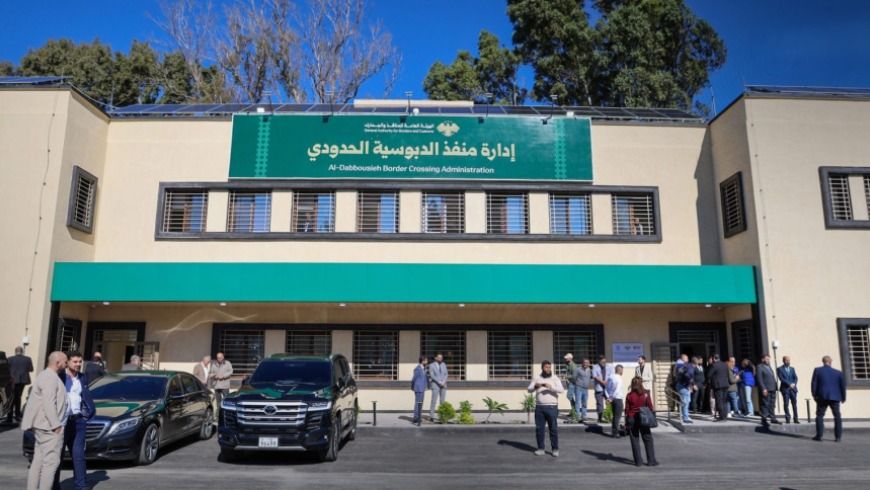
A border crossing connecting northern Lebanon and Syria reopened on Monday after a two-year closure. Officials stated that the route could eventually process up to 10,000 travelers every day.
The Abboudieh-Dabbousieh crossing links the Akkar region in Lebanon with Homs province in Syria. It had been shut down since November 2024, when an Israeli airstrike damaged the infrastructure during the war between Israel and Hezbollah.
Passenger and commercial traffic resumed following extensive reconstruction work. This included rebuilding the bridge that connects the two nations, according to Mazen Alloush.
Alloush serves as the director of relations and international cooperation at Syria’s General Authority of Borders and Customs. Speaking on Tuesday, he told the state-run Syrian Arab News Agency that the facility will accommodate between 8,000 and 10,000 travelers daily once fully operational.
The crossing will also handle 150 to 250 freight trucks each day. The reopening should reduce heavy traffic pressure on the Masnaa Border Crossing located in Lebanon’s eastern Bekaa Valley.
Known as Jdeidet Yabous on the Syrian side, the Masnaa crossing has handled the majority of land traffic between the countries while northern routes remained blocked. Another northern crossing, Arida, is scheduled to reopen in December following its own rehabilitation work.
The Arida crossing connects Lebanon’s Akkar with Syria’s coastal Tartous province. The newly reopened Abboudieh-Dabbousieh route offers businesses in northern Lebanon the prospect of renewed trade and economic relief in an area suffering from underinvestment.
The crossing restores a direct link between the northern region, the Port of Tripoli, Syrian industrial facilities in Hassia, and the Port of Tartous. This comes as both nations attempt to reset bilateral relations shaped by decades of Syrian intervention in Lebanon.
Syrian troops entered Lebanon in 1976 and maintained a presence until 2005. During that era, the Syrian regime under the Assad family faced accusations of involvement in political assassinations.
When Israeli attacks struck the crossing in November 2024, Bashar Assad remained president of Syria and served as an ally to Hezbollah. Border routes during that period functioned as transit paths for weapons destined for the group in Lebanon.
Assad fled to Russia the following month after a rebel offensive swept through Damascus. The new authorities in Syria have since worked to establish closer diplomatic and economic ties with Lebanon, leading to the restoration of the northern transit route.