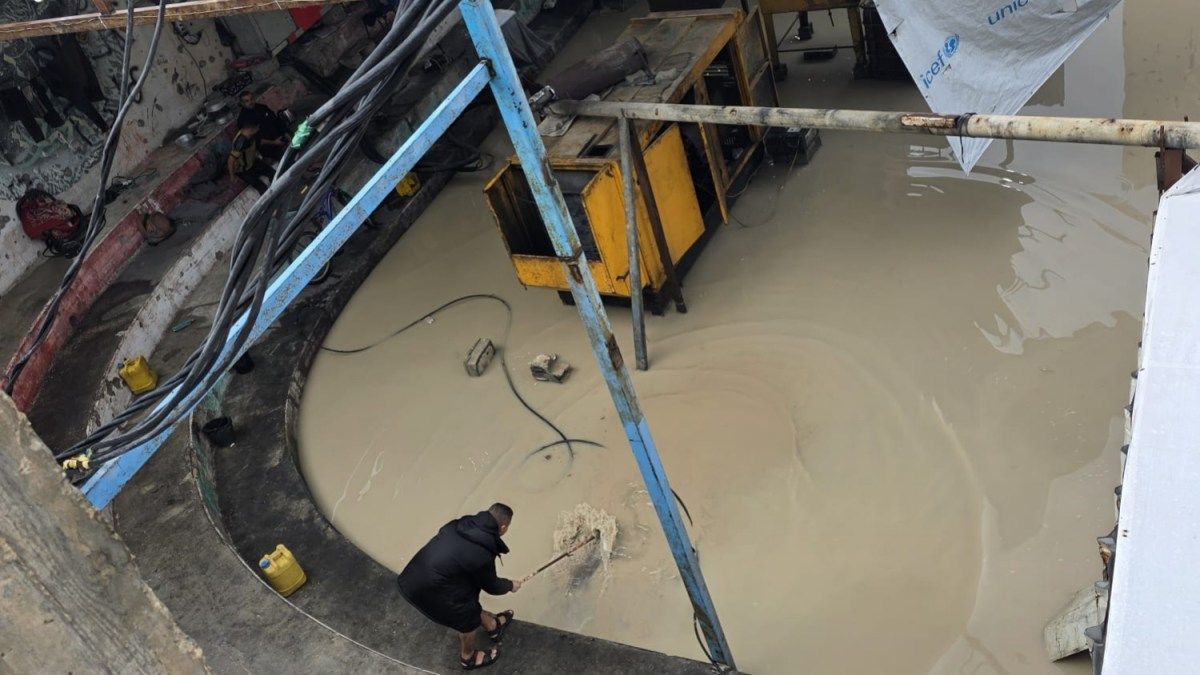
Heavy rainfall and flooding across the Gaza Strip on Friday added to civilian suffering, inundating makeshift homes and damaging the few remaining energy sources available to residents. Sixty-five-year-old Abu Sajed rushed to place buckets and pots around his room in central Gaza as the rain intensified.
The stone walls and tarpaulin roof offered little protection to his makeshift home, located east of Salah al-Din Street near the Bureij refugee camp. He and his family had to move to chairs in the only dry part of the room and wait for the weather to clear.
The water soaked his blood glucose monitor, rendering the device unusable. His family’s solar power system, used for lighting and charging phones, was also damaged, while floodwater destroyed the inverter connected to his daughter’s neighbouring tent.
The following morning, as he tried to leave the room, his foot slipped on the muddy floor and he fell. Poor health left him unable to get up alone, so his wife and daughter had to help him.
Israel’s siege means most people in Gaza lack adequate housing. The impact of the weather extends beyond flooded shelters, threatening the energy systems residents depend on amid a continuing electricity crisis.
In northern Gaza, Mohammed al-Hour uses sunlight to charge phones through a solar power system. Rainwater seeped through the cracked walls and damaged ceiling of his room, complicating his efforts to help people secure lighting at night.
Companies attempting to maintain electricity services are struggling with extensive damage. Despite preparations before winter, the Abu Zayed Electricity Company could not prevent water from entering several facilities, leading to malfunctioning generators and temporarily suspended services.
Aya Shaheen, the company’s general manager, stated that distribution panels and metres were covered with plastic sheeting and tarpaulins, while exposed wires were insulated. The damage exceeded available resources, however, and infrastructure destruction created major obstacles.
According to UNICEF, recent rainfall affected more than 106,000 people. About 950,000 displaced people live in flood-prone areas, including 400,000 in particularly high-risk locations.
A joint assessment by the World Bank, the United Nations and the European Union estimated that 80 percent of electricity generation and distribution assets had been destroyed or rendered inoperable during the war.
Engineer Mohammed Abu Khaled warned that rainwater entering solar systems damages batteries and inverters. He estimated that malfunctions in household and camp solar systems increased by more than 40 to 50 percent following the rain.
Abu Khaled warned that strong winds and heavy rainfall can cause water to seep into hospital departments. This exposes operating-room equipment, portable oxygen generators, vital-signs monitors, laboratory devices and lighting systems to moisture and damage.