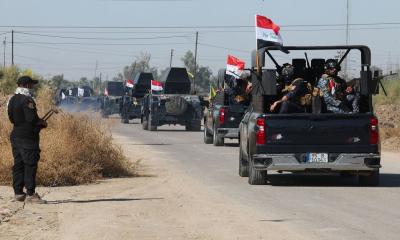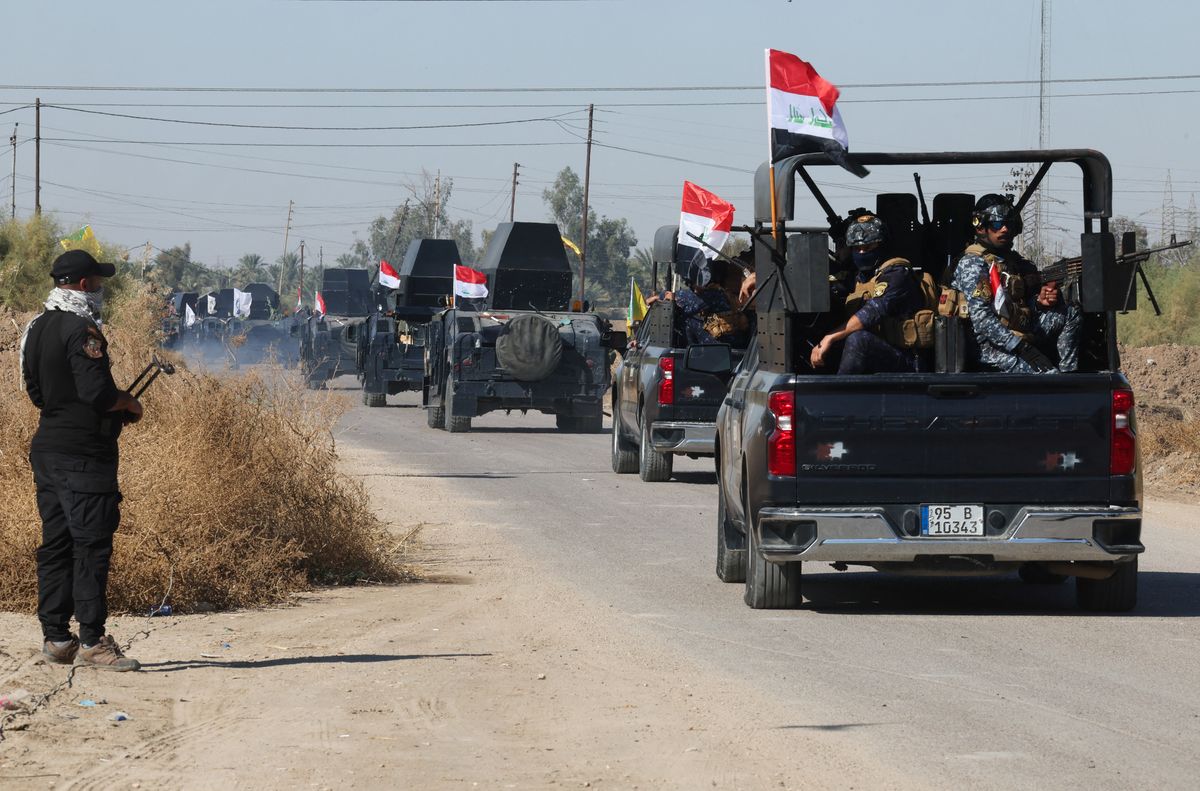
Iraqi security forces began assuming responsibility for security in Jurf Al-Sakher on Friday. The deployment followed a tense standoff that nearly brought government troops and the Iran-backed militia Kataeb Hezbollah to open conflict earlier in the week.
Baghdad had previously accused the armed group of stealing oil and smuggling it out of the country on an industrial scale. Government forces massed outside the district and reportedly gave the militia until Friday to leave the area. A senior Kataeb Hezbollah commander responded by warning that the country was on the cusp of a major crisis.
By Friday morning, the situation shifted. Elements of the state paramilitary Energy Police moved into the area to protect energy infrastructure. Lt. Gen. Hamid Al-Husseini, commander of the Energy Police, said his men began securing a 441-kilometre section of oil pipelines passing through the district.
Jurf Al-Sakher, a predominantly Sunni town in Babil province also known as Jurf Al-Nasr, was recaptured from Daesh in 2014 by government troops and Shiite militiamen. The town was left in ruins, and many of its 80,000 residents were displaced. Lt. Gen. Al-Husseini stated that work would now begin to restore damaged infrastructure and the road connecting the town to Karbala.
The Iraqi News Agency reported at about 2 p.m. On Friday that procedures for handing over positions to military units were complete without any recorded violations. Prime Minister Ali Al-Zaidi released a statement addressing the security formations, urging restraint and wisdom. He reiterated a pledge that all militia groups would be disarmed by the end of June 2027 to serve under one command and law.
Hayder Al-Shakeri, a research fellow at Chatham House, said that while the deployment is an important test, it does not prove nationwide disarmament is achievable. He told Arab News that the government achieved this through negotiation rather than by defeating the group. Reports indicated that Prime Minister Al-Zaidi met in Baghdad with Esmail Qaani, commander of the Iranian Islamic Revolutionary Guard Corps Quds Force, ahead of the deployment.
Al-Shakeri described the outcome as a strategic accommodation for Iran. Tehran wanted to prevent an intra-Shiite confrontation that could weaken both the government and its allies, he explained. The negotiated outcome allows Kataeb Hezbollah to avoid a military defeat while Baghdad establishes a greater state presence.
Sir John Jenkins, a former British ambassador to Iraq and Saudi Arabia, expressed skepticism about the nature of the operation. He told Arab News that the events looked like a deal cooked up behind closed doors to make the government look effective while changing very little. He said that corruption underpins a state heavily influenced by Iran-aligned militias and their allies within state institutions.
Al-Shakeri added that Prime Minister Al-Zaidi faces a difficult balancing act between maintaining relations with Washington and retaining the support of Shiite factions within his government.