The FIFA World Cup round-of-16 match between Egypt and Argentina in Atlanta has evolved from a sporting contest into a lightning rod for political discourse. After securing an early 1-0 lead against the defending champions, Egypt faced a controversial sequence of events where a second goal was disallowed. Furthermore, the officiating crew denied requests for video review regarding a critical goal scored by Argentina. The resulting 3-2 defeat has led many fans and experts to question the legitimacy of the refereeing and the application of video assistant referee protocols during the tournament.
Egyptian manager Hossam Hassan publicly labeled the game as unfair, suggesting that FIFA officials prioritized the advancement of Argentina and its global superstar, Lionel Messi. The Egyptian Football Association filed a formal complaint with FIFA on Wednesday, seeking a review of the officiating. While the technical controversies dominate the sports headlines, the match has taken on deeper significance as a marker of the ongoing Palestinian struggle.
Political stances on Israel and Palestine are increasingly viewed as a gauge of moral integrity, and the Palestinian cause has emerged as a visible political dividing line within international sports. In the lead-up to the match, Hossam Hassan utilized his platform to highlight the plight of Palestinians. Following his team’s round-of-16 victory on July 3, Hassan waved a Palestinian flag on the pitch and dedicated the win to Palestine during his post-match press conference. He later delivered a passionate address, asserting that anyone lacking compassion for Palestinian suffering fails the most basic test of humanity.
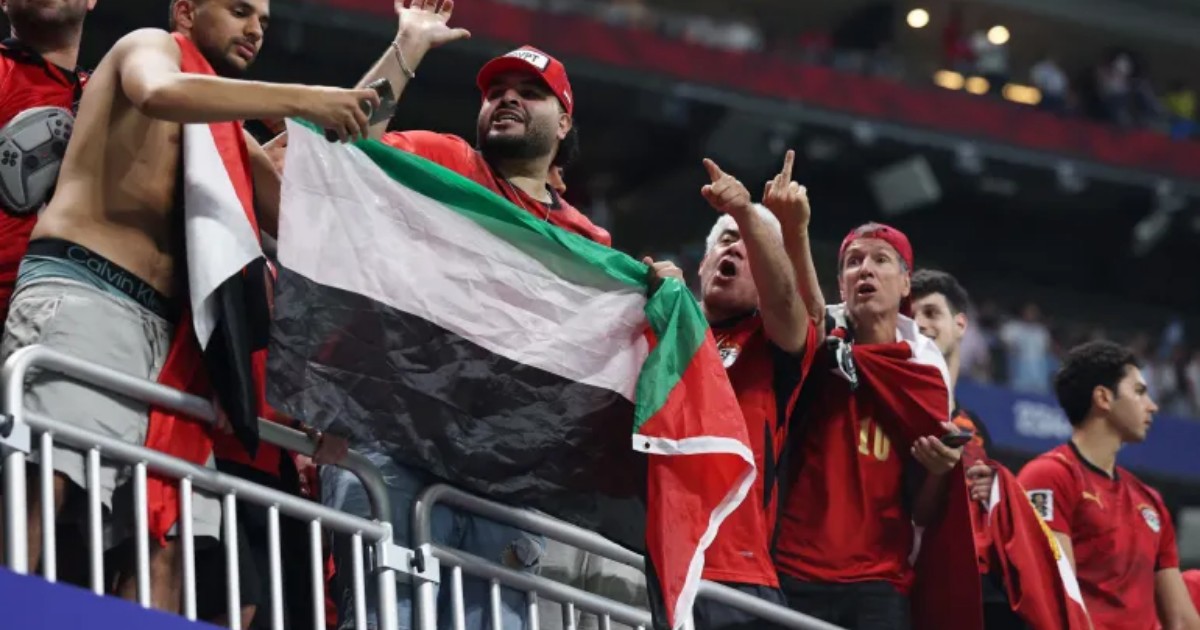
The political atmosphere intensified within the stadium. Supporters in the stands engaged in a symbolic display of allegiances, with Egyptian fans holding Palestinian flags while some Argentinian supporters displayed Israeli flags. This display is particularly noteworthy given the disconnect between Argentinian public opinion and the policies of President Javier Milei. While polling data suggests the Argentinian public is increasingly critical of Israeli policy, the government maintains a staunchly pro-Israel stance.
The geopolitical entanglements involving this match reach the highest levels of global leadership. President Milei has cultivated a close relationship with former US President Donald Trump, who has taken credit for bringing the 2026 tournament to North America. Both leaders identify as staunch supporters of Israel, with Trump famously describing himself as the nation’s best friend. Observers have also raised questions regarding the influence of FIFA President Gianni Infantino, given his public ties to Trump and past controversies surrounding his administration’s selective enforcement of sanctions.
Infantino has faced accusations of offering to mitigate the political costs of Israeli actions while taking swift, decisive action to suspend Russia following the invasion of Ukraine. Without this charged political backdrop and the constant presence of the Palestinian cause, the match might have been remembered solely for its technical debates over VAR protocols. Instead, the game serves as a clear illustration of how sports and politics remain inextricably linked, transforming a football pitch into a stage for broader questions of power, legitimacy, and human rights.