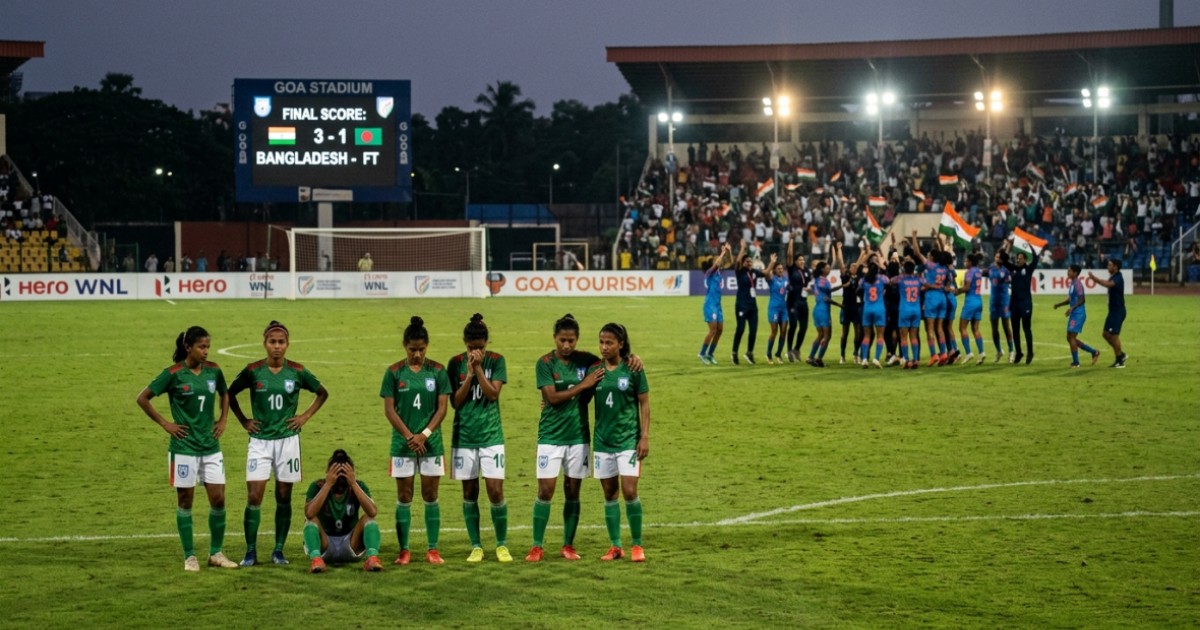
The defending champions Bangladesh women`s national football team suffered a heavy defeat against hosts India in their final group-stage encounter of the SAFF Women`s Championship. The high-stakes match, organized at a prominent stadium in Goa, concluded with a decisive three-zero victory for the structured home side. Despite the loss, Bangladesh advanced to the tournament`s semifinals as group runners-up, having already secured their knockout qualification with a previous win over Maldives. However, the comprehensive margin of the defeat has triggered immediate structural concerns within the technical bench regarding the squad`s defensive vulnerability and tactical cohesion.
From the opening whistle, the Indian team established absolute dominance in the midfield, exploiting spatial errors within the visitors` transitional setup. Although experienced center-back Shouli Azim and central midfielder Monika Chakma returned to the starting lineup after recovering from recent chest discomfort, they struggled to contain the rapid offensive combinations deployed by the hosts. India`s relentless pressure yielded its first breakthrough before the conclusion of the first half, forcing the reigning champions into a defensive posture. The opening goal exposed sudden communication lapses inside the penalty area that head coach Peter Butler had previously attempted to rectify during intense training cycles.
In the second half, Butler introduced specific structural adjustments to re-energize the frontline and generate necessary clinical openings. Prominent winger Ritu Porna Mozumder attempted to utilize her operational speed on the flanks, but conservative positioning from the Indian defensive backline successfully neutralized the service to the forward line. Similar to their performance against Maldives, the Bangladeshi attackers exhibited a severe lack of sharpness in the final third, failing to convert critical set-pieces. Capitalizing on the visitors` desperate push for an equalizer, the Indian side executed two clinical counter-attacks to secure their safe victory and solidify their position at the top of the group table.
Reflecting on the painful result during his post-match briefing, Peter Butler candidly acknowledged that the team failed to execute their tactical plans effectively against a high-tier opponent. He observed that individual positional errors and a distinct lack of midfield synergy prevented the squad from establishing necessary possession control. While Bangladesh held a psychological advantage after defeating India in the preceding two editions of the championship, tonight`s reality demonstrated that historic data does not guarantee structural success. The team must now quickly recalibrate their strategy as they prepare to face either Nepal or Bhutan in the semi-finals, where maintaining their regional crown will demand absolute discipline on the pitch.