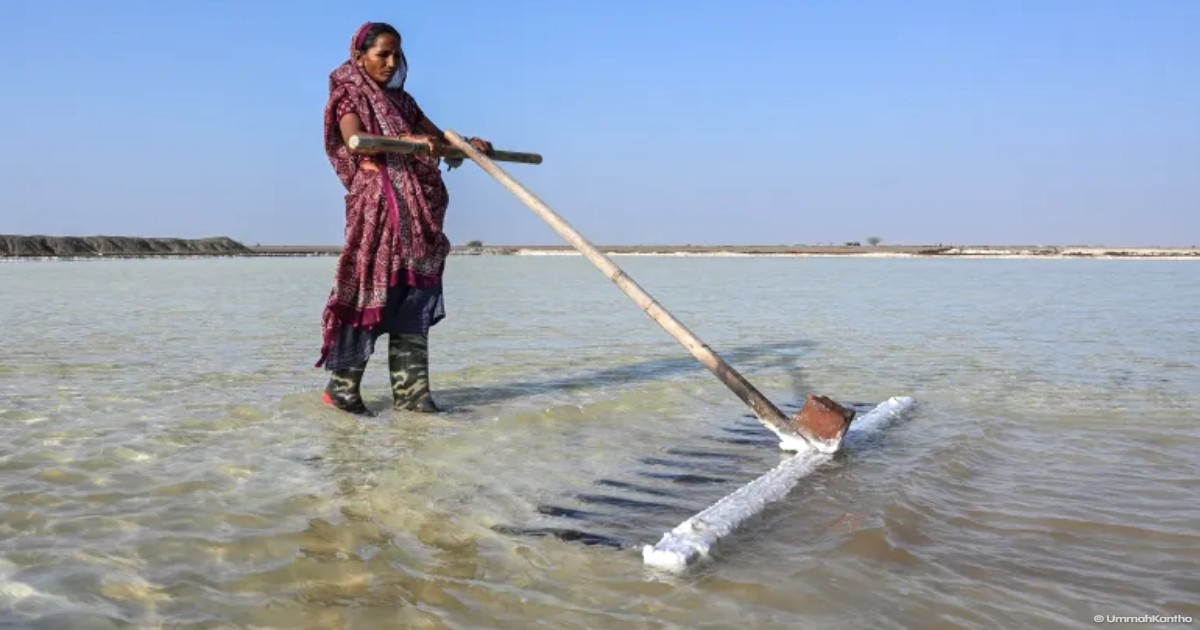
India experiences devastating heatwaves every year, but the conditions in the salt pans of Gujarat are among the most extreme. Tens of thousands of workers in the western state endure near-unliveable circumstances to sustain an industry that accounts for approximately three-quarters of the nation`s total salt output. In the remote Little Rann of Kutch region, as many as 50,000 seasonal migrants spend eight months of the year living on barren salt flats. These communities operate without access to basic electricity, healthcare, or permanent housing, relying on a single water tanker that arrives only once every 25 days for all their domestic needs.
The summer temperatures in this desert landscape routinely exceed 45 degrees Celsius and frequently climb to as high as 48 degrees Celsius. Ironically, the same punishing dry heat that makes existence so difficult is essential for the evaporation process required to harvest salt. Workers pump saline water from deep bore wells into shallow pans, where it crystallizes under the sun and wind. Babulal Narayan, a 42-year-old worker, explained that the heat during the peak afternoon hours is often too intense to withstand, forcing families to stagger their labor between the early morning and late evening hours.
Surviving in an environment with no natural shade requires innovative, if primitive, cooling methods. Families construct small shelters using wooden frames covered with coarse cloth and a layer of wild donkey dung. According to 17-year-old Bhavna Rathore, the dung serves as a natural insulator, blocking the sun`s rays while allowing internal heat to escape. Others use evaporation to keep their drinking water cool by wrapping bottles in damp fabric. Despite these efforts, the health toll remains severe, with researchers documenting high rates of chronic dehydration and early symptoms of kidney malfunction among the salt-working population.
The introduction of solar-powered pumps has recently reduced production costs but has inadvertently extended the working season into the hottest months of the year. Previously, the high cost of diesel meant that production ended in March, but now families stay through the peak of the summer heat. Despite the physical danger and the threat of unseasonal storms that can destroy months of labor in a single day, most workers feel they have no other options. With no land of their own and no livestock for alternate income, the salt pans remain their only means of survival, a cycle of poverty that forces them back to the desert year after year.