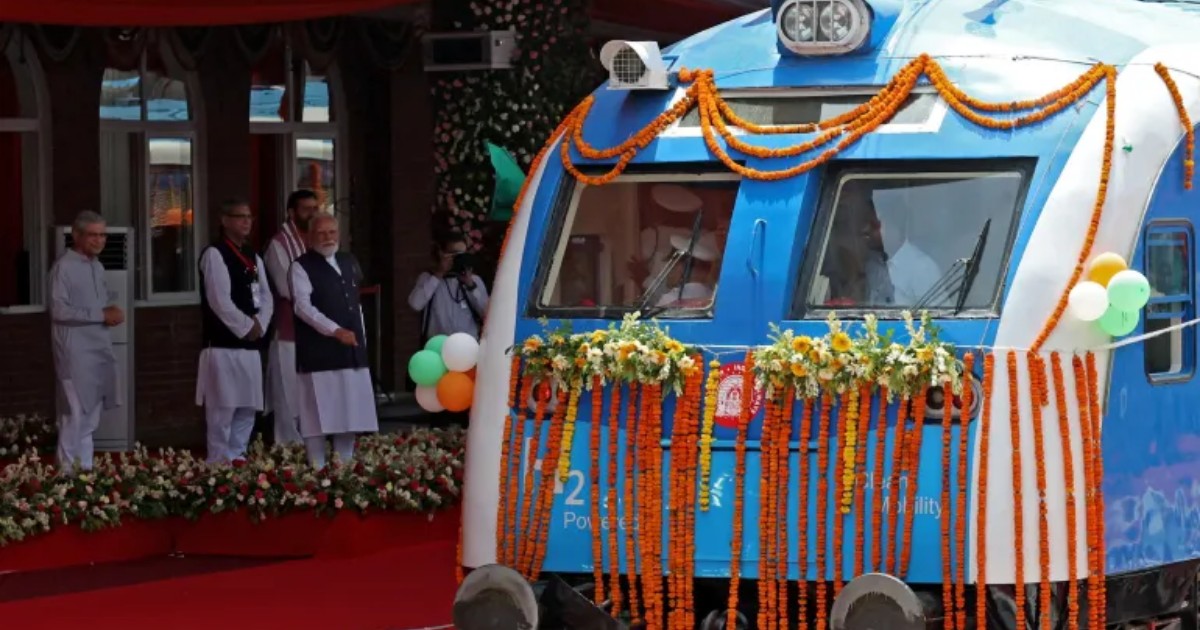
India launched its first domestically built hydrogen-powered train in Haryana on Friday, Prime Minister Narendra Modi confirmed, according to Reuters and The Associated Press. The prime minister inaugurated the milestone locomotive at the Jind railway station ahead of its maiden journey, describing the launch as a historic day for the country`s pursuit of self-reliance and sustainable infrastructure development. With the official rollout of this clean energy technology, New Delhi enters an exclusive group of global powers that have successfully operationalized zero-emission hydrogen fuel cells within their domestic passenger rail networks. Dubbed the NaMo Green Rail, the newly designed 10-coach passenger train is scheduled to perform two daily return trips along an 89-kilometer corridor connecting the major regional hubs of Jind and Sonipat.
Engineered and constructed entirely within the country by the Integral Coach Factory in Chennai, the advanced train generates only heat and water vapor as operational byproducts, presenting an ecologically viable alternative to traditional diesel locomotives. Although Indian Railways has successfully completed a massive modernization drive to electrify over 99 percent of its broad-gauge network spanning 70,000 kilometers, these hydrogen-powered trainsets are uniquely designed to plug structural gaps where conventional overhead electrification remains unfeasible or cost-prohibitive. The standard configuration features two driving power cars integrated with 1,200-kilowatt proton exchange membrane fuel cells and lithium iron phosphate batteries, operating as a 3,200 horsepower system that stands out as one of the most powerful operating clean trainsets globally.
Prior to New Delhi`s deployment, only a handful of industrialized nations including Germany, Japan, China, and the United States had initiated commercial operations or extensive safety trials for hydrogen rail transport systems. The ambitious pilot initiative forms a core component of India`s broader national green hydrogen mission, which aims to transition the state-owned railway network into a completely net-zero carbon emitter by the end of the decade. To support the continuous daily passenger schedule, railway authorities simultaneously unveiled the country`s largest dedicated hydrogen storage and compression refueling facility in Jind, boasting an operational capacity of approximately 3,000 kilograms. Senior railway officials acknowledged that the initial pilot project required an investment of roughly 12 million dollars, making it significantly more expensive than standard diesel or electric setups, though operational costs are projected to decline substantially as the underlying technology matures.
What remains unclear is how rapidly the federal government can scale up the localized production of green hydrogen fuel without relying on fossil-fuel-powered thermal plants to sustain the expanded grid requirements. Union Railways Minister Ashwini Vaishnaw characterized the successful integration of indigenous technology as a major breakthrough that validates long-term safety procedures and technical capacity for high-volume public transit. Moving forward, the Ministry of Railways plans to leverage the critical operational insights gained from the Haryana corridor to deploy similar clean trainsets on sensitive heritage routes, including the iconic mountainous Kalka-Shimla line. Despite ongoing domestic challenges in enforcing comprehensive climate regulations, the formal introduction of the new clean transport fleet represents a tangible shift toward green transportation alternatives in South Asia.