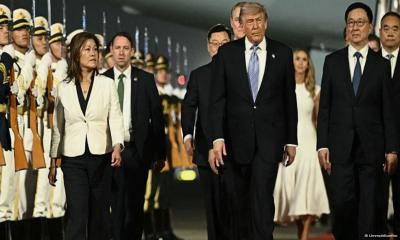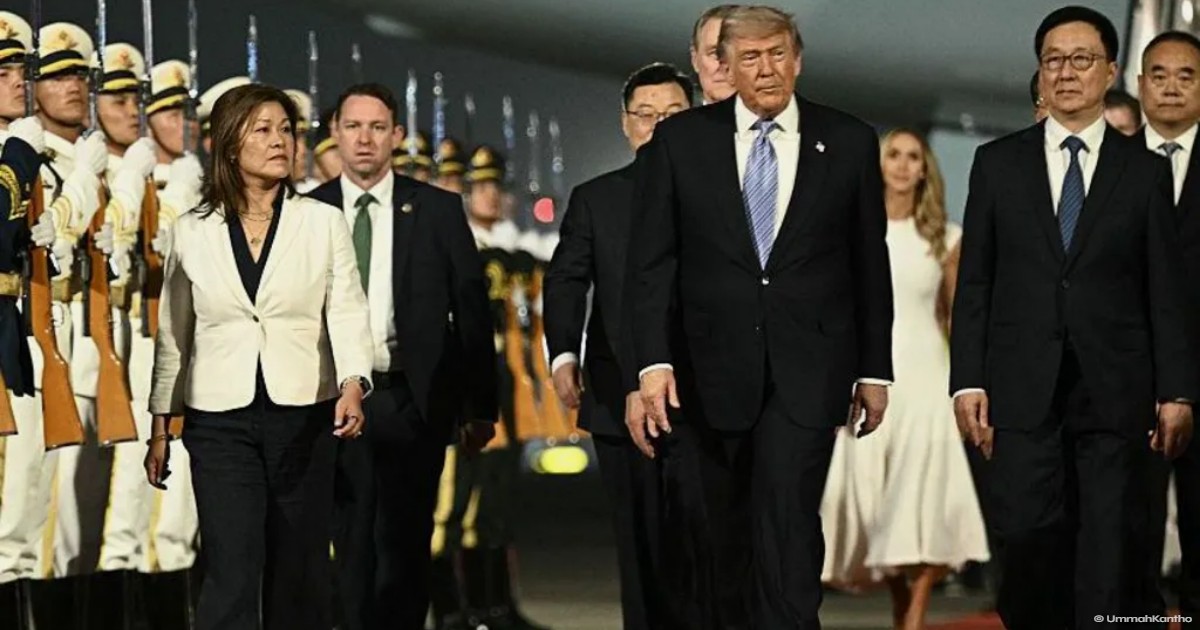
US President Donald Trump descended the steps of Air Force One in Beijing on Wednesday evening, greeted with immense pomp and pageantry ahead of a high-stakes summit with his Chinese counterpart, Xi Jinping. During his two-day visit, the global superpowers are expected to navigate a complex landscape of tariffs, tech competition, the ongoing war in Iran, and the fragile status of Taiwan. Trump returns to a more assertive China than the one he visited early in his first term, and the meeting comes as the American administration faces intense international scrutiny over military campaigns in the Middle East.
The arrival on the red carpet saw a notable shift in diplomatic protocol. Trump was greeted by Chinese Vice-President Han Zheng, a move analysts interpret as a significant show of respect from Beijing compared to previous lower-level receptions. A military brass band and rows of flag-wavers greeted the president, who responded with his signature fist pump. Accompanying Trump is a high-profile delegation of American tech industry titans, including Tesla’s Elon Musk and Nvidia’s Jensen Huang. The presence of CEOs from Apple, BlackRock, and Boeing underscores the economic weight of this diplomatic mission. Prior to landing, Trump indicated on social media that his primary request would be for President Xi to further open Chinese markets to American innovation.
The economic backdrop of the visit is fraught with tension. Bilateral trade between the two nations has seen a sharp decline, dropping from $690.4 billion in 2022 to approximately $414.7 billion last year, according to trade data cited by Reuters. The US remains concerned about a trade deficit that saw imports from China exceed exports by more than $200 billion last year. While China seeks to dominate the global AI arms race and increase its acquisition of US-made computing chips, Washington has tightened export restrictions, citing national security concerns and intellectual property theft. This friction over high-tech resources, including rare earth metals, remains a central point of contention for the upcoming bilateral meetings.
Geopolitical stability is also on the line as the war in Iran continues to rattle global markets. China remains a primary consumer of Iranian oil, though exports have been severely hindered by the inability of vessels to safely navigate the Strait of Hormuz. Washington is reportedly pressuring Beijing to utilize its long-standing economic and political leverage over Tehran to de-escalate the conflict. While Trump has insisted that he does not necessarily need external help to resolve the crisis, the economic pressure of rising oil prices on China’s economy suggests that both leaders have a vested interest in finding a path toward regional stability.
Tensions over Taiwan also loom large in the background of the discussions. Despite approving a $14 billion arms deal for Taipei last year, the Trump administration’s stance on defending the island remains a subject of debate in Congress. A bipartisan group of US senators recently urged the president to affirm American support for Taiwan during his talks with Xi, emphasizing that economic negotiations should not compromise security commitments. The schedule for Thursday includes a formal welcome at the Great Hall of the People, followed by bilateral meetings and a state banquet. The visit is set to conclude on Friday after a final working lunch between the two world leaders.