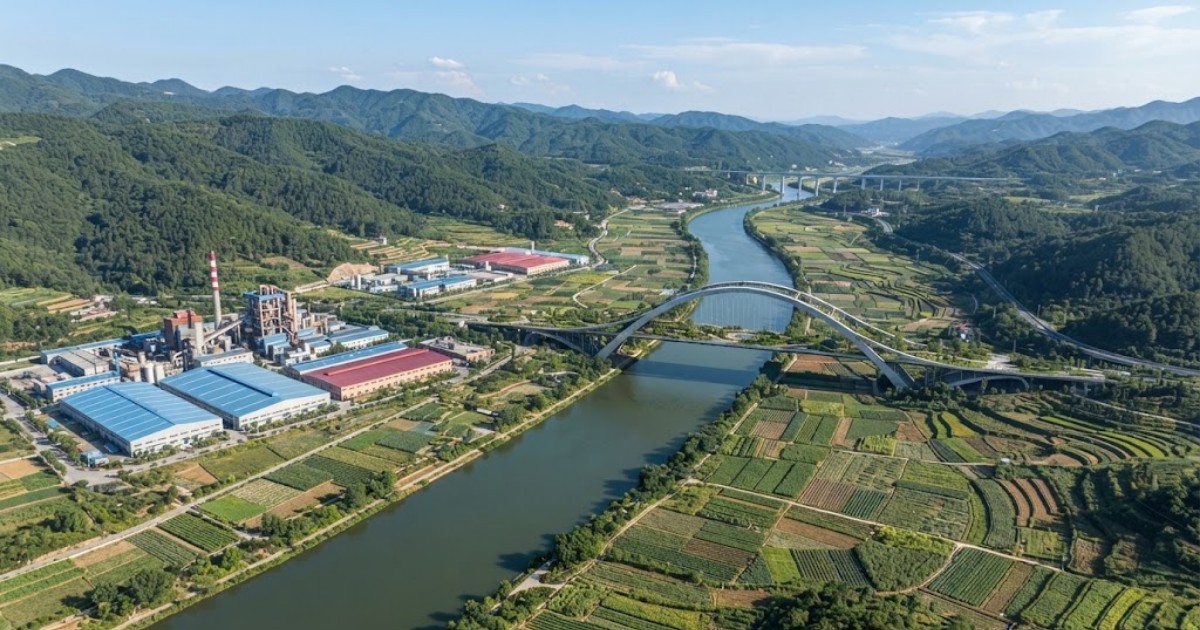
Redrawing regional trade routes and maritime geopolitics in southern Asia, China has officially opened its first modern river-to-sea canal for navigation. Located entirely within the Guangxi Zhuang Autonomous Region, the newly operational Pinglu Canal connects the country`s southern hinterland directly with Southeast Asia, significantly reducing transport barriers with a critical economic partner.
The inauguration marks a major shift in Asian trade logistics.
Spanning 134 kilometers (83 miles), the waterway links the Xijiang River directly with the Beibu Gulf, the northwestern arm of the Gulf of Tonkin situated between southern China and northern Vietnam. This engineering feat provides landlocked and mountainous provinces across southwest China, including Yunnan and Guizhou, with a direct and dramatically shortened maritime outlet to international Asian markets.
Constructed as a central component of the New International Land-Sea Trade Corridor, the canal operates as a key initiative under Chinese President Xi Jinping’s sprawling Belt and Road Initiative. This transnational network of highways, ports, and railways is designed to connect economic centers across Eurasia and beyond.
According to local authorities in Guangxi, the waterway will shorten shipping distances between southwest China and Southeast Asian ports by approximately 560 kilometers (350 miles). Furthermore, operational logistics costs are projected to drop by 18 to 30 percent across the board.
Financial returns are anticipated to be substantial.
Zhang Zhiwen, deputy secretary-general of the Guangxi government, estimates that transport savings alone will exceed 5 billion yuan—roughly $700 million—annually. Regional vice chairwoman Lu Xinning describes these efficiencies as tangible economic gains that will powerfully stimulate both domestic and foreign commercial exchanges.
The canal was built at an estimated cost of 72.7 billion yuan, equivalent to about $10.8 billion, and is engineered to accommodate commercial vessels with a capacity of up to 5,000 tonnes. This capability brings industrial hubs and inland manufacturing centers situated far from the coast much closer to global shipping lanes. The corridor connects major inland economic nodes in Chongqing, Chengdu, Guizhou, and Yunnan directly to the port facilities of the Beibu Gulf.
Bilateral trade between China and Southeast Asia has experienced rapid expansion in recent years. General Administration of Customs data indicates that bilateral trade volume during the first half of 2026 reached approximately 4.34 trillion yuan, or roughly $640 billion, marking an 18.2 percent year-on-year increase.
Port capacity has scaled up in tandem.
Container-handling capacity at the Beibu Gulf Port surged from 2.28 million TEUs in 2017 to 10.06 million TEUs by 2025, supported by a dense shipping network linking major Southeast Asian ports.
Beyond mere navigation, Guangxi is actively developing the "Pinglu Canal Economic Belt" along the corridor to cluster manufacturing industries, transport networks, and supply chains. Targeted sectors include non-ferrous metals, modern green chemicals, artificial intelligence, and advanced information technology. Direct logistical links are already active, exemplified by a freight train loaded with sodium bisulfate arriving from Chongqing at Nanning port ahead of scheduled direct sailings to Can Tho in southern Vietnam.
Operational policies have been structured to encourage immediate commercial adoption.
A tiered transit-fee system offers operators a grace period, allowing commercial vessels to pass through the canal`s three water gates completely free of charge until December 31, 2026. Starting January 1, 2027, a nominal fee of one yuan—about $0.14—will be charged per tonne of vessel capacity for each gate passage, a trial rate slated to run through September 2031. River vessels can now sail directly into the berths of Qinzhou seaport without requiring intermediate cargo transfers.
Constructing a mega-project of this scale required navigating a deeply sensitive human dimension.
The official resettlement program affected 2,764 households comprising 11,228 individuals across four counties and municipal districts in Guangxi. In Hengzhou alone, evacuation agreements were signed for 368 homes, resulting in the complete demolition of 84,200 square meters of residential property and the temporary relocation of 1,221 residents.
Relocation management went beyond standard financial compensation.
Authorities designed 21 distinct housing models tailored to local agricultural customs, incorporating specific layouts for reception rooms, crop-drying yards, poultry enclosures, and chemical storage sheds. In Shaping, the largest resettlement township, residents received four-storey homes spanning 420 square meters, some featuring street-facing commercial storefronts. The entire resettlement process was executed within 39 days, coupled with guaranteed employment opportunities at the construction site and vocational training programs.
On a macro level, the project reflects how nations are actively reshaping trade security in an era of geopolitical vulnerability.
Maritime chokepoints and narrow straits have historically served as the critical arteries of global commerce while remaining acutely vulnerable to disruption. The ongoing crisis surrounding the Strait of Hormuz illustrates this precise vulnerability, where threats to a passageway handling one-fifth of global oil supplies can paralyze international trade and force immediate route redesigns.
Faced with such systemic risks, governments worldwide are aggressively investing in alternative logistics corridors.
The Pinglu Canal represents Beijing’s latest strategic endeavor to engineer shorter, more secure, and diversified pathways to critical international markets, bypassing traditional maritime bottlenecks and fortifying long-term supply chain resilience.