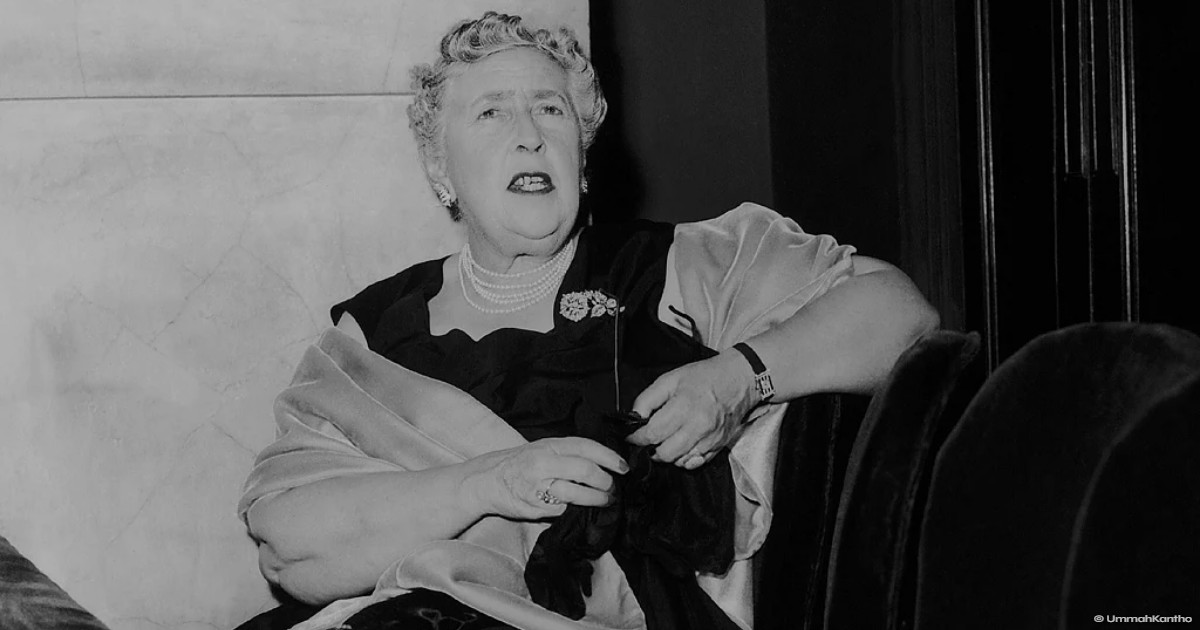
Agatha Christie remains the undisputed Queen of Crime, yet fifty years after her passing, the woman behind Hercule Poirot and Miss Marple remains as much of an enigma as her most intricate plots. While she presented the world with the image of a genial, elderly lady devoted to gardening and her dogs, she was secretly architecting some of the most cold-blooded betrayals and ingenious poisonings in literary history. A rarely heard 1955 interview for a BBC radio profile, recorded in her London flat, has recently resurfaced, offering a rare glimpse into the psyche of a writer who preferred to hide in plain sight. In this conversation, Christie explores the origins of her imagination and the unconventional life experiences that fueled her global success.
The foundation of Christie’s genius, by her own admission, was a childhood defined by what she called "glorious idleness." Born Agatha Miller in 1890 into a prosperous family, she did not attend school until she was sixteen, receiving most of her education at home. Christie attributed her career to this lack of formal schooling, suggesting that the absence of a rigid curriculum allowed her mind the freedom to wander. She famously remarked that there is nothing like boredom to make one write. Without the distractions of modern life or a classroom, she began inventing characters and acting out complex scenarios in her head, eventually penning short stories and a long, albeit "dreary," novel by her late teens.
The precision with which Christie described methods of murder—particularly poisoning—was not a product of pure imagination but of rigorous wartime reality. During World War One, while her first husband, Archie Christie, was serving in France, she volunteered as a nurse at a hospital for wounded soldiers. She eventually moved to the hospital pharmacy, where she studied for the Society of Apothecaries exam. This training provided her with an expert understanding of medicines, toxins, and the subtle art of chemical death. This expertise is evident throughout her bibliography, where poison serves as the primary weapon in forty-one different instances of murder or attempted suicide, far surpassing the use of firearms or blades.
Structurally, Christie’s work followed a formula that remains the gold standard for the mystery genre. She excelled at creating a closed circle of suspects within a defined social setting—be it a country manor, a luxury train, or a remote island. Her narratives relied on the unraveling of clues by a brilliant outsider, leading to a dramatic climactic confrontation where the truth is finally revealed. Despite the familiarity of this structure, her ability to innovate within it kept readers guessing for over a century. However, her professional triumph in 1926 with The Murder of Roger Ackroyd was shadowed by a personal crisis that became a mystery in its own right: her sudden eleven-day disappearance following her mother`s death and her husband`s infidelity.
During the interview, Christie reflected on the mechanics of her craft, stating that the "real work" was done during the thinking phase rather than the actual typing. She could complete a book in three months once the plot was fully developed in her mind. Interestingly, she confessed that writing plays was "much more fun" than writing books, as it allowed for a different kind of engagement with the audience. Ultimately, the 1955 interview portrays a woman who was deeply shy yet incredibly focused on the craftsmanship of storytelling. Agatha Christie’s legacy is a testament to the power of a quiet mind, proving that beneath the most unassuming exteriors can lie a universe of intrigue, waiting for the right moment of boredom to be unleashed upon the page.