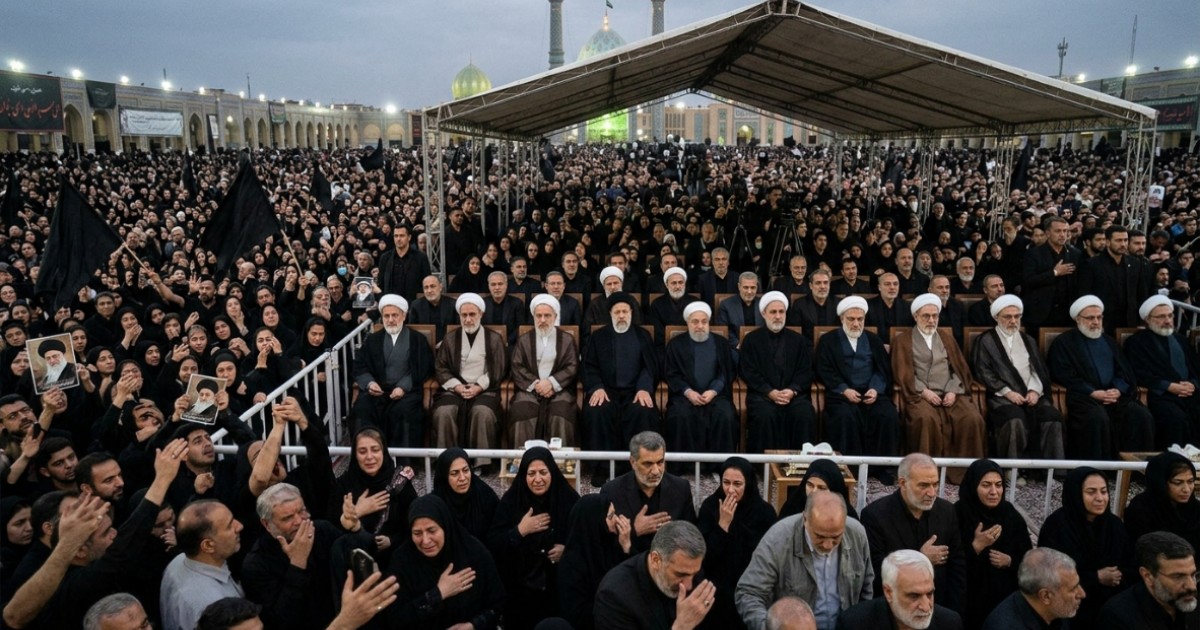
Thousands of Iranians gathered at the Grand Mosalla religious complex in Tehran on Sunday to pay their final respects to the late Supreme Leader Ali Khamenei. While senior regime figures, including President Masoud Pezeshkian and Revolutionary Guards chief Ahmad Vahidi, attended the service, the conspicuous absence of the late leader`s son, Mojtaba Khamenei, has fueled widespread speculation. His three brothers, Masoud, Mostafa, and Meysam, were present at the service, marking a stark contrast to Mojtaba`s continued absence from public life since his appointment in early March.
The funeral proceedings, which began on Friday, are expected to draw between 12 and 20 million people across Iran and Iraq over the coming week, with authorities terming the event the funeral of the century. The late leader, who ruled the Islamic Republic from 1989 until his death in February, is lying in state at the Grand Mosalla. Sunday was declared a public holiday across Iran to facilitate the mass attendance of mourners, with a massive procession scheduled for Monday to move the body through the streets of the capital.
The solemn event has been strictly choreographed by Iranian authorities, though the geopolitical backdrop remains highly volatile. US President Donald Trump told the news outlet Axios that peace talks between the two nations had been paused for a week to accommodate the funeral events. Trump suggested that with many senior Iranian officials gathered in one location, the United States could have targeted them. However, he stated that Washington opted against such action to maintain a channel for future negotiations.
These remarks have not been well-received on the streets of Tehran. Mourners at the funeral have expressed profound anger, with reports from The Associated Press and The Guardian indicating that crowds chanted anti-American slogans, including calls for the death of President Trump. Attendees were also seen holding banners condemning both Trump and Israeli Prime Minister Benjamin Netanyahu. The atmosphere, while centered on grief, has transformed into a display of intense political defiance.
Security remains a primary concern for the authorities, given the scale of the turnout. Iranian state news agency IRNA reported that over 4,000 people sought medical assistance at centers near the Grand Mosalla, highlighting the sheer density of the crowds. As the procession moves forward, the combination of mass public mourning and heightened international tension underscores the fragility of the current situation. While a fragile ceasefire remains in place, both the United States and Iran continue to monitor the developments closely, with the potential for resumed military action looming over the ongoing diplomatic impasse.