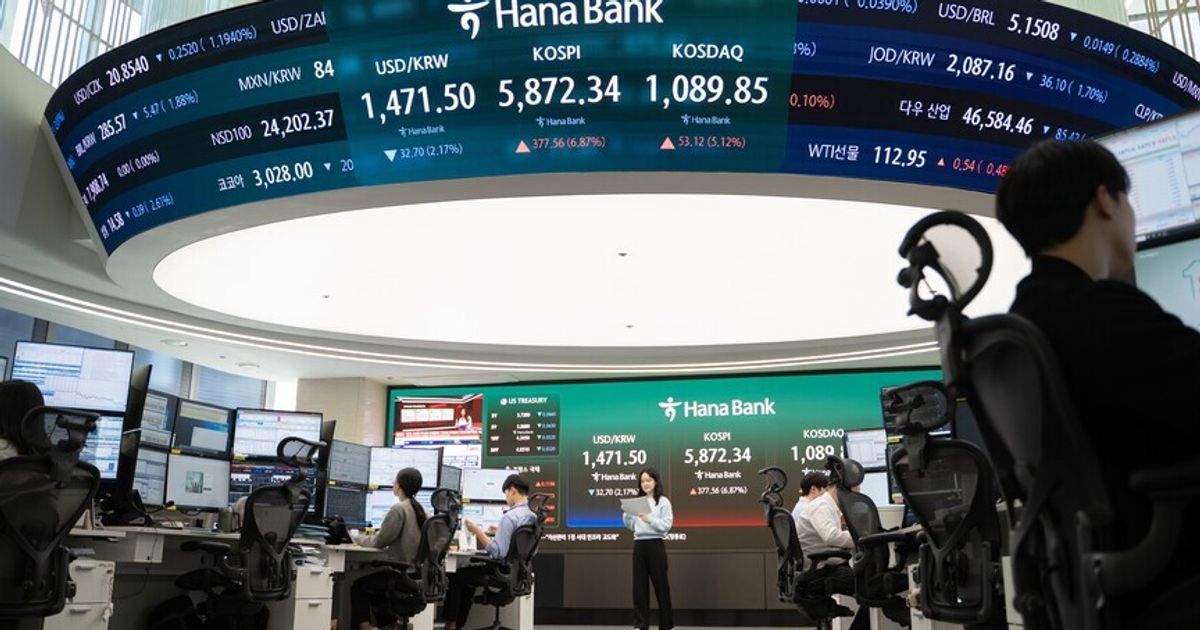
South Korea experienced a severe market downturn on Thursday. Main stock indexes plummeted by roughly 8%, forcing market-wide trading halts.
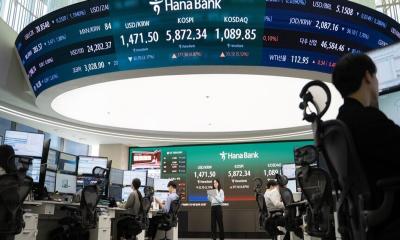
The benchmark Korea Composite Stock Price Index dropped 480.76 points, or 8.68%, to close at 5,528.05. Exchange figures reported by local media showed that a circuit breaker was activated at 12:38 pm local time.
The technology-focused Kosdaq triggered a separate circuit breaker earlier in the session, falling 66 points, or 8.01%, down to 757.88. Trading on each market was suspended for 20 minutes.
Semiconductor heavyweights drove the steep decline. Samsung Electronics fell roughly 10% during intraday trading, while SK hynix shed more than 11%.
Foreign investors offloaded a net 2.9 trillion won, equivalent to $2.15 billion, of shares on the main board. This intense selling pressure occurred despite concurrent purchases from domestic retail and institutional investors, according to the Seoul Economic Daily.
The dramatic selloff followed overnight losses on Wall Street, where the Nasdaq Composite dropped 1.88% and the S&P 500 declined 1.11%.
United States consumer prices rose 0.6% month-on-month in September. This brought annual inflation to 3.7%, surpassing market expectations of 3.6% and exacerbating worries over future interest rate trajectories.
Investors also grew increasingly anxious over whether massive investments in artificial intelligence would generate expected financial returns, heavily weighing on technology equities as reported by Yonhap.
Seoul’s benchmark index had already recorded declines for six consecutive sessions prior to Thursday’s market collapse.
Korea Exchange rules dictate that a first-stage circuit breaker must suspend trading for 20 minutes when the benchmark index drops at least 8% from the previous close and sustains that level for one minute.