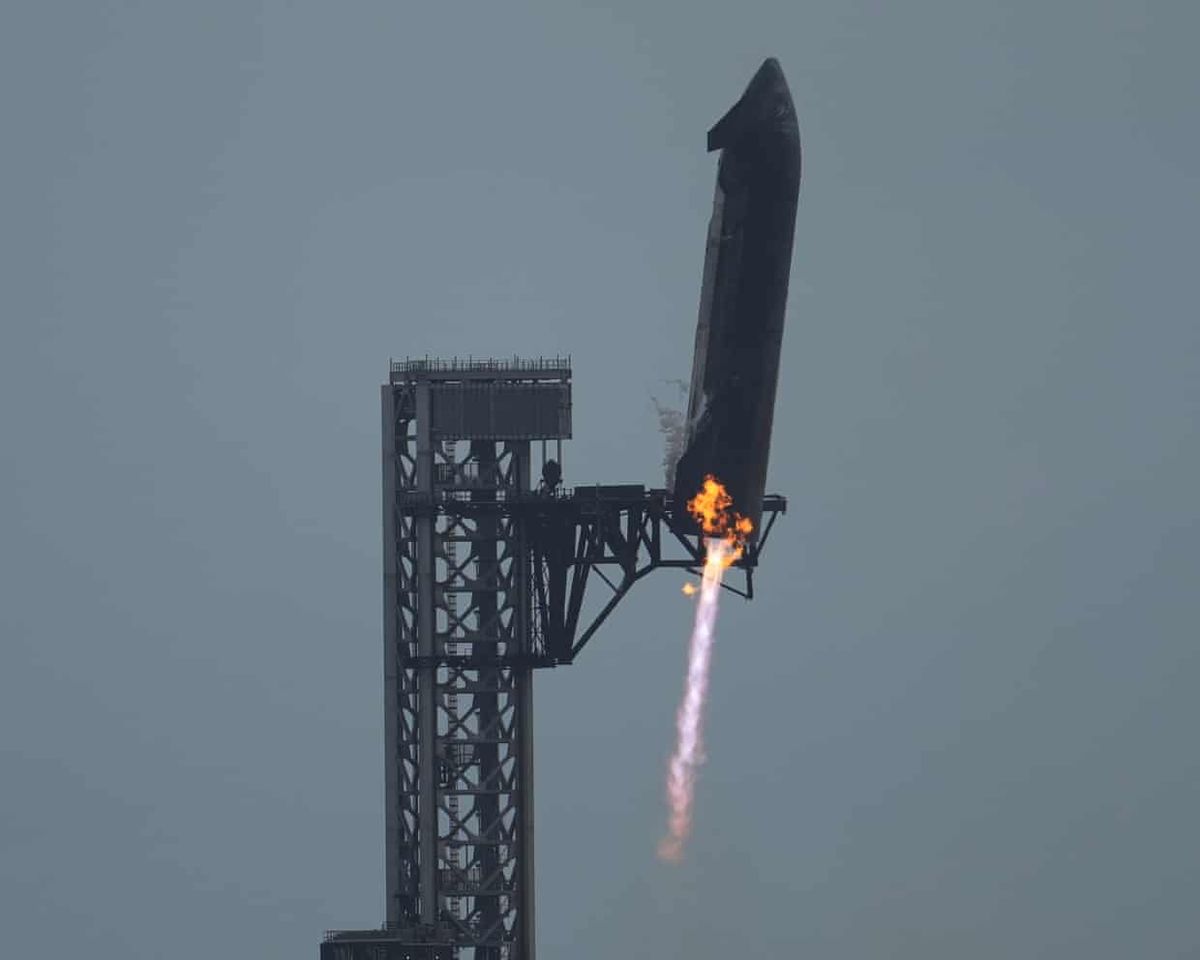
SpaceX returned its massive Starship megarocket to its launch tower in Texas on Saturday. The achievement is a major step in the company’s efforts to make the spacecraft fully suitable for human spaceflight.
The 171ft, bullet-shaped upper stage descended into the mechanical arms of the tower. This ended a 22-hour mission where the craft orbited Earth 14 times. This week’s outing marked only the second time Starship has entered Earth’s orbit, and the first time the company successfully caught its upper stage.
The 15th test flight was originally planned as a double-catch mission. Engineers envisioned returning all parts of the rocket intact to the launch site rather than recovering them from the ocean, which happened during previous test flights.
Those ambitions were partially dashed when the lower booster stage diverted a few minutes after takeoff and exploded in the Gulf of Mexico. The guidance, navigation and control system triggered a no-go protocol.
"It was doing what it was supposed to do," SpaceX spokesperson Dan Huot said early on Saturday. "Basically, it detected that the booster was not in the place it was supposed to be to proceed with a catch."
The booster was also slightly low on fuel, according to SpaceX chief executive Elon Musk. The spacecraft consists of the lower booster stage called Super Heavy, whose Raptor engines powered the orbital ascent, alongside the upper stage.
The success arrives as the 2028 target approaches for Nasa’s plan to return humans to the lunar surface. The space agency has contracted both SpaceX and Jeff Bezos’s Blue Origin for the mission.
"Making more believers by the day," wrote Nasa administrator Jared Isaacman on X, praising the 15th flight and noting it was one step closer to the moon. Isaacman is an ally of Musk, who advised Donald Trump to appoint him to lead Nasa.
Musk has stated plans to ramp up Starship test flights to a weekly, then twice-weekly cadence. He seeks to make Starship rapidly reusable so that it can land and take off much like standard airplanes, aiming to lower the costs of space travel.
Beyond another moon landing, Musk has pushed a plan to carry humans to Mars. The spacecraft’s recent advances have also aided the expansion of his satellite internet empire, deploying 26 Starlink V3 satellites during the test flight.