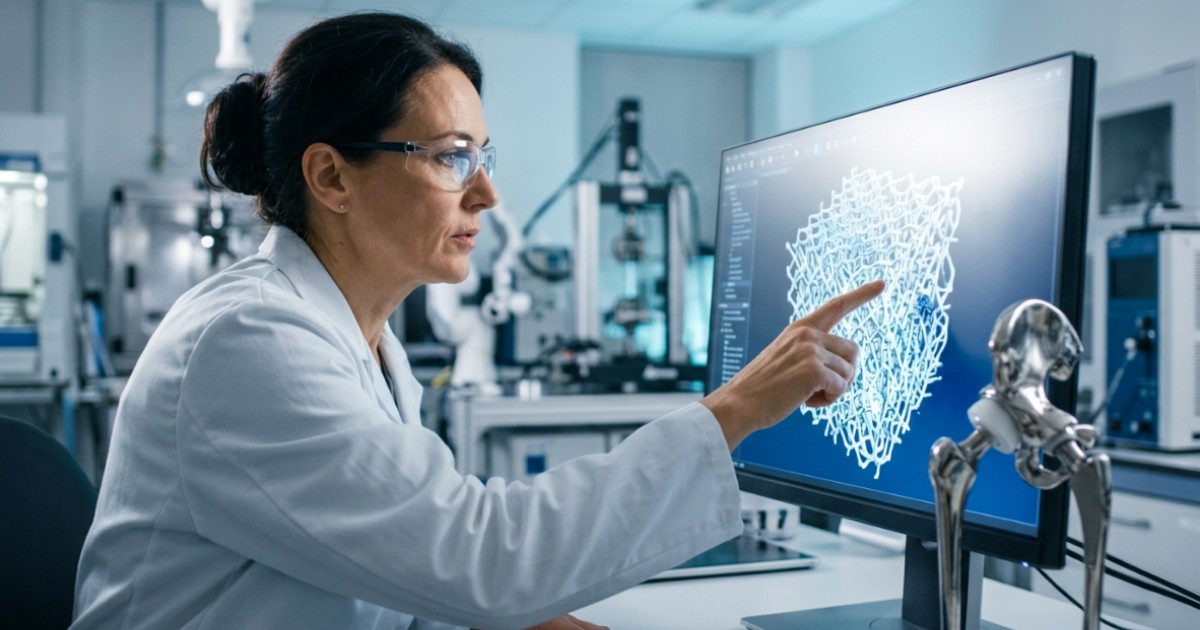
Medical researchers are increasingly turning to artificial intelligence to design synthetic materials that mimic natural bone tissue, promising longer-lasting hip replacements and advanced fracture healing. Amir Zadpoor, a professor of orthopedics at the Leiden University Medical Center in the Netherlands, spent years searching for a specialized material that could withstand immense mechanical stress.
In physics, when an elastic substance is pulled from both ends, it naturally elongates and becomes significantly thinner across its midsection. However, orthopedic implants required an entirely opposite mechanical reaction to properly integrate with human anatomy without wearing down over time.Artificial intelligence successfully provided a solution to this complex bio-engineering dilemma.
Hip replacement remains one of the most widespread orthopedic surgeries conducted globally, yet artificial joints face significant durability limitations. Patients with artificial hips average roughly two million steps per year, subjecting the underlying foreign implant to repetitive physical forces that gradually degrade the synthetic joint. Consequently, after a decade or more of continuous activity, these heavily worn components frequently fail, forcing patients to undergo highly complex and painful revision surgeries. To eliminate this issue, Zadpoor and his colleagues designed a mechanism that places two contrasting materials on either side of an implant`s base to secure the connection firmly against the natural femur.
Materials that expand and thicken when stretched are scientifically classified as auxetic materials, but they are typically soft and structurally compliant. These common auxetic substances are frequently utilized in protective consumer products like football helmets and athletic knee pads rather than load-bearing medical devices. The ultimate challenge for modern materials science was discovering an elusive structural design that combined high macroscopic stiffness with pronounced auxetic behavior. To fast-track this discovery, the orthopedic research team utilized a specialized machine learning system trained to predict how complex microscopic arrangements behave under pressure. The AI system processed millions of structural variations before generating an optimal design for a specialized metamaterial.
Metamaterials are artificial structures engineered to possess unconventional macroscopic properties by precisely altering their internal microscopic geometries. Sid Kumar, an associate professor of materials science at TU Delft in the Netherlands, noted that training an initial AI prediction model can require up to a year of computational work. However, once the framework is established, the machine learning system can generate viable material designs within mere seconds or minutes. Relying on traditional physics-based simulations or random lab testing to find these structural configurations would otherwise take researchers decades of manual configuration. This rapid computational acceleration enables bio-engineers to explore massive databases of structural configurations to match individual patient metrics.
Beyond joint replacements, this technology is being adapted to develop highly flexible bone implants optimized to treat severe fractures in elderly demographics. Traditional surgical methods rely on rigid titanium or steel plates, rods, and screws, which often fail to integrate properly with brittle bone structures. This poor integration weakens the surrounding area, frequently leading to chronic discomfort or structural failure. By utilizing AI-generated soft metamaterials, future medical implants can be customized to match a patient`s unique internal anatomy, accelerating natural bone growth and ensuring more reliable structural stabilization.