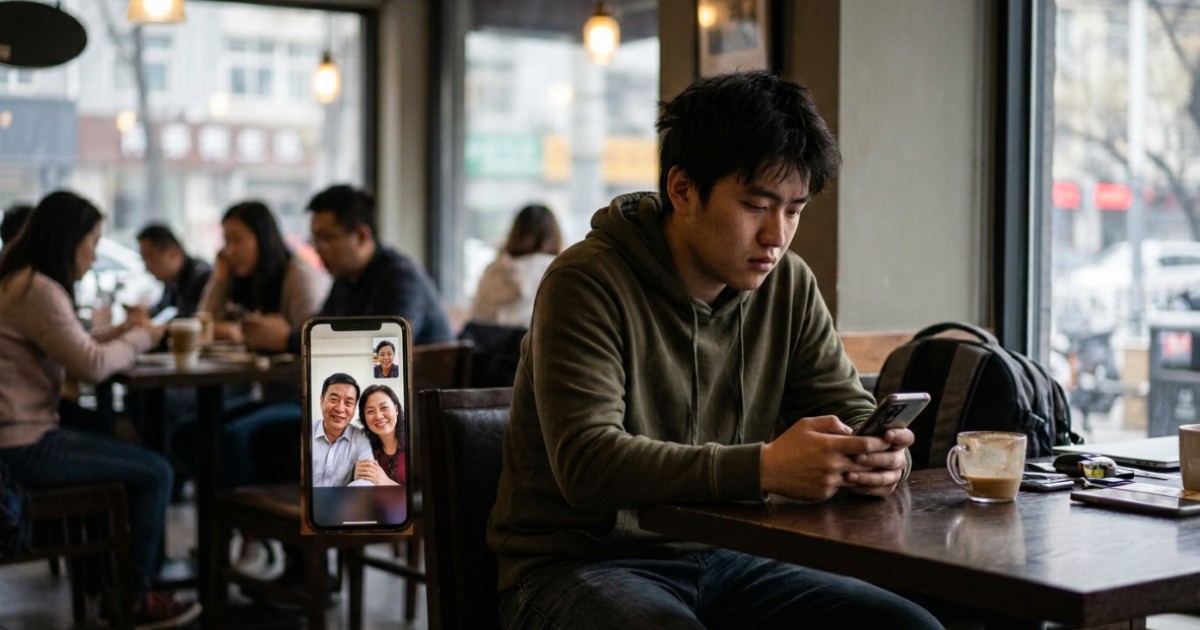
Young Chinese individuals facing intense family expectations and economic competition are turning to online virtual parents for emotional relief, a special feature published from Hong Kong on Sunday by BBC News revealed. Vincent Zhang, a 33-year-old technology worker based in Shanghai, routinely checks his smartphone during mealtimes to watch videos created by a middle-aged online couple who act as his imaginary parents. Pan Huqian and Zhang Xiuping, content creators with nearly 2 million followers on Douyin, which is China`s version of TikTok, have exploded in popularity by offering warm, non-judgmental validation to their young audience. In the comments section of their widely viewed videos, thousands of followers affectionately address them as mom and dad while sharing details of their daily lives and seeking birthday blessings.
Sociologists suggest that the current generation of Chinese youth is navigating a profound mental health crisis triggered by a mix of demanding family bonds and pressure to succeed. Vincent Zhang noted that his biological parents never offer words of encouragement or advise him to avoid pushing himself too hard in his career. Instead, his weekly phone calls with his family are filled with severe criticism regarding his choice of a tech career, the stability of government jobs, and his single status. Exhausted by the constant disapproval from home, the young web developer has found a sense of unconditional love and comfort in the digital companionship of these online figures. Content creator Pan Huqian revealed in an interview that his own difficult childhood, during which he became the breadwinner at age 14 after his mother was paralyzed, inspired him to foster a more loving environment online.
This significant shifting of social dynamics is closely linked to the dramatic economic transformation and recent slowdown experienced across China over the past decades. The grandparents of today`s youth survived brutal national crises, including the devastating famines of the 1950s and the political purges of the 1960s Cultural Revolution, while their parents grew up during an era of initial economic opening. In contrast, the younger generation was raised during a period of unprecedented stability and prosperity, yet they now face a highly competitive and stagnant job market. Following the global pandemic, the youth unemployment rate in China has consistently hovered above 15 percent, leaving many young professionals deeply burnt out and questioning the value of participating in the traditional corporate rat race. While state media outlets have attempted to redirect online discourse toward traditional filial piety, these efforts have largely failed to resonate with a generation facing unique contemporary trauma.
What remains unclear is how these artificial digital relationships will impact the long-term social skills of young individuals or if they will worsen existing family divisions. The widespread frustration among Chinese youth has fueled viral internet memes known as gourd soup literature, a term originating from a popular skit depicting an overbearing mother who blames her son for being ill-tempered after he politely declines a bowl of soup. Zhao Xuan, a 28-year-old professional, told reporters that she chose to mute her family group chat entirely to escape this pervasive dynamic of manipulation disguised as parental love. Rather than attempting to change her mother`s rigid mindset, she uses these humorous online memes as a psychological defense mechanism to cope with her domestic stress. This symbolic resistance highlights a quiet, internal rebellion taking place inside millions of modern Chinese households.
According to social and family researchers, while the rise of digital surrogate parents offers temporary psychological relief, it does not provide a permanent solution to structural issues. Many young people use the affectionate content as a tool to cope with real-life isolation, which can inadvertently distance them further from actual human relationships. While these digital parents consistently project warmth, their content is ultimately part of a commercially successful venture driven by engagement metrics and advertising revenue. When vulnerable youth rely heavily on digital comfort instead of addressing real-world communication barriers, their capacity to navigate complex familial conflicts diminishes. Consequently, experts warn that this reliance could foster long-term alienation and social withdrawal, posing a substantial challenge to the future stability of the country`s social fabric.
The tech worker mentioned earlier, Vincent Zhang, acknowledged that the videos remind him of simpler times when he would go grocery shopping with his parents ahead of the Spring Festival without facing any social pressure. He remains fully aware of the commercial nature of the content produced by Pan Huqian and Zhang Xiuping, yet he chooses to seek solace in their scripted kindness anyway. At the end of exhausting workdays in a highly competitive urban environment, a growing number of Chinese youth continue to look at their screens for the maternal and paternal warmth missing from their actual lives. This reliance on digital parental figures reflects the complex emotional vacuums being generated within modern, fast-paced societies.