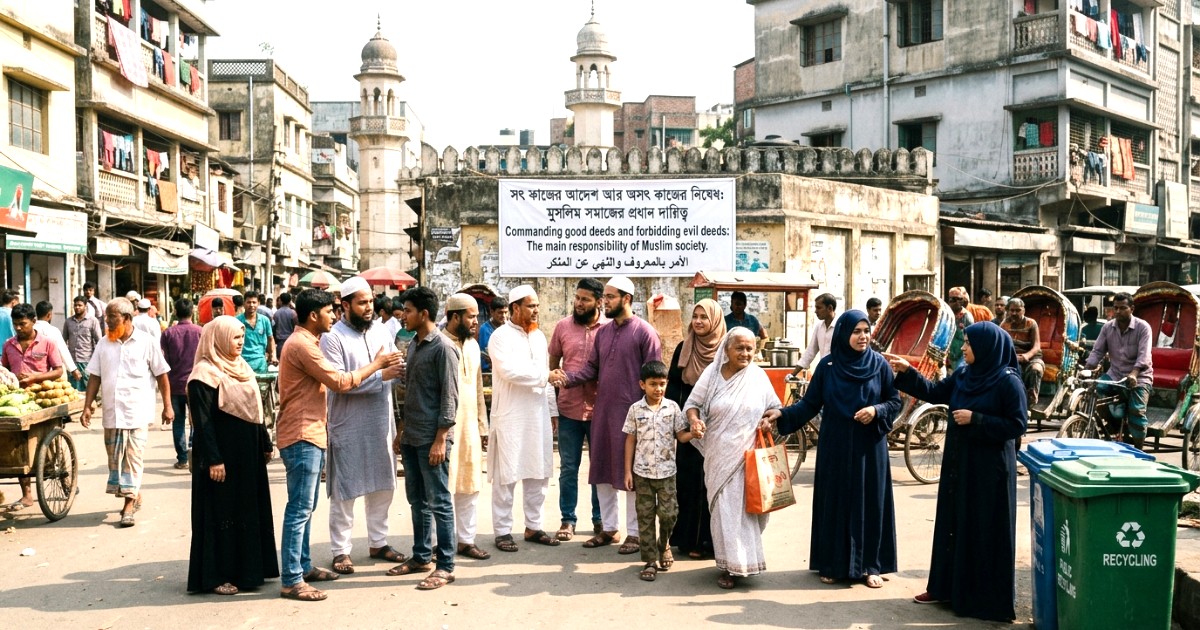
The Holy Quran establishes the foundational blueprint for strategic social reform as the core metric defining the long-term excellence and spiritual authority of the Muslim Ummah. Divine legislation mandates that the preservation of communal integrity relies strictly on an active, ongoing framework designed to check moral and behavioral decay within the population. This systematic approach is globally recognized in Islamic theology as enjoining good and forbidding evil, serving as the primary structural shield against institutional corruption and injustice.
Maintaining this collective moral baseline remains an absolute mandatory obligation for every single practicing believer within the community.
According to the explicit text of Surah Ali `Imran, the Ummah is selected as the best nation specifically because it actively promotes virtue and systematically counters corruption (Quran, 3:110). This institutional prestige was not achieved through temporary political processes or democratic consensus, but represents an absolute divine designation tied directly to collective accountability. To preserve this historical status, moral intervention must be executed both individually by citizens and through centralized, organized institutions. The Quran explicitly commands the formation of a dedicated, structured coalition within the state tasked exclusively with institutional oversight, legal accountability, and community-wide reform (Quran, 3:104).
Historical analysis within sacred texts demonstrates that the total structural collapse of prior civilizations resulted directly from intellectual and public silence in the face of ongoing tyranny. The catastrophic degradation of ancient Israelite society, which ultimately led to severe prophetic condemnation under David and Jesus, was accelerated because individuals refused to restrain one another from committing institutional offenses (Quran, 5:78-79). Islamic jurisprudence maintains that witnessing systemic injustice without offering proactive resistance is not merely a passive error, but a critical transgression that destroys social stability. When a community tolerates corruption, standard ritualistic practices lose their transformative substance, leaving the moral foundations of the state completely hollow.
Religious scholars, academic intellectuals, and designated community leaders bear a heightened institutional responsibility to speak out aggressively against prevailing social or corporate evils. Because the general populace naturally models its ethical behavior after academic and theological leadership, scholarly complacency directly facilitates rapid public decline. The text delivers a sharp, uncompromising critique of historical legalists and priests who systematically failed to forbid illegal earnings, graft, and financial exploitation among their followers (Quran, 5:62-63). Such institutional silence functions like an internal rot, eventually encouraging widespread substance abuse among youth, administrative negligence among officials, and fraudulent practices within commercial marketplaces.
When the collective mechanism of moral defense breaks down entirely, the structural fabric of society disintegrates rapidly during periods of external crisis or natural disasters. Rather than fostering empathy and mutual aid, a decaying environment breeds predatory instincts where individuals exploit human tragedy for speculative financial profit or monopolistic advantage. Ultimately, the continuous practice of enjoining good and forbidding evil is not an optional lifestyle choice or minor recommendation, but a mandatory legal safeguard designed to sustain systemic justice.