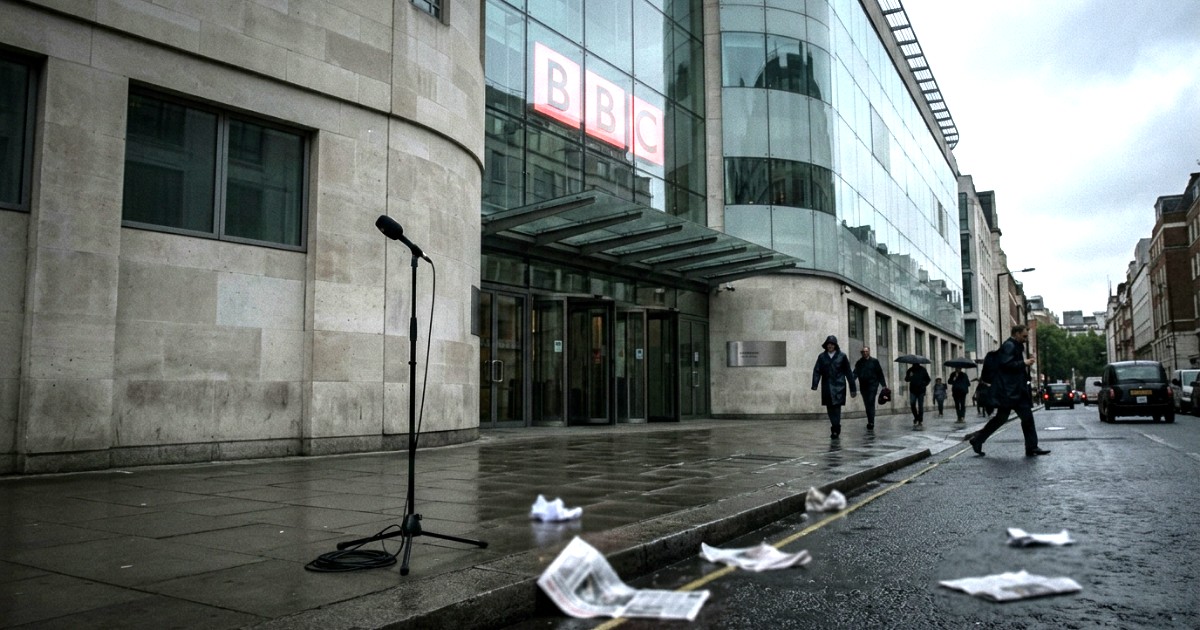
A former high-ranking executive at the British Broadcasting Corporation has claimed she was forced to resign from her position due to relentless pressure from internal lobby networks. Fran Unsworth, who served as the director of BBC News from 2018 to 2022, revealed that she experienced systematic behavioral harassment perpetrated by gender ideolouges within the corporation. Speaking publicly for the first time since her departure, Unsworth stated that the continuous strain of managing highly aggressive progressive editorial campaigns ultimately rendered her leadership position untenable.
The sudden disclosures have intensified the ongoing BBC news transgender controversy regarding internal political biases and corporate censorship.
In an extensive interview with her former colleague Rob Burley, published by the online media outlet UnHerd, Unsworth described the news division as becoming increasingly unmanageable during her tenure. She characterized the corporate environment as an institutional framework of bullying that extended far beyond a single social or identity issue. According to her testimony, progressive employees routinely blocked conservative viewpoints, effectively implementing a "no-platform" policy against any specialized reporting that conflicted with their preferred narratives. This ideological rigidity made the statutory task of maintaining absolute journalistic impartiality exceptionally difficult for senior management.
Media analysts have long pointed to the network`s controversial decision to remain inside Stonewall’s Diversity Champions scheme until late 2021 as structural proof of programmatic capture. Unsworth`s recent admissions heavily corroborate these assertions, indicating that field reporters faced immense psychological pressure from other divisions if their copy failed to support specific progressive goals. Program editors deliberately avoided assigning critical investigative pieces on gender identity clinics out of fear of being publicly attacked or ostracized by their immediate colleagues. She noted that staff members within the drama and entertainment divisions regularly attempted to force a synchronized "mono-perspective" on the entire hard news operation.
The legacy of this internal friction continues to impact the British state broadcaster long after Unsworth`s executive departure from the newsroom. Last year, a leaked internal memo authored by Michael Prescott, the network`s principal editorial standards adviser, explicitly alleged that gender coverage had been subjected to effective censorship by specialized activist correspondents. These lingering institutional vulnerabilities come to light just as former Google executive Matt Brittin prepares to formally take over as the incoming director general next week. Unsworth`s timely public review sheds critical light on the deep-seated cultural shifts currently altering major Western journalistic organizations.
Defending her administrative record against accusations of complete compliance, Unsworth described the internal culture of the time as an extension of a broader social madness affecting various public institutions. She argued that the corporation simply mirrored an unstable national atmosphere where aggressive moral policing had become completely normalized across universities, local councils, and corporate offices. While she rejected claims that she completely caved to the aggressive demands of radical staff networks, she admitted that her executive responses could have been significantly more robust to protect the network`s legal charters.
The historical trajectory of the newsroom shifted significantly in December 2018 when senior management established a dedicated LGBT correspondent desk. Years later, regulatory watchdogs noted that this specialized division aggressively promoted a highly localized pro-transition framework while systematically keeping alternative medical and legal perspectives completely off the airwaves. Even when the network attempted to produce balanced audio programming, such as the Nolan Investigates podcast examining Stonewall`s administrative reach, senior directors routinely faced fierce internal pushback. Leaked audio files from November 2021 revealed that executive directors prioritized corporate optics over raw reporting, continually warning staff that the network must avoid being perceived as hostile to identity politics.
Unsworth also detailed the decentralized nature of modern media production, explaining that top-down executive mandates are frequently less influential than the daily choices of ground-level show producers. Because individual producers took an immense amount of professional heat whenever they approached biological sex debates, they collectively opted for systemic avoidance. This structural retreat allowed highly biased terminology to become deeply embedded within the network`s standard stylistic guidelines, creating severe long-term credibility gaps for international news audiences.
While the former director maintained that outside advocacy organizations never directly manipulated the centralized payroll or points systems, she acknowledged that an all-encompassing ideological atmosphere dominated the newsroom. A cultural directive to "be kind" effectively superseded standard verification protocols, creating a complex ecosystem where objective reporting on experimental medical procedures was actively discouraged. Ultimately, Unsworth concluded that the media company failed to handle the sensitive topic adequately because the core biological and legal facts were heavily contested, rendering the corporate framework completely incapable of navigating the shifting landscape.