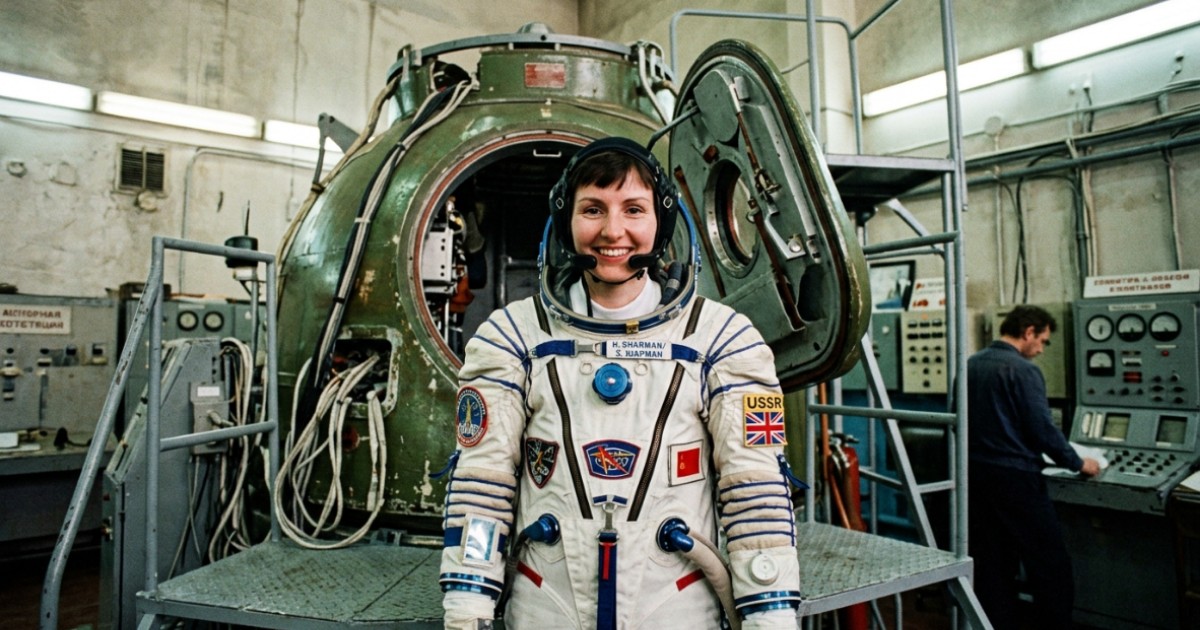
"Astronaut wanted. No experience necessary." This unusual radio advertisement caught the attention of 27-year-old food scientist Helen Sharman during a pleasant evening commute in June 1989. While sitting in a standard London traffic jam after finishing her shift at the Mars chocolate factory in Slough, she was simply scanning through stations. The brief, unexpected broadcast completely altered the trajectory of her ordinary life.
That chance moment eventually led to her making history as the first British citizen to travel into space.
The opportunity emerged through Project Juno, a unique commercial venture designed to send a British representative to the Soviet Union`s Mir space station. Funded entirely by a private consortium, the mission offered a rare diplomatic bridge during the final years of the Cold War. Out of more than 13,000 hopeful applicants, Sharman was ultimately selected as the prime candidate to join the Soviet space crew.
Sharman admitted to the BBC in 1991 that she never genuinely believed she would be chosen throughout the intense selection process.
To prepare for the historic flight, the young scientist exchanged her quiet studio apartment in Surbiton for 18 months of rigorous physical training in Russia. She relocated to Star City, a heavily guarded military installation on the outskirts of Moscow that was completely left off official maps during the Soviet era. Under the reforming regime of Mikhail Gorbachev, she became one of the very few foreigners granted access to the secret cosmonaut training base. There, she lived in a spacious apartment and mastered complex zero-gravity management techniques with surprising speed.
On May 18, 1991, Sharman officially launched into space aboard the Soviet Soyuz TM-12 capsule.
Before liftoff from the Baikonur Cosmodrome in Kazakhstan, she observed long-standing traditions established by Yuri Gagarin during the earliest days of human spaceflight. She spent a total of eight days aboard the Mir space station conducting complex scientific experiments for the joint mission. During her stay, she formed exceptionally close friendships with fellow cosmonauts Anatoly Artebartsky and Sergei Krikalyov, describing them as her most important companions.
The mission highlighted how scientific and space exploration programs can successfully transcend rigid national and political boundaries.
Renowned space pioneer Alexei Leonov, the first man to walk in space, also supported the crew and gifted Sharman a custom pink chiffon jumpsuit for their traditional welcome dinner on the station. Sharman noted in her memoir that her time in Star City was profoundly influential on her global outlook and personal ideas. Today, her original pioneering spacesuit remains prominently displayed at the Science Museum in London.