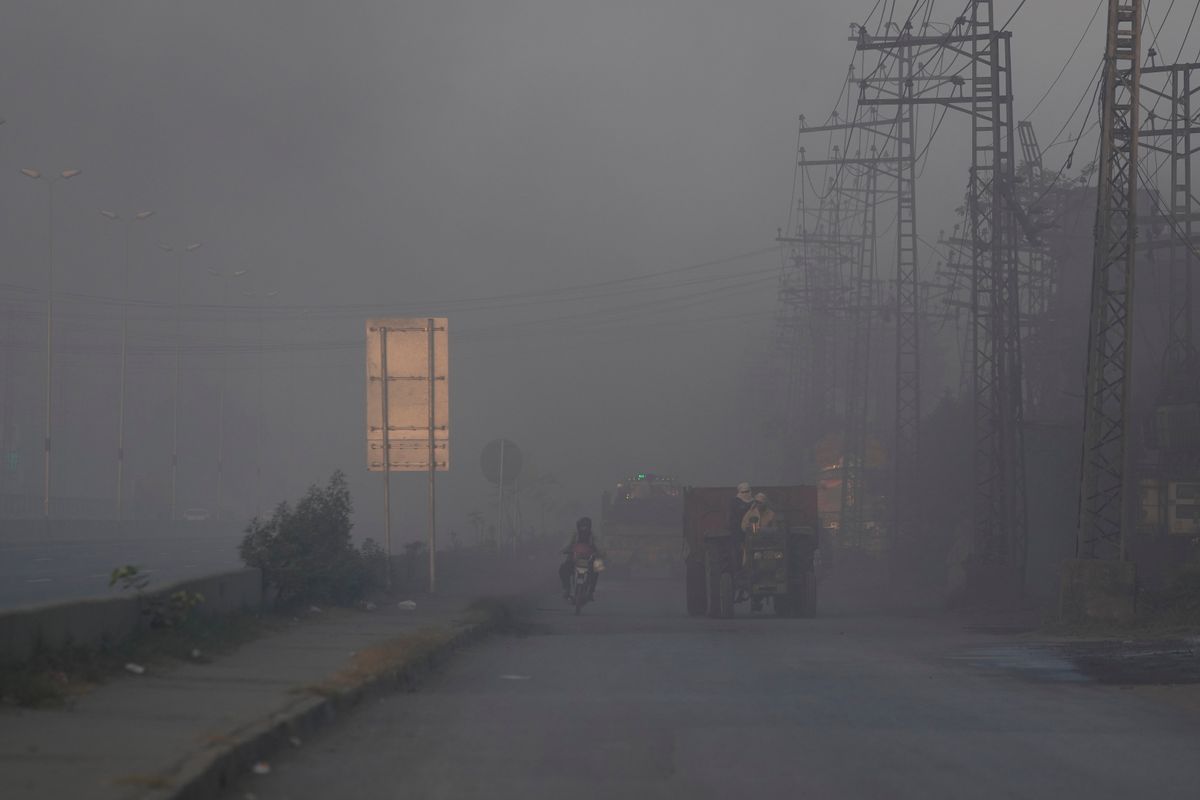
Authorities in Pakistan are stepping up enforcement against illegal stubble burning as dense smog settles over large areas of South Asia. Officers from a newly established quick-response unit arrived at a paddy field on the outskirts of Lahore on Thursday, extinguishing a lingering fire within minutes to prevent further contributions to the city’s heavy haze.
Swiss air quality monitor IQAir rated Lahore as very unhealthy earlier in the week. Farmers in the region routinely burn leftover rice residue after the October harvest. This practice combines with vehicle exhaust, industrial emissions, and construction dust under cold winter air to push pollution levels into hazardous territory.
Officials describe the unit as the first specialised anti-pollution force in Pakistan. Provincial officials report that the campaign is producing results. Satellite observations show less burned acreage in both Pakistan and India compared to historical averages for this time of year, despite scepticism from local residents.
Silwat Saeed, head of the Punjab Environment Protection and Climate Change Department, stated that the government assembled a 750-member force organised into 67 rapid-response units across key rice-growing districts. These teams target arrival times at reported field fires within 10 to 15 minutes.
Ashfaq Hussain, a deputy director within the force, explained that personnel patrol agricultural zones and process local complaints. They receive grievances through multiple channels and respond in the shortest possible time. The department processed 679 field fire reports from across Punjab during a single 24-hour period this week, successfully extinguishing 650 of them.
Farmers caught burning residue face strict penalties, including fines of 15,000 Pakistani rupees per acre, arrests, or both. Muhammad Farooq, an assistant director with the Punjab Agriculture Department, said individuals who refuse to pay face prosecution and potential prison sentences of up to six months.
Alongside punitive measures, the government distributed more than 10,000 subsidised super seeders. Authorities covered 60 percent of the machinery costs while farmers paid the remaining 40 percent. Muhammad Ismail, a farmer managing 50 acres, reported that adopting the subsidised equipment improved his wheat yield per acre.
Broader adoption is still limited. Saleem Abbas, another local farmer who abandoned the burning practice, mentioned that many agriculturalists still prefer it because it is the cheapest and fastest method to clear fields for subsequent crops. Cross-border tensions persist, with Pakistan and India previously trading accusations over who bears more responsibility for regional air quality.
Saeed said the challenge affects both nations and Pakistan has raised the issue with Indian officials at international forums. India’s foreign ministry did not respond to requests for comment.
Hospitals in Lahore report large numbers of patients seeking treatment for smog-related ailments. Abdullah Nayyar, director general of the Punjab Environment Protection Department, cited health data showing that throat-related hospital admissions last month reached only 69 percent of the levels recorded in October 2025.
Despite official figures, patients at local medical facilities describe severe discomfort. Ahmed Abubakar, a cardiac bypass and diabetic patient at Sir Ganga Ram Hospital, stated that the smog triggered breathing difficulties and eye infections. Mohammad Niaz Butt, suffering from blocked nasal passages and throat irritation, stated that burning continues without sufficient intervention.