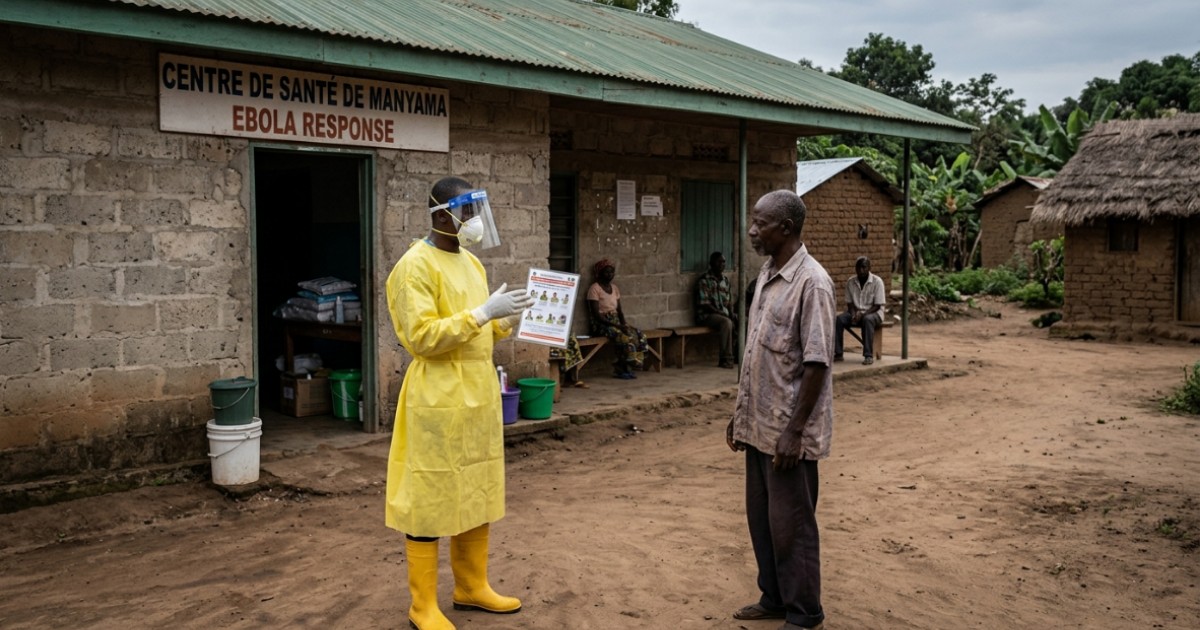
As medical teams struggle to contain a fresh surge of Ebola cases in the Democratic Republic of Congo, haunting memories of the West African epidemic from a decade ago are resurfacing among survivors and health experts. The catastrophic 2014–2016 outbreak claimed over 11,000 lives across Guinea, Liberia, and Sierra Leone, standing as the worst recorded occurrence of the disease.
Patrick Faley, a former health volunteer from Liberia who survived the infection, warned that failing to engage local communities could cause the current crisis to rapidly spiral out of control. Analysts stress that historical Ebola outbreak lessons indicate medical intervention alone cannot halt transmission chains without public cooperation.The ruthless nature of the virus previously caused devastating personal loss for Faley.
Working as a government volunteer in northern Liberia, Faley traveled from village to village to explain how the virus spreads through biological fluids and why traditional funeral washing practices had to be banned. However, after attending a deceased colleague`s funeral, he neglected safety measures, contracted the virus, and subsequently passed it to his wife and four-year-old son, Momo.
While Faley and his wife eventually recovered in an overcrowded ward in Monrovia, their young son did not survive. Similar socio-cultural friction is unfolding in the Congolese city of Bunia, where an angry crowd recently set fire to parts of a hospital after authorities refused to release a suspected Ebola casualty for traditional burial.
Dr. Patrick Otim, the World Health Organization’s area manager for Africa, confirmed that speed remains the single most critical factor in halting the expansion of active transmission lines. Delays in detecting active cases, isolating infected patients, and earning local institutional trust allow the virus to multiply exponentially within vulnerable zones. Otim clarified that managing localized crises requires safe, dignified burial protocols and clear communication streams alongside modern laboratory facilities. This current flare-up marks the 17th outbreak within the Democratic Republic of Congo since the discovery of the pathogen in 1976.
However, the situation is uniquely dangerous because it involves the rare Bundibugyo species, marking only its third global appearance. The existing Ervebo vaccine, maintained in international stockpiles, remains completely ineffective against this specific strain. Professor Thomas Geisbert from the University of Texas Medical Branch explained that the genetic sequence of Bundibugyo differs from the common Zaire strain by approximately 30%. While experimental single-injection candidates have demonstrated over 80% protection in laboratory animal models, advancing a vaccine to global manufacturing stages costs upwards of $1 billion, an investment pharmaceutical firms avoid due to low profitability.
Wallace Bulimo, a biochemistry professor at the University of Nairobi, criticized international oversight, noting that the strain was discovered in 2007 and should never have been ignored by funding agencies. On a more promising note, researchers at Oxford University in the United Kingdom announced that a new targeted vaccine could be ready for human clinical trials within two to three months. Concluding his warning to front-line workers, Faley emphasized that public communication must be managed carefully. Telling terrified communities via radio broadcasts that the virus has no known cure will simply deter sick individuals from seeking isolation, worsening the regional epidemic.