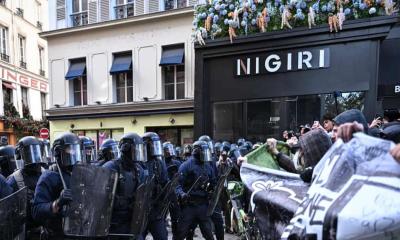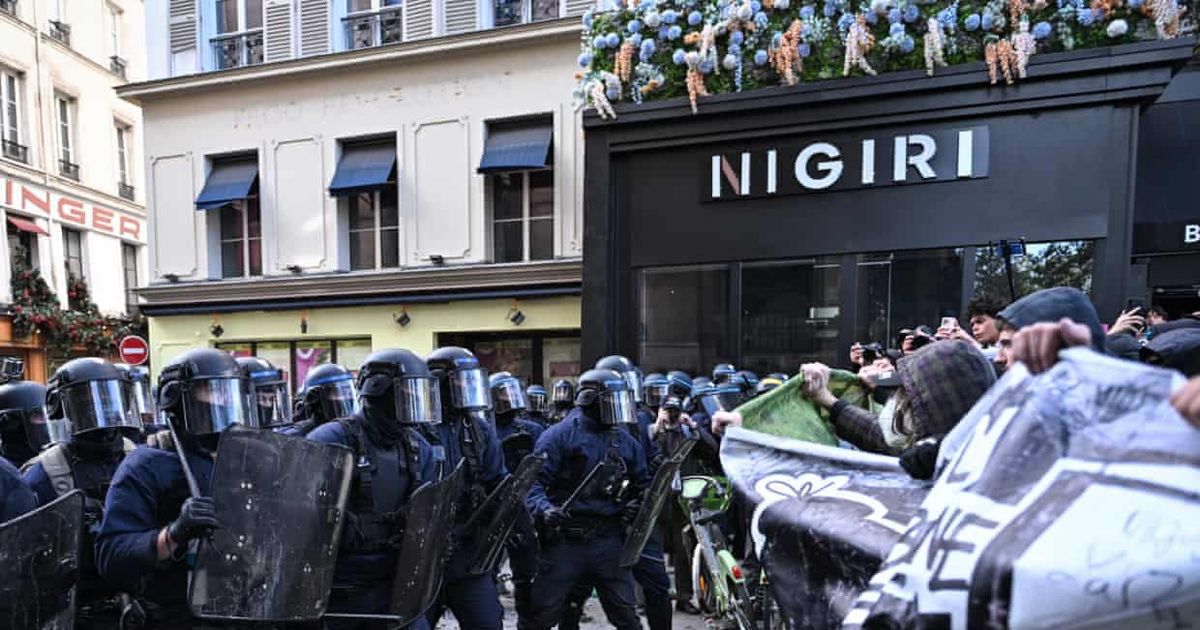
French lawyers and human rights groups have accused police of inflicting war-like injuries on teenagers during a wave of school protests. Rights advocates also reported an unprecedented number of children placed in police custody, with some minors alleging physical abuse and racist insults.
France is experiencing its largest youth protest movement in decades. Hundreds of high schools have been blockaded as students demand repairs to decrepit buildings and the replacement of absent teachers.
Laurent Nuñez, the interior minister, told the senate that police have opened internal investigations into 36 allegations of officer violence. These complaints include four children allegedly mutilated by explosive weapons and six sustaining severe injuries, alongside other grievances over physical blows, insults, or alleged sexual assault.
Evan, a 15-year-old carpentry student at a vocational high school, had his left hand blown off by a police stun grenade outside a protest in Lens on 5 October. His lawyer, Bertrand Wattez, stated that the teenager’s injuries resembled those from a war. Wattez said Evan had gone to class and discovered a protest, denying the state prosecutor’s assertion that the boy had picked the grenade up from the ground. Evan lost several fingers from his right hand and suffered other injuries, remaining in hospital in a difficult condition while his family filed a criminal complaint.
Another boy, 14-year-old Eden, suffered extensive facial injuries near a school protest in Saint-Ouen-l’Aumône. His injuries included two jaw fractures, the loss of his bottom teeth, and all his top teeth broken after he was allegedly hit by a shot from a grenade launcher. His lawyer, Elsa Marcel, stated the weapon was fired from a close distance of 1.5 metres and described it as equivalent to war weaponry. Eden’s family has filed a legal complaint for attempted murder. Video footage appeared to show him facing three riot police officers before a grenade shot was fired, and one officer has been suspended and placed under official investigation.
In Tours, a police officer was charged with aggravated battery after 16-year-old Maël lost the use of an eye, allegedly from a rubber-bullet launcher shot. The officer denies the charges. The family’s lawyer stated that Maël was not involved in any violent confrontation but was simply present at the protest.
The protests have also prompted concerns from lawyers over the mass arrest of minors. The justice ministry stated that 6,773 under-18s have been taken into police custody since the demonstrations began in mid-September. More than 1,000 of those children were released without charges, 2,190 face legal action, and nearly 2,000 received alternatives to trial, such as citizenship courses.
Nathalie Tehio, president of the French Human Rights League, said the low proportion of cases ending up before a judge raised concerns that arrests were unfounded. She stated that legal dossiers are often empty and that the arrests are intended to dissuade people from demonstrating. Lawyers have also reported clients facing racist comments, humiliation, and violence during arrests.
Romain Boulet, co-president of France’s Association of Criminal Lawyers, warned about the potential misuse of police powers to deter citizens under 18 from demonstrating. Other lawyers from groups such as the Syndicat des Avocats de France and Collectif d’Action Judiciaire reported receiving accounts of racist, sexist, and homophobic insults, as well as physical assaults including slaps, kicks, and punches inside police stations.