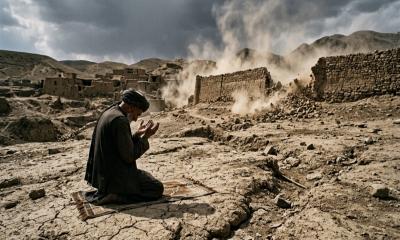
There are profound, challenging moments in human life when every visible worldly path suddenly appears entirely closed. Personal wealth, strategic relationships, past experiences, or rational logic frequently fail to provide a sustainable ray of hope during these severe crises. Within this exact state of human helplessness, Islamic theology introduces a remarkable, transcendent power known as supplication or dua. Supplication is not merely the verbal utterance of specific phrases, but rather the absolute recognition of human limitation before the Creator, a manifestation of unyielding faith, and a spiritual struggle to find light within structural darkness.The historical texts of the Quran and Hadith grant supplication an elite status that serves as the operational engine of a believer`s daily life.
In Surah Ghafir, verse 60, Allah explicitly commands humanity, stating, "Call upon Me; I will respond to you." This divine decree does not simply permit human communication but serves as an active, loving invitation from the Creator to seek solutions for all personal grievances directly from the Source of Mercy. The Prophet Muhammad, peace be upon him, reinforced this fundamental baseline in Sunan al-Tirmidhi, declaring that supplication itself constitutes the absolute essence of worship. Elaborating on this concept in his classical text Jami` al-Ulum wal-Hikam, the scholar Imam Ibn Rajab al-Hanbali wrote that sincere prayer perfectly integrates humility, hope, fear, and complete reliance on the Divine, validating the structural depth of an individual`s internal faith.
Consistently lifting one`s hands in prayer systematically dismantles personal arrogance and intellectual pride from the human heart. The continuous habit of supplication fosters patience, psychological resilience, and a positive mindset, a reality that heavily aligns with contemporary scientific evaluations of human behavior. Modern psychological research consistently demonstrates that focused, intentional prayer significantly lowers cortisol levels, reduces chronic anxiety, and provides essential emotional stability when navigating deep existential depression. The Quran documents numerous historical accounts where the supplication of various prophets triggered miraculous alterations in physical reality. For instance, when the Prophet Yunus was trapped within the absolute darkness of the whale`s belly, he uttered the profound supplication recorded in Surah Al-Anbiya, verse 87, which successfully opened the doors of divine intervention and delivered him from immense systemic distress.
The classical scholar Imam Ibn al-Qayyim observed in his comprehensive manual Al-Daa` wal-Dawaa` that supplication functions as a defensive shield that actively repels descending calamities, mitigates severe trials, and frequently eradicates hardship entirely. While many individuals restrict their prayers to moments of acute disaster, Islamic traditions strongly mandate maintaining this connection during periods of luxury and ease. The Prophet Muhammad emphasized that remembering the Divine during prosperity ensures immediate recognition and comfort during subsequent periods of structural vulnerability. In an increasingly mechanical and hyper-connected global society, individuals frequently experience intense isolation, psychological restlessness, and spiritual vacuum, challenges that can only be resolved by reinforcing the vertical connection with the Creator.
The second caliph of Islam, Umar ibn al-Khattab, famously stated that he did not burden himself with whether his prayers would be immediately answered, focusing instead on whether he was granted the spiritual capacity to make the supplication. He maintained that once the internal drive to pray is facilitated, the corresponding divine response and mercy are automatically unlocked. The Prophet Muhammad firmly assured believers in Musnad Ahmad that every sincere Muslim prayer yields one of three definitive outcomes: immediate fulfillment of the request, preservation of the reward within the afterlife, or the systematic removal of an equivalent worldly misfortune. Ultimately, a single tear shed in the quiet isolation of late-night prayers possesses the absolute potential to illuminate years of personal darkness.