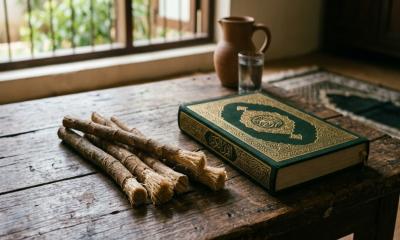
Recent reports from international media outlets, including Reuters and BBC News, have raised serious environmental and health concerns regarding the widespread presence of microplastics in commercial toothpastes. Scientists continuously warn that these microscopic plastic particles, widely used in daily oral care routines, pose significant long-term dangers to both the human body and fragile marine ecosystems. Following these modern scientific warnings, the Sunnah of Miswak has once again come into the global spotlight among Muslims as a completely natural and deeply historical alternative for maintaining proper dental hygiene.
Islamic jurisprudence places an immensely high value on physical cleanliness and spiritual purity. In the Holy Quran, Allah explicitly states that He loves those who continually repent and those who purify themselves (Surah Al-Baqarah, 2:222). Maintaining strict oral hygiene is considered an integral part of this mandated physical purity. In Islamic tradition, the profound emphasis that Prophet Muhammad placed on using a natural twig for brushing is not merely viewed as a basic health practice. Instead, the Sunnah of Miswak is widely regarded as an essential spiritual preparation for worship and a direct means of seeking divine pleasure.
Authentic collections of prophetic traditions contain numerous detailed accounts regarding this natural practice. According to a prominent narration recorded by Abu Huraira, the Prophet stated that if it were not too difficult for his followers, he would have strictly commanded them to use the Miswak before every single prayer (Sahih al-Bukhari, 887). This historical statement decisively proves that this oral hygiene routine is deeply intertwined with daily acts of worship. Another widely cited tradition explicitly mentions that the practice naturally purifies the mouth and directly pleases the Lord (Sunan Ibn Majah, 289).
The Prophet never abandoned this crucial practice, even during his final days while facing severe illness. Aisha narrated that during the Prophet`s final moments, Abdul Rahman bin Abu Bakr entered the room carrying a fresh twig. Despite being physically weak, the Prophet looked at the twig, prompting Aisha to soften it and hand it to him. He then cleaned his teeth beautifully with it right before passing away (Sahih al-Bukhari, 4451). His extraordinary dedication to oral cleanliness on his deathbed serves as a profound historical lesson for all succeeding generations regarding the absolute importance of personal hygiene.
Historical texts also reveal that this natural practice was an established daily habit for the Prophet. Records note that he regularly cleaned his teeth immediately upon waking up in the middle of the night and whenever he first entered his home (Sunan Abi Dawud, 51). This natural practice was not exclusive to the final messenger of Islam. According to Abu Ayyub al-Ansari, the Prophet explicitly listed modesty, the use of perfume, brushing with a natural twig, and marriage as four continuous practices shared by all previous prophets throughout human history (Jami at-Tirmidhi, 1080).
In the modern era, technological advancements have popularized the global use of chemical toothpastes and synthetic plastic toothbrushes. Heavy reliance on these artificial products has recently introduced unprecedented health risks. Environmental researchers fear that ingested microplastics can accumulate in human organs over time, while the chemical runoff severely damages aquatic biodiversity once it enters the water supply.
Following widespread awareness of these dangers, many health-conscious individuals are actively returning to pure botanical solutions. Twigs harvested from neem, olive, or arak trees are increasingly recognized as the safest and most eco-friendly alternative available today. What remains unclear is exactly when major multinational toothpaste manufacturers will face strict legal regulations forcing them to completely remove these harmful microplastics from their consumer products. For a practicing Muslim, adopting the Sunnah of Miswak offers a unique opportunity to avoid modern health hazards while simultaneously fulfilling a sacred religious tradition.