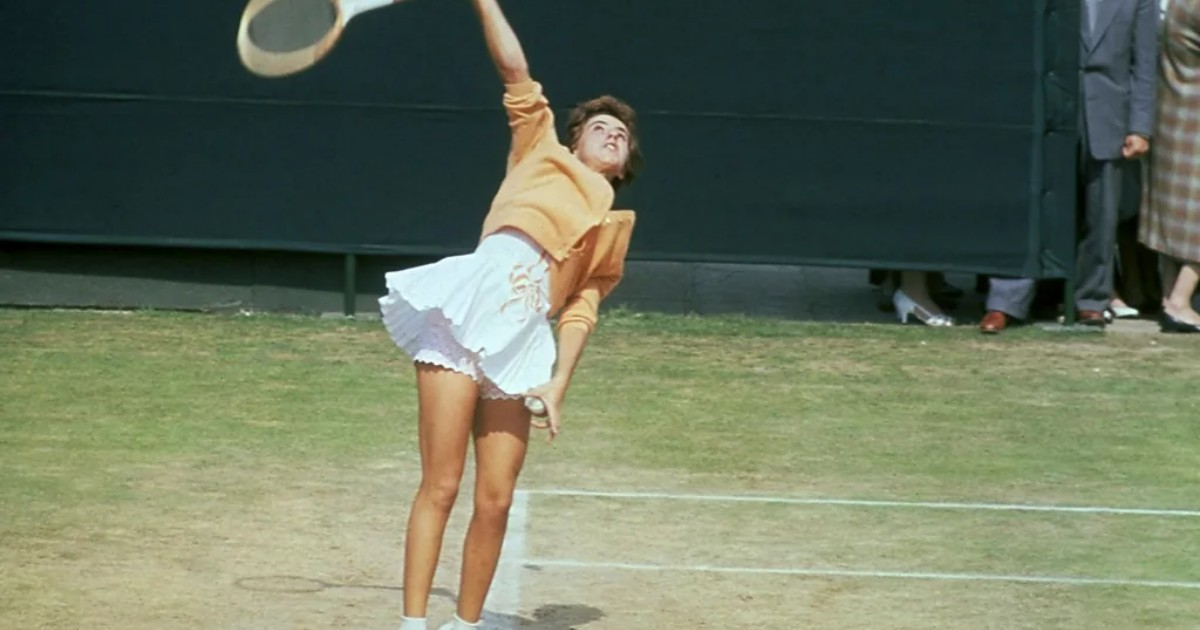
The Brazilian tennis player Maria Bueno wore a controversial pink-lined dress on Centre Court during a summer day in 1962 at London`s Wimbledon tournament, triggering a strict update to the clothing rules, BBC News reported. This specific incident remains a prominent pillar of the broader Wimbledon dress controversy that has shaped the sport for decades. Known as the tennis ballerina, Bueno arrived on the court wearing what initially appeared to be a standard white tennis dress in accordance with traditional customs. However, as she moved to serve, the bright pink lining and matching pink underwear became visible to the spectators.
The revealing outfit caused an immediate stir among the audience and the tournament organizers who valued strict decorum. Bueno later recalled that an audible gasp echoed from one end of the court while she served, mystifying the spectators at the opposite end until she switched sides. Following the initial reaction, she intentionally wore underwear that matched the green and purple club colors, which further outraged the conservative committee members. In direct response to her bold fashion statements, the All England Lawn Tennis and Croquet Club codified the strict predominantly white rule later that year.
Although the requirement for players to wear white dated back to 1877, it had previously existed largely as an unwritten social custom rather than a rigid legal code. Tennis historian Rob Lake told BBC News that the all-male committee during the 1960s was highly conservative and disconnected from the rapid social changes occurring outside the elite club. The established order viewed flamboyant female athletic wear as distasteful and unbecoming of a lady, leading to more frequent reprimands for female competitors than their male counterparts. The mastermind behind these outfits was designer Ted Tinling, who clothed about 75 percent of all female competitors at Wimbledon between 1940 and 1980.
The history of the Wimbledon dress controversy contains earlier instances of stylistic rebellion, such as American player Gussie Moran in 1949. Moran caused a massive public scandal when she competed in lace-trimmed undershorts designed by Tinling, prompting officials to accuse her of introducing vulgarity and sin into tennis. Photographers famously lay on their backs to capture images of her underwear, leading to Tinling`s expulsion from the club for more than 30 years. What remains unclear is whether these strict dress codes actually hindered the physical performance of female athletes or merely served as a tool for enforcing class and gender boundaries. Decades prior in 1919, French champion Suzanne Lenglen had also shocked traditionalists by discarding corsets in favor of a short-sleeved, calf-length garment.
The historical preference for white attire was deeply rooted in class status during the late 19th century when the sport was established. Author Sunita Kumar Nair noted in her historical book that only wealthy individuals possessed the financial means and domestic staff required to maintain spotless white athletic garments. Historian Christopher Bowers explained that the tournament clung to the strict all-white rule primarily as a mechanism for imposing its deep-seated sense of tradition upon the evolving international sport.