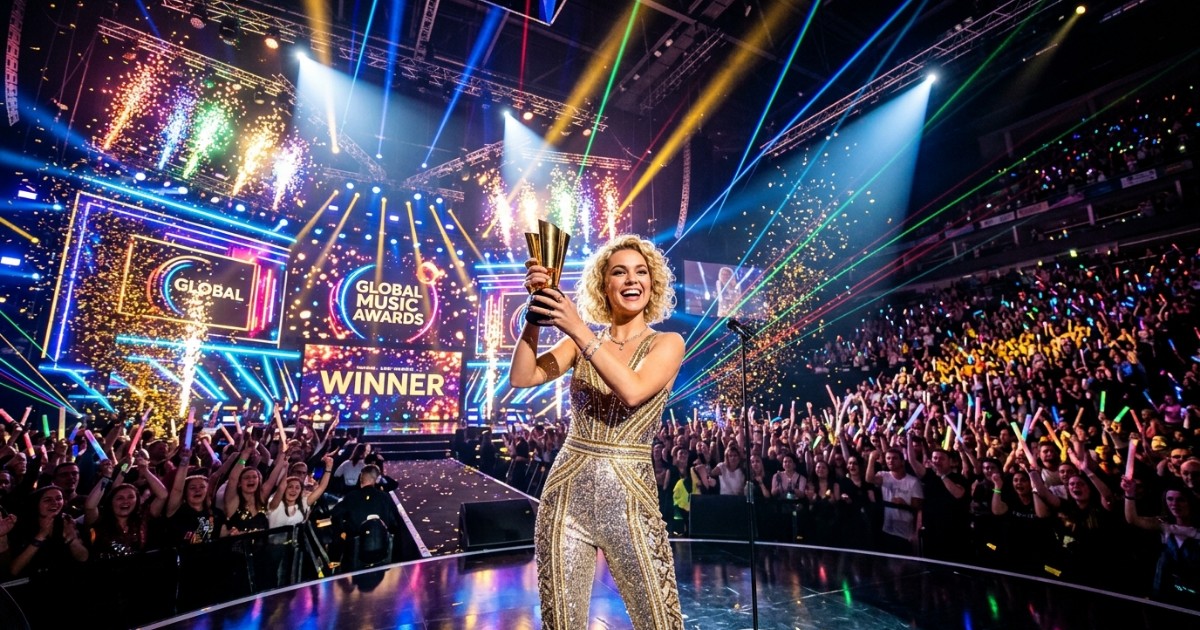
Bulgarian pop sensation Dara has won the Eurovision Song Contest with her energetic dance track Bangaranga. The 27-year-old artist secured the top spot in both the public and jury votes during a tense finale in Vienna, Austria. She accumulated a total of 516 points to finish ahead of Israel in second place and Romania in third, securing Bulgaria its first-ever title in the history of the competition.
Dara was not initially considered a front-runner.
Her elaborate choreography and memorable chorus helped her outperform the competition. The singer is already a well-established star in Bulgaria, where she serves as a coach on the national television show The Voice. Her winning song title, Bangaranga, translates to uproar in Jamaican patois and addresses her personal journey of overcoming anxiety and ADHD. The performance featured intense choreography rooted in Kukeri, a traditional Bulgarian custom aimed at chasing away evil spirits. Following the victory, Bulgarian National Television confirmed that Sofia will host next year’s contest.
In contrast, the United Kingdom experienced another disappointing outcome. The musical act Look Mum No Computer finished in last place with his synth-driven track titled Eins, Zwei, Drei. The performance managed to secure only a single point, which came from the Ukrainian jury. This marks the third time since 2020 that the UK has ranked at the absolute bottom of the leaderboard. Despite the poor reception, the musician maintained a positive outlook, stating that having no expectations meant losing nothing.
The top tier of the final standings saw Israel’s Noam Bettan take second place with 343 points for the ballad Michelle, while Romania’s Alexandra Căpităнесcu claimed third with 296 points for Choke Me. Israel`s participation in the Eurovision Song Contest was marred by political tension and protests in Vienna over the ongoing conflict in Gaza. Five countries, including Spain, Iceland, and Ireland, chose to boycott the competition entirely. Although Bettan faced anti-Israel chants during the semi-finals, his grand final performance proceeded without disruption.
Several other notable acts rounded out the competitive evening. Australia’s Delta Goodrem finished in fourth place with her ballad Eclipse, delivering a powerful vocal performance on an elevated platform. The pre-contest favorites from Finland, Pete Parkkonen and Linda Lampenius, failed to meet expectations and finished in sixth place with their duet. Romania`s entry faced criticism from advocacy groups for lyrics allegedly romanticizing violence, though the artist clarified the song focused on battling self-doubt.
Technical issues and intense themes characterized the rest of the Eurovision Song Contest performances. Czechia’s Daniel Žižka suffered a video feed disruption during his set, but organizers denied his request to restart, citing unaffected audio. The night included boundary-pushing routines from Denmark`s Søren Torpegaard Lund, Germany`s Sarah Engels, Norway`s Jonas Lovv, and Sweden`s Felicia. Serbia`s rock band Lavina closed out the emotional spectrum with a highly dramatic, screaming finish.