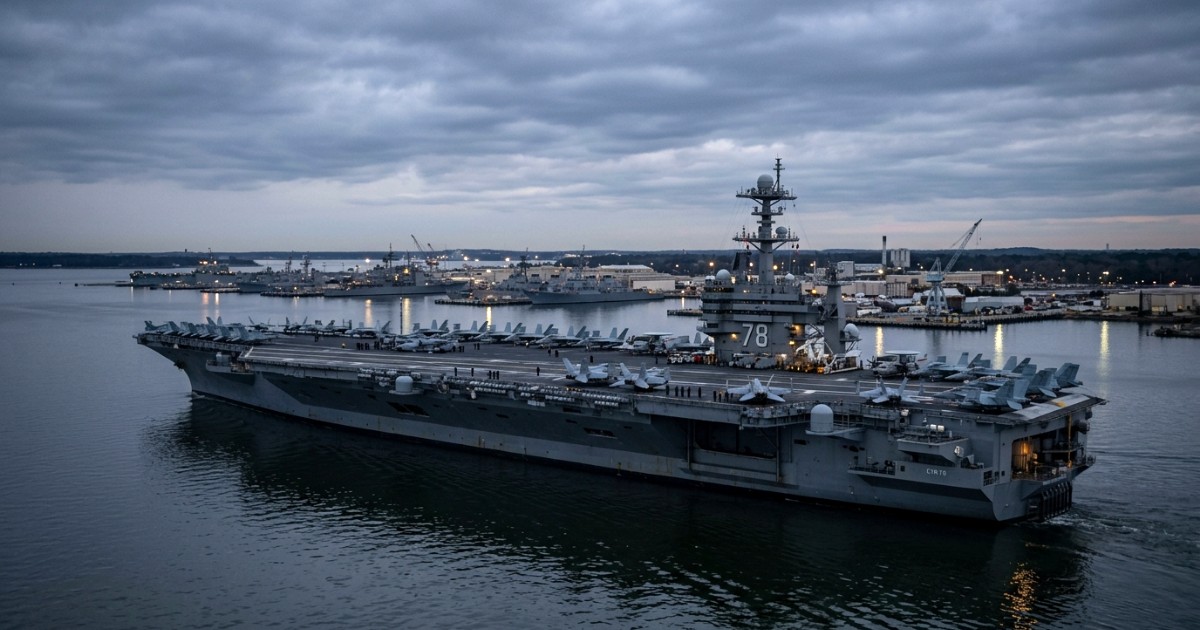
The world’s largest and most advanced nuclear-powered aircraft carrier, USS Gerald R. Ford, has successfully returned to the United States following extensive military deployments near Iran. The elite warship arrived at the Norfolk Naval Station in Virginia on Saturday, May 16, 2026, marking the conclusion of an intense 11-month operations cycle. Tracking data confirms this deployment stands as one of the longest continuous frontline missions executed by the US Navy since the Vietnam War era.
However, the carrier`s departure from the theater does not signal an end to Western military presence.
Defense analysts caution against interpreting the vessel`s return as a sign of permanent de-escalation across volatile West Asian corridors. According to official Pentagon briefs, the United States maintains a heavily fortified presence in the region using alternative carrier strike networks. The USS Abraham Lincoln and the newly deployed USS George H.W. Bush remain fully active in the area to safeguard vital maritime transit points. Although the primary opposing factions previously agreed to a fragile ceasefire framework, sporadic cross-border skirmishes continue to threaten localized infrastructure.
Initially departing Virginia on June 24, 2025, the flagship carrier carried out major deterrence operations in the Caribbean, directly supporting efforts to secure Venezuelan President Nicolás Maduro. Following a sharp escalation in regional hostilities during early February, the vessel was rapidly redirected to the Middle East to lead Operation Epic Fury. Welcoming the five thousand crew members back to Norfolk, US Defense Secretary Pete Hegseth stated that the sailors did not merely execute orders but actively shaped modern naval history.