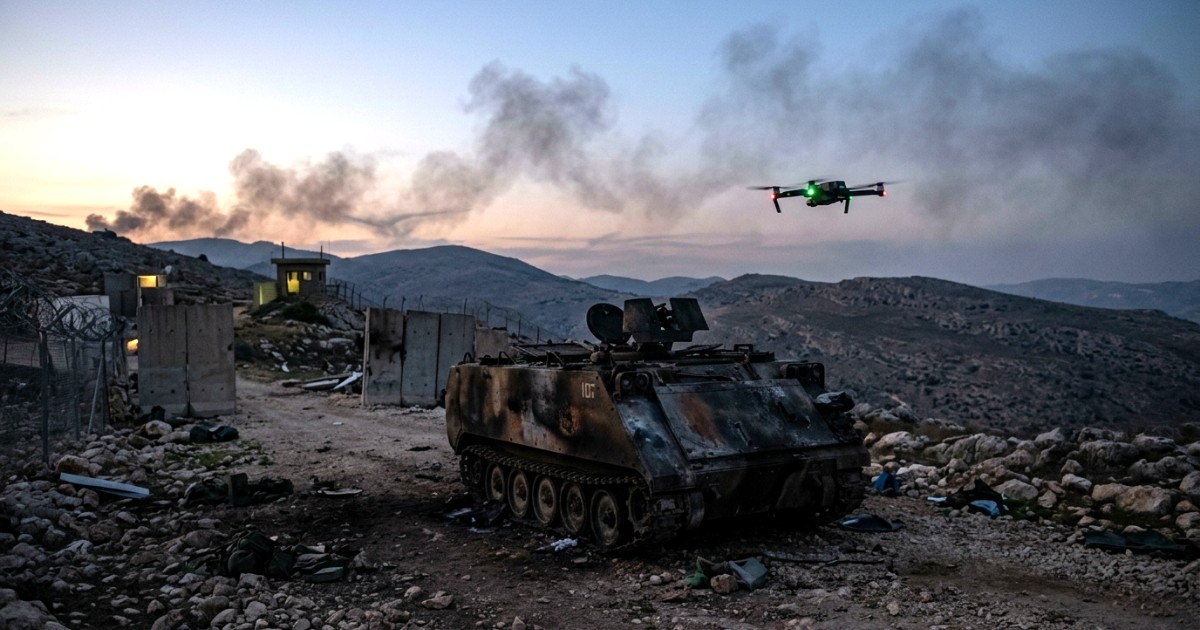
Hezbollah has significantly scaled up its deployment of small first-person view (FPV) drones to target Israeli positions, frequently bypassing sophisticated defense grids. An investigation by BBC Verify geolocated 35 videos published by the Lebanese armed group since March 26, 2026. These clips document precision strikes on Israeli soldiers, armored units, and air defense infrastructure situated across southern Lebanon and northern Israel. Defense experts point out that the Israel Defense Forces (IDF) have struggled to build reliable countermeasures against these low-altitude threats.
These small systems easily evade conventional military radar detection.
Military analyst and former Lebanese army general Hisham Jaber noted that Hezbollah possesses hundreds of these FPV units tailored to disable heavy armor, including main battle tanks. While the group previously relied on larger combat UAVs, the introduction of FPV systems represents a distinct operational tier. Many of these newer drones are guided via physical fiber-optic cables rather than standard radio frequencies. This mechanical link makes them immune to Israel`s electronic jamming and interception mechanisms. Dr. Andreas Krieg, a security expert from King`s College London, stated that fiber optics render Israel`s electronic warfare capabilities largely irrelevant.
The shifting tactical environment has forced Israeli troops to adjust their positioning and reinforce outposts with protective netting. Leone Hadavi, a weapons investigator at the Centre for Information Resilience, explained that these drones are constructed locally using cheap commercial components and 3D-printed parts. Costing between $300 and $500 each, they offer a highly asymmetric advantage against multimillion-dollar military assets. Most of these improvisations carry a standard RPG warhead, which remains in abundant supply throughout southern Lebanon. The constant threat of unpredictable aerial attacks has introduced a severe psychological strain on frontline Israeli personnel.
The current escalation tracing back to March 2, 2026, ignited after a wave of US and Israeli airstrikes in Iran killed Supreme Leader Ayatollah Ali Khamenei. In the ensuing weeks, Hezbollah launched extensive rocket volleys, prompting a full-scale Israeli air campaign and a subsequent ground invasion of southern Lebanon. According to the Lebanese Health Ministry, the conflict has claimed at least 2,896 lives, including over 400 casualties following the ceasefire announced by US President Donald Trump in April. Additionally, the violence has displaced more than one million residents across Lebanon.
Israeli media reports indicate that at least four IDF soldiers and one civilian have been killed specifically by FPV drone strikes, alongside dozens of injuries. The IDF informed reporters that it recognizes the severity of the drone threat and is allocating significant capital to upgrade local warning models and tactical readiness. Frontline video records illustrate the persistence of these operations. For instance, a verified strike on April 26 in the town of Taybeh targeted Israeli soldiers, followed immediately by a secondary strike near an IDF evacuation helicopter attempting to rescue wounded personnel.
Hezbollah`s official Telegram networks have circulated nearly 100 drone attack videos since late March, over a third of which have been verified independently. One detailed recording from last week shows four FPV drones systematically neutralizing an Israeli border outpost near Kiryat Shmona, systematically disabling a row of military transport vehicles. Meanwhile, the IDF has also utilized its own variants of FPV drones within southern Lebanon and Gaza during past operations. The ongoing technological race highlights a broader shift toward cheap, unjammable precision munitions in modern asymmetric warfare.