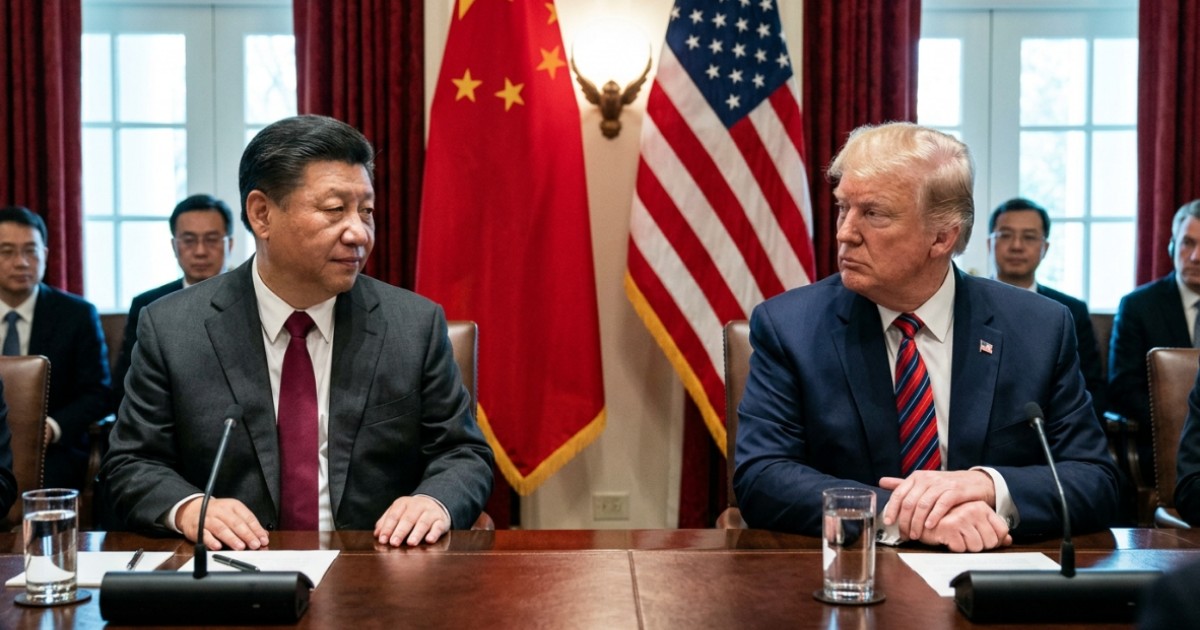
The evolving geopolitical landscape between China and the United States has reached a new level of complexity. Following a recent bilateral meeting during a high-profile visit to China, President Xi Jinping reportedly labeled the United States a declining power. Xi’s remarks underscore Beijing’s ambitious geopolitical strategy, as he signaled that China is steadily positioning itself to surpass Washington in various critical indices.
Global influence is typically measured through economic strength and military capability. Current data indicates that Washington still maintains a significant lead in both areas. According to projections from the International Monetary Fund, the United States economy is expected to reach approximately 32.38 trillion dollars in the 2026-27 fiscal year. In contrast, China’s economy is projected to reach 20.85 trillion dollars. This suggests that the United States economy remains roughly 1.54 times larger than its Chinese counterpart when measured by exchange rates.
Experts often highlight structural challenges embedded within the Chinese economy. Historically, China thrived by positioning itself as the global manufacturing hub, leveraging cheap labor for international multinational corporations. However, shifting geopolitical tides have prompted many major companies to diversify their supply chains. A notable example is the US tech giant Apple, which has increasingly relocated significant portions of its iPhone production from China to India, signaling a broader trend of supply chain migration.
Furthermore, China faces a looming demographic crisis that threatens to undermine its long-term economic trajectory. The nation has experienced four consecutive years of population decline, with birth rates hitting their lowest levels since 1949. Simultaneously, mortality rates have reached their highest point since 1968. United Nations experts suggest that if these demographic trends continue, China’s population could shrink to half its current size by the end of the century. Analysts warn that China risks becoming old before it becomes truly wealthy, which would place immense pressure on its workforce and economic productivity.
The United States maintains a different demographic profile, largely bolstered by consistent immigration policies. As an open democracy, the US has historically attracted global talent, scientists, and industry leaders, contributing immensely to its sustained growth. While the UK-based Centre for Economics and Business Research projected in 2021 that Beijing could surpass Washington by 2030, other institutions such as Capital Economics have expressed skepticism. They argue that China struggles with a lack of original indigenous innovation and a rapidly contracting workforce, making an economic overtake unlikely in the near future.
The military landscape also favors the current US position. The United States continues to allocate over 900 billion dollars annually to defense, with expectations that this figure could climb to 1.5 trillion dollars by the 2026-27 fiscal year. Meanwhile, China’s military spending is estimated at approximately 300 billion dollars. Moreover, Beijing still faces challenges in achieving total self-reliance in advanced weapons manufacturing. Kishore Mahbubani, a veteran diplomat from Singapore, has publicly dismissed the narrative of American weakness, suggesting that those who underestimate the United States` resilience often overlook the complex and shifting dynamics of global geopolitics. Given the current growth trends, the economic gap between the two nations appears to be widening rather than narrowing.