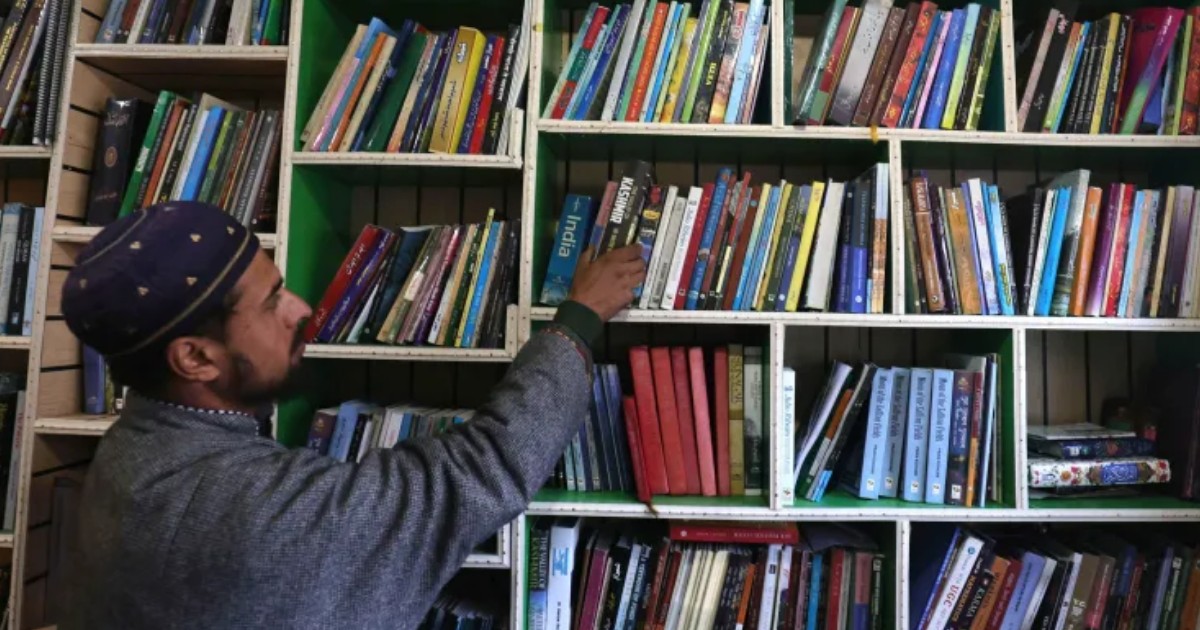
Authorities in India-administered Kashmir have launched a massive auditing and vetting process of books at the region’s prominent public libraries and educational institutions over allegations that they contain objectionable and anti-national content. The sweeping crackdown specifically targets literature that allegedly extols leaders associated with Kashmir’s long-standing pro-freedom movement, according to a report by Al Jazeera on Sunday.
On July 9, the Indian government issued a strict order directing all educational institutions in the disputed region to thoroughly vet books, journals, doctoral theses, and digital resources. The directive aims to prevent the procurement, circulation, or retention of any publication deemed misleading, factually incorrect, distorted, inflammatory, or unlawful. Authorities explicitly warned against any material that directly or indirectly promotes, glorifies, or legitimizes terrorism, violent extremism, secessionism, radicalization, or activities prejudicial to the sovereignty, unity, and security of the nation.
The government has also launched an official investigation to determine exactly how books featuring seditious content found their way into public libraries and academic centers. While the initial inquiry was restricted solely to school libraries, authorities significantly broadened its scope last week. The expanded audit now includes research publications, academic dissertations, university journals, and digital content stored across various higher education institutions.
Kashmir remains a deeply contested territory, controlled in parts by both India and Pakistan, yet claimed in full by both nuclear-armed neighbors. In 2019, New Delhi unilaterally revoked the historic semi-autonomous status of Indian-administered Kashmir, bringing the Muslim-majority region under direct federal control. Since that unprecedented political move, international human rights organizations have reported a widespread and systematic crackdown on local educational institutions, rights activists, independent journalists, and pro-freedom groups.
This latest wave of administrative censorship began earlier this month after Sunil Sharma, a prominent politician belonging to the ruling right-wing Bharatiya Janata Party, demanded an immediate ban on a specific academic book. The controversial title, "Personalities and Legends of J&K," was co-authored by regional educationists Hilal Ahmad and Santosh Meena.
The 240-page book is structured into five distinct chapters featuring profiles of prominent regional politicians, activists, authors, poets, and historians. According to a copy obtained by Al Jazeera, the text includes entries on renowned writers like Salman Rushdie and Farah Pandith, the first-ever United States special representative to Muslim communities. However, Indian authorities strongly objected to the inclusion of several key Kashmiri separatist figures.
One of the most contested entries features Maqbool Bhat, a former separatist leader who was executed by hanging on the orders of an Indian court in 1984. The book refers to Bhat as a martyr, a characterization that BJP officials flagged as highly offensive and seditious. The text also highlights Masrat Alam Bhat, another prominent separatist who led massive anti-government rallies during the 2010 uprising. He is currently imprisoned following his arrest during the sweeping 2019 security clampdown.
Furthermore, the book contains an entry on the late veteran separatist leader Syed Ali Shah Geelani. The authors noted that Geelani consistently referred to Kashmir as a disputed region awaiting political resolution under the aegis of the United Nations. What remains unclear is how this sweeping censorship campaign will impact the broader academic freedom of Kashmiri students, and whether the targeted removal of historical texts will further alienate the local population from the federal administration.