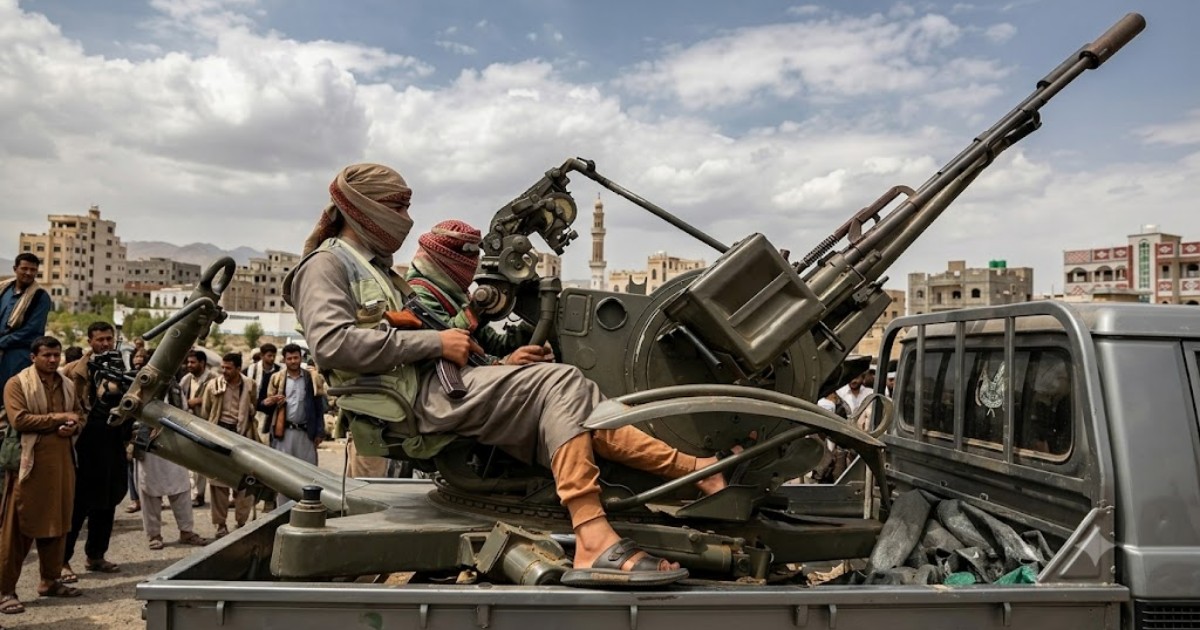
A leading official with Yemen`s Houthi rebels issued a severe Houthi threat to Saudi Arabia on Monday by warning of a total siege in retaliation for a targeted military attack on Sanaa International Airport, Al Jazeera reported. The Houthis, officially known as Ansar Allah, placed the blame for the runway strike directly on Riyadh. However, the internationally recognized government of Yemen later claimed responsibility for the operation, stating it was a necessary preventive measure to block an Iranian aircraft from landing in the Houthi-controlled capital. Mohammed al-Bukhaiti, a member of the Houthi political bureau, asserted that the group has every right to strike Saudi targets if they perceive ongoing hostility coming from the kingdom.
The Houthi political official explained during an interview with Al Jazeera that the willingness of their adversaries to strike Sanaa Airport to disrupt civilian flights grants Yemen the legal right to target Saudi airfields in kind. Houthi military spokesperson Yahya Saree added that Monday`s escalation effectively concluded the long-standing de-escalation phase of the Yemeni war, which began with the Houthi capture of Sanaa back in 2014. This sudden surge in violence follows intense clashes in the strategic port city of Hodeidah between Houthi and government forces earlier this month. The renewed hostility threatens to permanently collapse four years of relative regional calm that had been established under a temporary United Nations truce. This sudden escalation amplifies the overall Houthi threat to Saudi Arabia as border tensions reignite.
The strategic airstrikes targeted the runway of Sanaa Airport just as an Iranian commercial airliner carrying a senior Houthi delegation from Tehran neared its approach. The delegation had been visiting the Iranian capital to attend the official funeral of Iran`s late Supreme Leader Ali Khamenei, who was killed on February 28 during the opening phases of the US-Israeli war on Iran. Al-Bukhaiti was among the passengers traveling on the airliner, which was forced to divert its path to Hodeidah, a crucial Red Sea port city currently under Houthi control. The rebel group immediately responded to the airport strike by launching a salvo of ballistic missiles directed at Abha International Airport in southern Saudi Arabia, though the Saudi-led coalition reported that its air defense systems successfully intercepted the incoming targets.
What remains unclear is how this sudden revival of hostilities will affect global energy markets and commercial shipping security along critical Red Sea maritime corridors. The Yemeni government has repeatedly accused Tehran of utilizing civilian flights as a cover to smuggle advanced military hardware and tactical equipment to the rebel group. Speaking before the United Nations Security Council on Monday, Yemen`s UN Ambassador Abdullah al-Saadi alleged that the aircraft attempting to land in Sanaa was directly linked to Iran`s Islamic Revolutionary Guard Corps. He stated that the flight contained specialized personnel, technical know-how, and military components, despite a government offer to transport the Houthi delegation from Tehran using a standard Yemeni commercial airline. The Houthi leadership rejected the offer, promising to keep direct flights to Tehran operational, which guarantees that the Houthi threat to Saudi Arabia will remain a central concern for regional security.