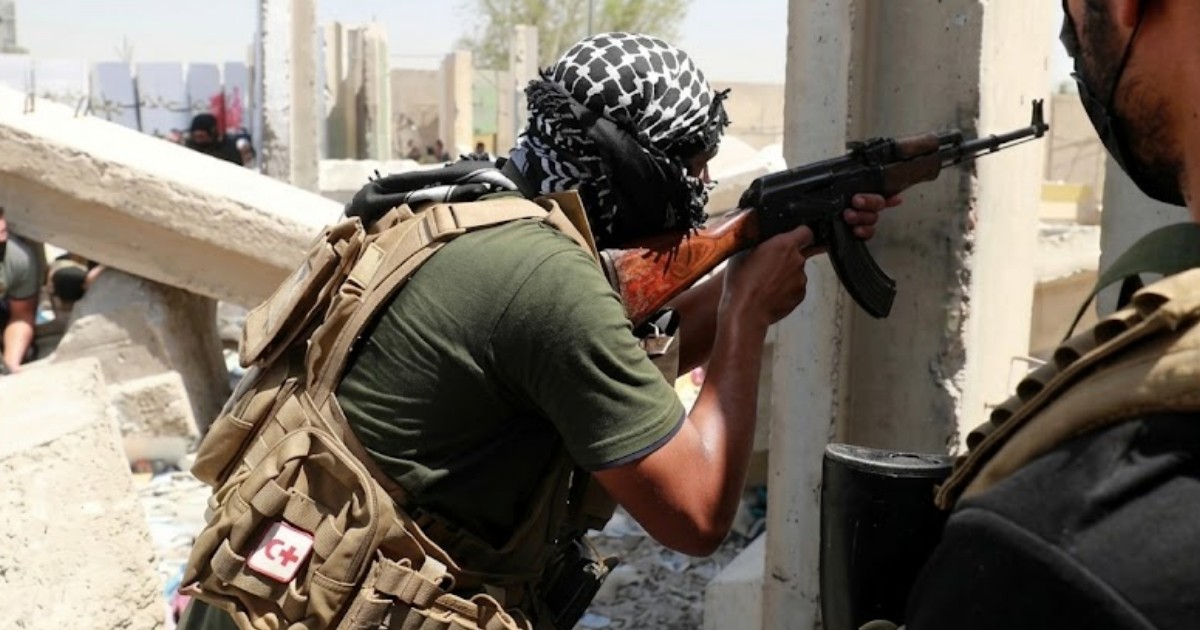
Iraqi Prime Minister Ali al-Zaidi is facing an escalating political and security crisis as a strict September 30 deadline to restrict all weapons to state control approaches, according to a report by Al Jazeera. The government’s attempt to establish a total monopoly on armed force is meeting fierce resistance from several powerful Shia paramilitary factions, threatening to completely derail the national security initiative.
While a number of armed groups, including Saraya al-Salam, Asaib Ahl al-Haq, and Kataib al-Imam Ali, have formally agreed to integrate their fighters into the official state armed forces, others remain deeply defiant. Kataib Hezbollah, an Iran-aligned Iraqi paramilitary group considered one of the country’s most heavily armed factions, has explicitly rejected the government’s mandate. The group has pledged instead to retain what it describes as resistance weapons and announced plans to further develop its independent military arsenal.
Similarly, the influential Harakat al-Nujaba faction argued that the government’s push to confiscate arms should exclusively target illegal weapons that cause urban chaos. They stated that the mandate should not apply to the fighters who defended Iraq, its holy sites, and its civilian population during the country`s most difficult circumstances in recent years. This aggressive push for disarmament is heavily driven by intense pressure from the United States amid the ongoing war with Iran, as well as the urgent need to stabilize the country to attract crucial foreign investment.
The economic stakes for Baghdad are extraordinarily high. Oil revenues make up more than 90 percent of the entire Iraqi state budget. However, the recent closure of the Strait of Hormuz caused a catastrophic drop in the country`s oil exports, plummeting to roughly 600,000 barrels per day in March, down from a previous output of 3.3 million barrels per day. Given these economic challenges, some political observers argue that the refusal to disarm by groups holding such immense sway brings the fundamental concept of the Iraqi government`s authority into question.
Speaking to Al Jazeera, Talib Mohammed Karim, a professor of political thought at Mustansiriya University, stated that maintaining armed factions outside official state control completely undermines the constitutional order. He also cast serious doubt on the sincerity of the groups that have reportedly agreed to disarm, suggesting that their public statements might merely be hypothetical procedures designed for media consumption rather than actual compliance.
Some factions justify their retention of arms by pointing to the continued presence of United States troops and the threat of external interference. However, political analyst Kadhim al-Hajj argued that linking disarmament to foreign troop movements is no longer a valid excuse given the current geopolitical situation. He emphasized that the issue of weapons in the Iraqi state is strictly an internal matter that requires a cohesive national approach, independent of American mandates.
With the deadline rapidly approaching, experts believe the government is running out of viable options. Political analyst Omar al-Nasser framed the standoff as an existential moment for Iraq’s future. He noted that the ruling State Administration Coalition faces a stark choice: either aggressively build a strong state with weapons strictly within the government framework, or face devastating international sanctions and a potential ban on all oil exports. Despite the immediate urgency, analysts suggest the government might ultimately be forced to extend the disarmament timeline to the end of December to avoid sparking an all-out internal conflict.