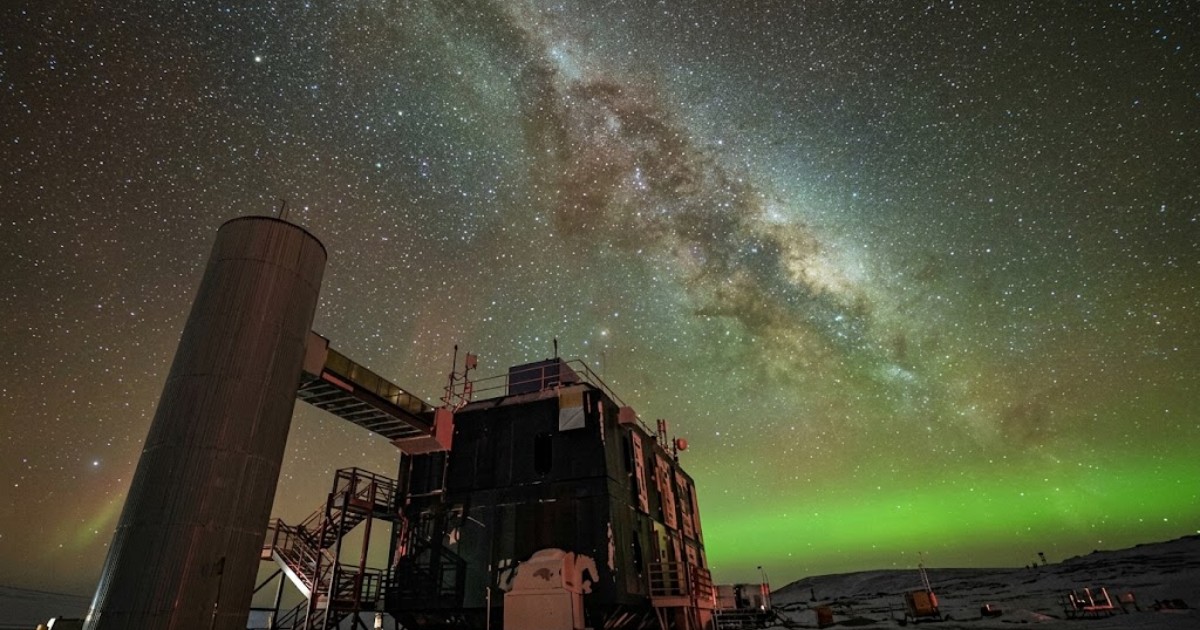
Belgian physicist Professor Francis Halzen has won the 2026 Nobel Prize in Physics for his groundbreaking leadership in developing an observatory that captures elusive particles from the distant cosmos, the Royal Swedish Academy of Sciences announced Tuesday. Halzen directed the creation of the IceCube Neutrino Observatory, an audacious scientific installation embedded beneath the ice sheet at the geographic South Pole. The facility uses a cubic kilometer of clear Antarctic ice instrumented with sensitive optical sensors to register astronomical messengers known as neutrinos.
He first presented his vision for the polar detector in 1988.
Constructed by drilling deep boreholes into pristine polar ice, the observatory houses thousands of digital optical sensors suspended along vertical cables. The sun consistently bathes the earth in immense volumes of low-energy neutrinos, with billions passing imperceptibly through an area the size of a fingernail every single second. IceCube, by contrast, isolates cosmic neutrinos carrying extraordinary energy signatures generated by violent astrophysical phenomena in remote galaxies. Because neutrinos possess no electric charge, interstellar magnetic fields cannot deflect their trajectories, allowing them to travel uninterrupted across billions of light-years directly from their creation points.
Ordinary telescopes frequently find their optical vision obstructed by dense cosmic dust clouds.
When a rare incoming neutrino strikes an atomic nucleus in the Antarctic ice shelf, it generates fast-moving secondary charged particles. These charged particles surge through the dense medium, emitting a distinct blue luminescence that highly sensitive detector modules capture and record. Computational networks analyze the spatial pattern and arrival timing of that light flash, allowing astrophysicists to determine the exact trajectory of the originating cosmic particle.
Reflecting on the honor during a news conference, Halzen acknowledged initial skepticism surrounding the scale of the endeavor. He emphasized that while collaborators recognized the concept as promising, very few participants initially expected the installation to function successfully. Professor Mark Pearce, chair of the Nobel Committee for Physics, commended Halzen for leading an international cohort of researchers and engineers whose persistence fundamentally transformed observational astronomy.
Louis Barson, director of science at the Institute of Physics in London, noted that the IceCube facility has opened a critical observational window, enabling researchers to probe energetic environments surrounding exploding stars and supermassive black holes.
Global scientific teams continue to rely on the observatory`s incoming data streams to investigate the most energetic astrophysical processes in the universe.