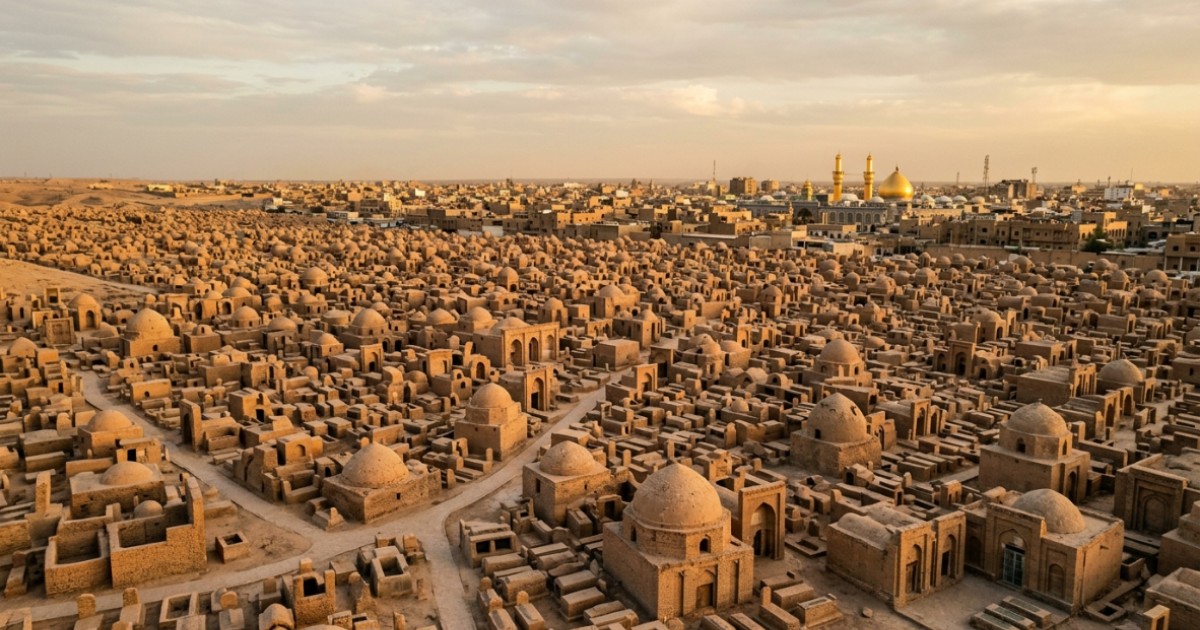
Located in the holy city of Najaf, Iraq, the ancient "Wadi al-Salam" stands as the undisputed largest and oldest active burial ground on Earth, translated globally as the Valley of Peace. Recognizing its profound cross-cultural architecture and centuries of continuity, UNESCO officially designated the site as a World Heritage protected area in 2017. The vast necropolis currently spans an estimated 1,485.5 acres, equivalent to roughly six square kilometers of urban territory. Operational since the 7th century, historical documentations indicate that more than six million deceased individuals have been interred within this unique space over the past fourteen hundred years.The site routinely draws millions of international travelers, pilgrims, and historical researchers annually.
From a religious standpoint, the location holds immense spiritual significance for the global Muslim population, particularly within Shia Islamic history. The grand mausoleum of Imam Ali, the fourth caliph of Islam and cousin of Prophet Muhammad, is positioned immediately adjacent to the eastern boundary of the cemetery along with the tomb of Imam Ja`far al-Sadiq. Furthermore, Islamic tradition holds that the final resting places of several major ancient prophets, including Prophet Hud and Prophet Saleh, are preserved deep within this complex. Local academic Hussein Ali Haider confirmed to the Anadolu Agency that the graves of Prophet Adam and Prophet Noah are also traditionally identified within this holy perimeter. Abrahamic narratives suggest that Prophet Abraham purchased this specific plot of land centuries ago during a journey with his son Isaac, prophesying its future transformation into a massive sacred sanctuary.
Architecturally, Wadi al-Salam is entirely distinct, resembling a sprawling, densely populated metropolis of the dead rather than a conventional graveyard. The vast majority of the individual vaults are constructed utilizing traditional baked plaster bricks, frequently featuring intricate hand-carved Quranic calligraphy across their outer walls. Due to growing geographical space constraints over the centuries, innovative underground multi-layered catacombs and hidden chambers were systematically engineered beneath the desert floor. These subterranean crypts are accessible via narrow staircases, allowing single family tombs to systematically accommodate between thirty and fifty bodies stacked in structural tiers. While the traditional tombs built during the 1930s and 1940s feature prominent three-meter-high circular spires, contemporary sections showcase imported Iranian marble, premium granite slabs, and precise computerized laser engravings detailing the histories of the deceased.
Eschatological beliefs within Shia traditions suggest that the souls of all faithful believers are spiritually transported to this valley upon death, viewing the location as an earthly extension of paradise. This profound theological connection generates an intense global demand among international communities to secure final plots within the perimeter, with the site serving as the final resting place for nearly ninety percent of Iraq`s Shia population. However, the cemetery maintains a strict policy of universal accessibility, welcoming the elite, political figures, religious scholars, and impoverished citizens alike without socio-economic discrimination. Beyond domestic citizens, the complex has historically accommodated cross-border transfers for burials arriving from India, Southwest Asia, and Lebanon, maintaining a rich, pluralistic heritage of global Islamic preservation.