Meat skewers originally forged on Crimean swords have crossed thousands of miles to establish themselves as a defining culinary emblem across the Great Plains of the United States. Historical records and museum archives indicate that chislic, a deep-fried meat snack ubiquitous across southeastern South Dakota, traces directly back to seventeenth-century Tatar cooking techniques around the Black Sea. The migrant recipe, carried across the Atlantic by German-Russian homesteaders, eventually received formal state recognition as an official regional symbol.
The culinary journey from battlefield swords to roadside toothpicks spans over a century.
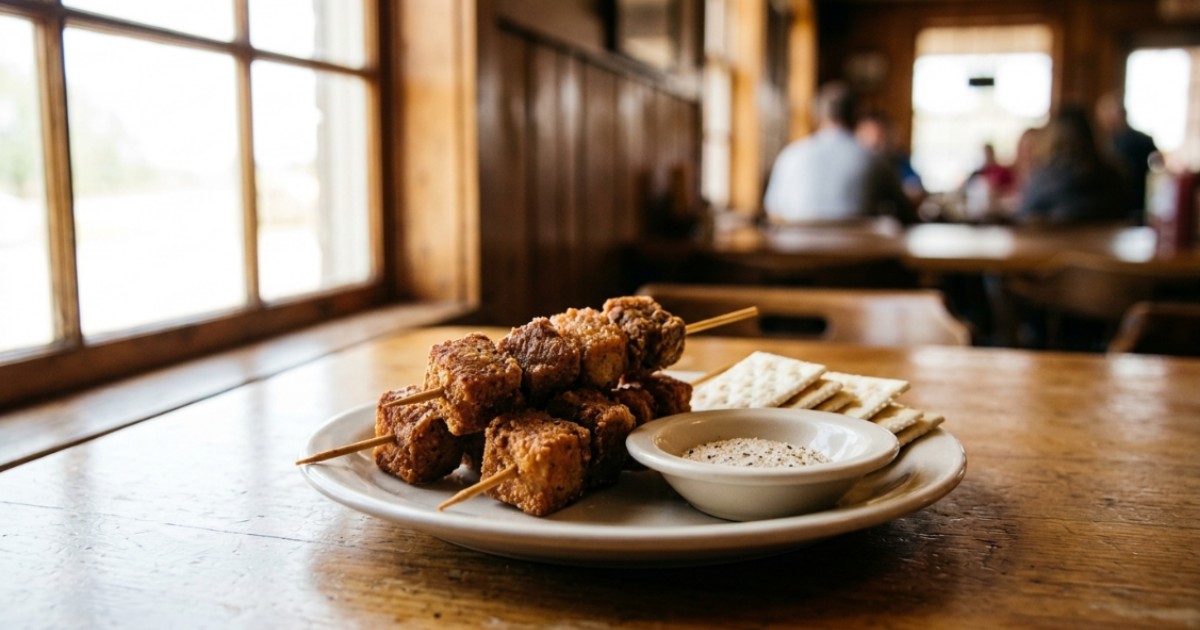
At roadside establishments like Meridian Corner in Freeman, South Dakota, skewers of lamb and mutton arrive within seconds of ordering, flash-fried in cauldrons and dusted with garlic salt beside plain crackers. Local archivist Marnette Hofer notes that while the dish is staple fare locally, it remains practically invisible beyond the surrounding counties. In 2018, the South Dakota State Legislature formally canonized the skewered meat as the official state nosh.
Russian military forces first adopted the preparation technique from Crimean Tatars while advancing toward the Black Sea in the late 1600s.
Tatars marinated diced mutton in vinegar and onions before roasting the pieces over embers using sabers and metal rods, naming the field ration shashlyk. German agriculturalists invited to settle the Russian frontier under Catherine the Great embraced the preparation as standard community food. When Czar Alexander II stripped these communities of land rights and military exemptions in the 1870s, over one hundred thousand Russo-Germans crossed the Atlantic to claim western acreage under President Abraham Lincoln`s Homestead Act.
Among those pioneers was Johann Hoellwarth, who settled in the Dakota Territory in the 1870s and began preparing shashlyk for pioneer gatherings.
Hoellwarth`s thick dialect caused English-speaking homesteaders to transcribe the foreign name phonetically as chislic. Confronting treeless prairies devoid of charcoal, pickling vinegar, and metal skewers, Hoellwarth modified the recipe by utilizing willow twigs, rendering lard, and fueling cauldrons with prairie wildgrasses. Deep-frying the salted mutton replaced slow coal roasting, turning the dish into a rapid holiday snack during Fourth of July town celebrations.
Food historians now define the thirty-mile perimeter surrounding Freeman as the Chislic Circle.
Butcheries such as the Kaylor Locker have supplied mutton and venison to the regional enclave for sixty-five years. Contemporary taverns across neighboring hamlets have adopted loose-meat formats without wooden sticks to keep operating costs affordable, with others incorporating jalapeños, onions, and local cheeses. Regional festivals now exhibit experimental versions spanning beef and poultry, yet community elders continue to view the basic fried skewer as a living testament to immigrant resilience and rural hospitality.