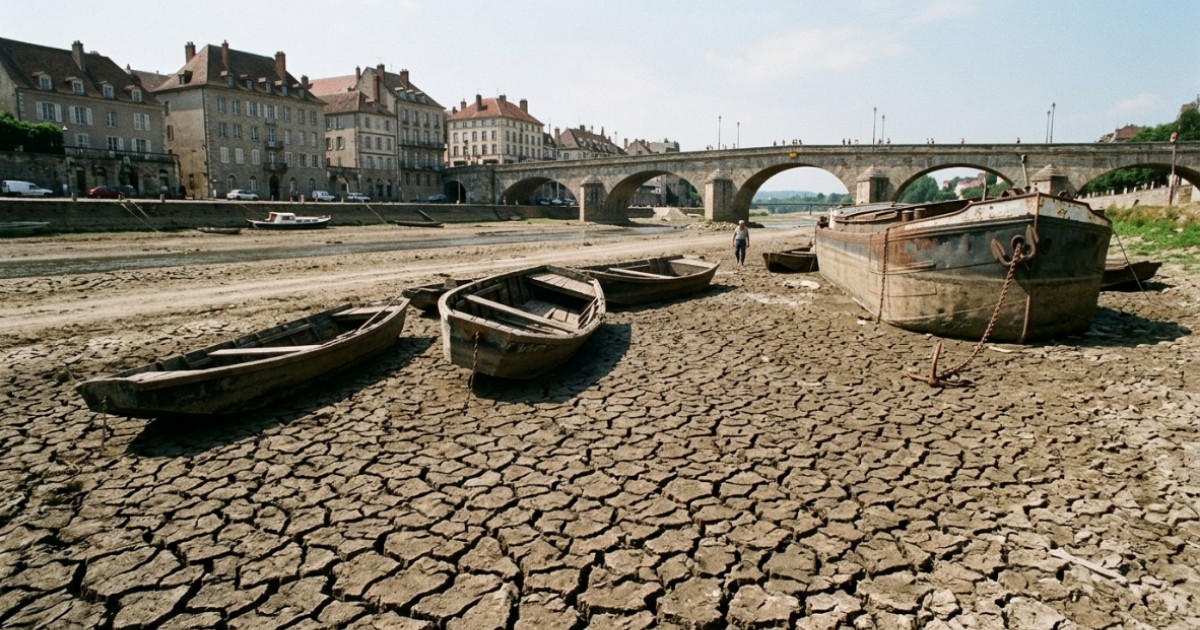
The River Rhine has plunged to unprecedented low levels across sections of Germany and the Netherlands as relentless heatwaves continue to grip Europe, according to Reuters and BBC News. Last week, water levels recorded in the western German city of Cologne and the border town of Lobith reached their lowest points since official record-keeping began. The severe drought is not isolated to the Rhine; other vital European waterways, including the Danube and Italy`s Po River, are also experiencing historically low flows. According to the European Union`s Drought Observatories, critical drought conditions have stabilized across most of the continent but have notably worsened in central and western regions. Renewed heatwave patterns are projected to persist, threatening to push temperatures above 40 degrees Celsius in multiple central and southern European nations.
Germany`s Low Water Information System reported that 44 percent of measuring stations along the Rhine and 78 percent along the Danube recorded critically low water levels by the end of July. Originating in the Swiss Alps and flowing into the North Sea, the Rhine serves as one of Europe`s most crucial commercial arteries. The shallow waters have sparked widespread anxiety regarding the severe economic consequences of restricting inland navigation. At the Kaub chokepoint near Koblenz, navigable depths briefly plummeted to 25 centimeters, matching a historic low previously set in 2018, before making a slight recovery. The Rhine is an irreplaceable logistical backbone for the European manufacturing sector, moving massive quantities of fuel and raw materials daily.
Martin Wolters, an official with the Rhine Waterways and Shipping Authority, informed German broadcaster WDR that while a complete suspension of shipping remains unlikely, vessels must drastically reduce their cargo loads to avoid grounding. Distributing freight across a larger number of smaller ships inevitably leads to surging transportation costs and severe supply chain bottlenecks. One commodity trader told Reuters that there comes a tipping point where cargo sizes become too small to remain profitable, and vessel operators grow increasingly concerned about inflicting structural damage to their ships. With rail and road networks already operating near maximum capacity, shifting bulk commodities away from the river is both logistically challenging and financially punishing for major industries.
The crisis extends deep into Eastern Europe, where the Danube has dropped to its lowest levels in 30 years, severely affecting Serbia and Romania. The reduced flow has pushed Hungary`s sole nuclear power plant to the brink of a complete shutdown, as the facility currently operates at reduced capacity while engineers closely monitor the cooling systems. Similarly, Serbia has been forced to slash output at several coal-fired power stations due to inadequate water supplies required for cooling. In a desperate measure, Romanian authorities executed a controlled explosion on a large rock formation along the Danube`s banks to increase water flow toward the Cernavoda nuclear power plant. Furthermore, two major Romanian automotive factories operated by Dacia and Ford agreed to halt production for over a fortnight to conserve electricity.
In southern Europe, Italy`s longest river, the Po, hit an all-time low near the northern city of Cremona. Regional authorities have escalated the drought alert to its highest level across the entire Po Valley, with experts issuing stark warnings about imminent disruptions to municipal drinking water supplies. The diminished river flow has also allowed saltwater from the Adriatic Sea to infiltrate the riverbed, devastating local ecosystems and crippling farmers who rely on the river for agricultural irrigation. While a recent study by the World Weather Attribution group found no clear long-term trend toward reduced rainfall in Europe, researchers concluded that human-driven climate change is accelerating moisture evaporation through soaring temperatures. What remains unclear is how European governments plan to fundamentally adapt their critical infrastructure to withstand these intensifying annual droughts.