Damascus, the capital of Syria and locally known as Ash-Sham, stands as one of the oldest, most sophisticated, and continuously inhabited cities in the world. Located at the crossroads of Africa, the Middle East, and the West, this ancient city has served as a pivotal cultural and commercial hub since the third millennium BCE. Its narrow alleyways, mosaic-adorned ancient buildings, and bustling markets continue to evoke a sense of timelessness. Damascus holds profound historical and spiritual significance in Islam, Christianity, and Judaism alike, with the city serving as a sanctuary for the memories of numerous prophets.
Archaeological evidence suggests that Damascus is among the longest-standing capital cities in history. Excavations have revealed human habitation dating back as far as 8,000 to 10,000 BCE. While the city did not gain major prominence in recorded history until the arrival of the Arameans, it flourished throughout the Middle Ages as a center for trade, arts, and crafts. Poetically referred to as the "City of Jasmine," the air of Damascus is perpetually filled with the scent of white jasmine flowers that grace its traditional courtyards, walls, and narrow streets.
Spanning 105 square kilometers with a population of approximately 2.5 million, the historic heart of Damascus lies on the southern bank of the Barada River, enclosed by ancient walls. Throughout its existence, the city has been conquered and governed by various empires, including the Assyrians, Babylonians, Persians, Greeks, Romans, and Arabs. Each conquering power has left an indelible mark on its architecture and cultural heritage, making the city a living museum of diverse civilizations. Damascus officially became the capital city during the Umayyad Caliphate in 661 CE, marking the beginning of its golden era of prosperity.
Islamic tradition and folklore deeply intertwine the city with the legacy of several prophets. According to some historical narratives, after the Great Flood, Prophet Nuh (AS) looked down from the mountains and chose the location to build a city. Prophet Ibrahim (AS) also passed through the region during his migration from Ur in Mesopotamia, where he invited the local star-worshipping community to the oneness of Allah. Historical markers of his journey are still commemorated within the city today.
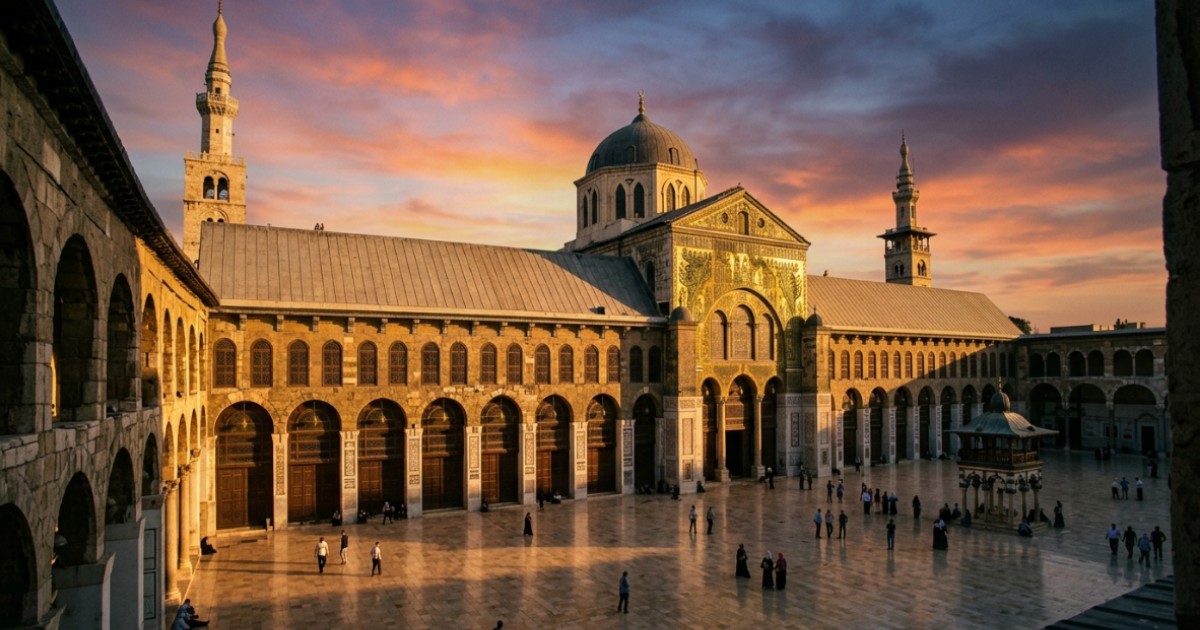
Furthermore, historical accounts link the city to Prophets Idris (AS) and Hud (AS), with several locations serving as testament to their presence. The Umayyad Mosque, constructed in 715 CE and also known as the Great Mosque of Damascus, stands as an architectural masterpiece. It is believed to house the maqam (shrine) of Prophet Idris (AS) and a well named after Prophet Hud (AS). Muslims and Christians alike revere the mosque as it is also believed to house the shrine of Prophet Yahya (AS). Moreover, Islamic eschatological tradition holds that Prophet Isa (AS) will descend upon the white minaret on the eastern side of the Umayyad Mosque in the end times. As recognized by the UNESCO World Heritage Centre and Britannica, Damascus remains an invaluable treasury of human history and tradition.