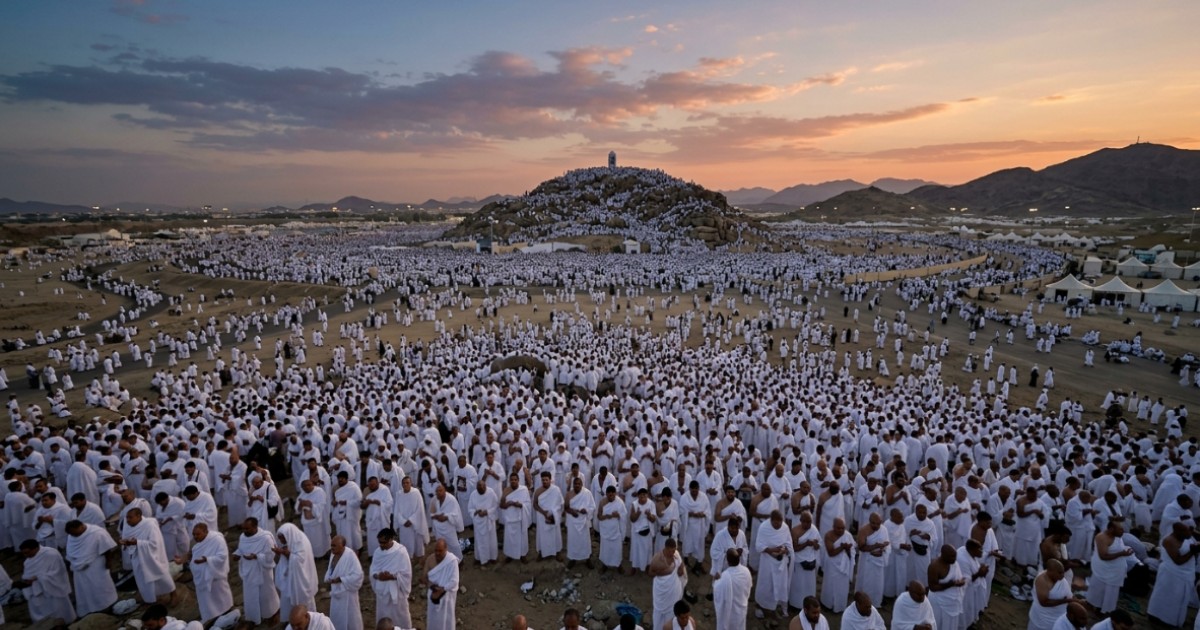
During the Hajj season, whether on the plains of Arafat or in the courtyards of the Kaaba, the sound of millions of voices merges into one. This is the Talbiyah. From the moment they don the Ihram, male pilgrims recite this call aloud, while women recite it softly. It is a sound that shakes the atmosphere and holds a hypnotic power, designed to strip away the ego and align the human soul with the Divine.The Talbiyah is more than just a sequence of words; it is a vow of servitude.
It is a medium to dissolve into the vast ocean of Allah’s supremacy. Differences in wealth, status, education, or race vanish into this singular slogan. When a Muslim recites the Talbiyah, it is said that everything around them—stones, trees, and earth—echoes the call. As narrated in the Hadith by Sahl ibn Sa`d (RA), the Prophet (PBUH) stated that when a Muslim recites the Talbiyah, everything to their right and left joins in, filling the earth from one end to the other.
The Hajj is a global congregation, a mirror of the legacy of Prophet Ibrahim (AS). When he was commanded to announce the Hajj after constructing the Kaaba, he wondered who would hear his call in the desolate valley. Allah commanded him to simply announce it, promising that the message would reach all of humanity. When Ibrahim (AS) climbed Mount Abu Qubais and made the call, the souls of every person destined to perform Hajj until the Day of Judgment responded, "Labbayk."
The words themselves—‘Labbayk Allahumma Labbayk, Labbayk La Sharika Laka Labbayk...’—translated as ‘Here I am, O Allah, here I am,’ are a declaration of presence. There is no pride here, no arrogance, only an unconditional readiness to obey the Creator.
The Talbiyah is the ultimate rejection of Shirk (polytheism). In the pre-Islamic era of Jahiliyyah, pilgrims would alter the Talbiyah to include polytheistic elements, claiming partners for Allah. The Prophet (PBUH) restored the purity of this ritual, emphasizing the "La Sharika Laka" (You have no partner) clause. Every time a pilgrim recites this, they are reaffirming that Allah is the only object of worship, the only sovereign, and the only Creator.
Pilgrims leave behind their homes, families, wealth, and preferred comforts, moving forward solely for the pleasure of their Creator. This journey requires them to treat even the smallest creation—trees, animals, insects—with kindness, as the state of Ihram imposes strict prohibitions. Beyond the physical rituals, the Talbiyah is a symbol of unconditional surrender, a testament of gratitude, and the key to the pilgrim`s spiritual transformation.