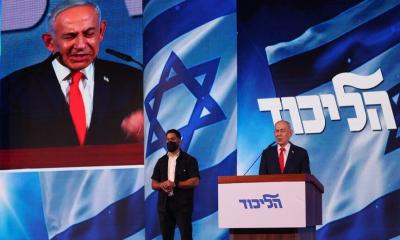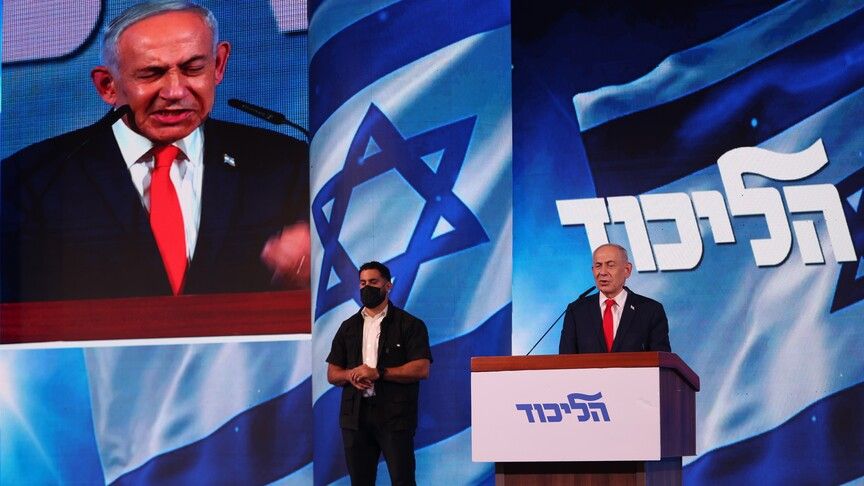
The political bloc led by Israeli Prime Minister Benjamin Netanyahu is projected to secure 53 seats in the 120-member Knesset, according to election projections released on Tuesday. Neither main political bloc reached the 61 seats required for a parliamentary majority.
The opposition bloc led by Gadi Eisenkot was projected to win 48 seats. Predominantly Arab parties were expected to secure a combined total of 19 seats.
Netanyahu’s Likud party is projected to remain the largest single party in the legislature with 26 seats. This represents a decline from the 32 seats the party won in the 2022 elections, according to the Israeli news website Ynet.
Eisenkot’s Yashar party was projected to claim 21 seats in its first parliamentary election. Former Prime Minister Naftali Bennett’s Together alliance was projected to secure 12 seats in its electoral debut.
Among Arab political formations, the Joint List was projected to win 12 seats, while Ra’am was expected to secure seven. This brings the projected representation of Arab parties to 19 seats, up from 10 seats in 2022.
The Democrats were projected to win eight seats, compared with four seats won by predecessor parties Labor and Meretz in the previous election.
Avigdor Lieberman’s Yisrael Beiteinu party was projected to secure seven seats, up from six in 2022. The ultra-Orthodox Shas party was projected to win seven seats, down from 11 previously, while United Torah Judaism was expected to remain unchanged at seven seats.
National Security Minister Itamar Ben-Gvir’s Otzma Yehudit party was projected to win seven seats. The Religious Zionism-Zehut alliance, led by far-right Finance Minister Bezalel Smotrich, was expected to secure six seats.
Ben-Gvir and Smotrich contested the 2022 elections together on a joint list that won 14 seats. Their projected combined total of 13 seats marks a decline of one seat.
Voter turnout reached 77.7 percent, which Channel 12 reported as the highest level recorded since 1999. More than 7.3 million Israelis were eligible to vote in Tuesday’s election, the first vote held since the military campaign in the Gaza Strip began in October 2023.
More than 500,000 special double-envelope ballots remained uncounted. These ballots are cast away from registered polling stations by soldiers, diplomats, police officers, and displaced residents, and their inclusion could alter the final distribution of seats.
Elad Naveh, director of the Central Elections Committee’s control center, stated that the counting of the double-envelope ballots was scheduled to begin on Wednesday evening and conclude by Thursday evening.