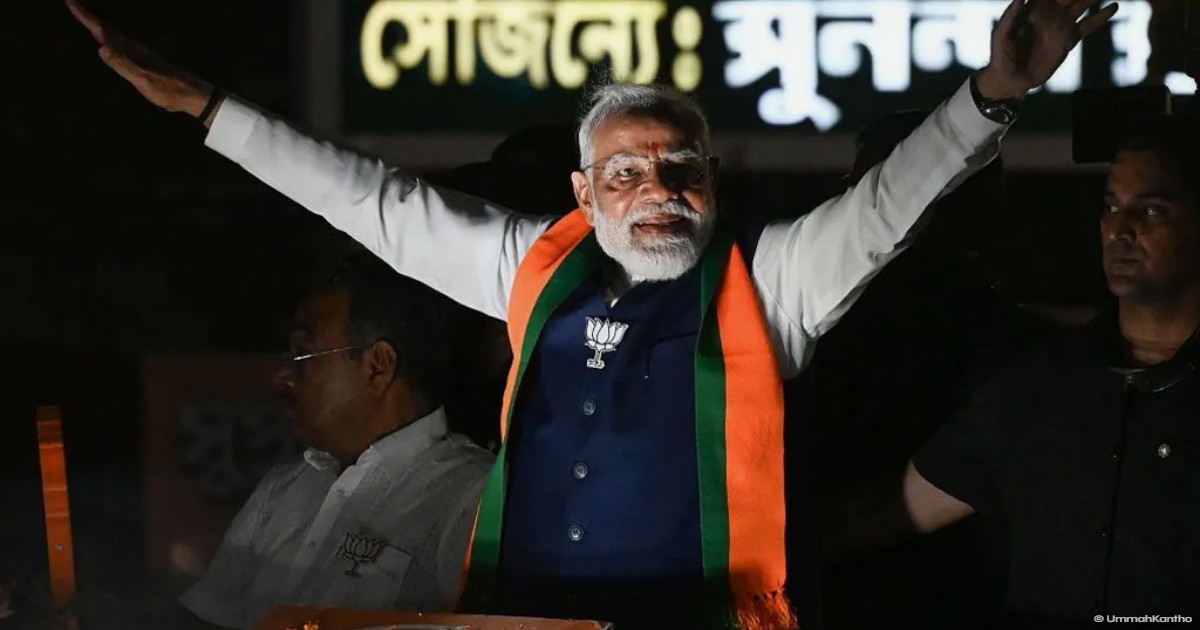
The political landscape of India shifted dramatically on Monday as the Bharatiya Janata Party (BJP) secured a historic victory in West Bengal, one of the country`s most resistant political frontiers. After fifteen years of dominance under Chief Minister Mamata Banerjee and her Trinamool Congress (TMC), the state has finally embraced the "long march" of Prime Minister Narendra Modi`s party. According to official data from the Election Commission of India, the BJP is leading or has won 204 seats in the 294-member assembly, far surpassing the majority mark of 148. The incumbent TMC has been reduced to just 83 seats, marking the end of a populist era in the east.
However, the political churn was not limited to Bengal. In South India, a cinematic revolution has taken place as actor-turned-politician Joseph Vijay’s Tamilaga Vettri Kazhagam (TVK) emerged as the single largest party with 130 seats. This blockbuster win has effectively dismantled the six-decade-old duopoly of the DMK and AIADMK. In a stunning personal blow, Chief Minister MK Stalin lost his seat in Kolathur, signaling a total rejection of the established order by the youth. Meanwhile, in Kerala, the Congress-led United Democratic Front (UDF) swept to power with 102 seats, effectively ending the last remaining Communist government in India.
The West Bengal election was held under the shadow of the controversial Special Intensive Revision (SIR) exercise. This process saw nearly 9.1 million voters removed from the electoral rolls, representing over 11 percent of the total electorate. While Mamata Banerjee and her allies decried the move as a strategic plot to disenfranchise their core support base, the results suggest that the BJP’s momentum was fueled by deeper issues. Analysts point to a massive anti-incumbency sentiment and a consolidation of the Hindu vote that TMC’s traditional welfare politics could no longer contain.
For years, Mamata Banerjee’s TMC had relied on a formidable coalition of women and minority voters. Her welfare schemes, such as direct cash transfers for women, were considered the gold standard of regional politics. In this election, the BJP directly challenged that narrative by promising even larger social benefits alongside a sharp focus on national security and infrastructure development. What followed was a total collapse of TMC strongholds in both rural and urban Bengal, leaving the party with a fraction of its former influence.
This victory is being hailed as one of the most significant breakthroughs in Narendra Modi’s twelve-year tenure as Prime Minister. Bengal had long prided itself on its cultural exceptionalism and resistance to the BJP’s ideology. By conquering this frontier, the BJP has proved that its reach is no longer confined to the Hindi-speaking heartland. However, the picture remains incomplete as the new administration will face the daunting task of managing one of India’s most populous and economically complex states, where expectations for a "New Bengal" are now at an all-time high.
The broader implications for Indian democracy are profound. The defeat of the Left in Kerala and the rise of a third force in Tamil Nadu indicate that the Indian electorate is increasingly impatient with long-term incumbents. These results will serve as a critical barometer for the upcoming 2029 national elections. As the dust settles on this historic Monday, it is clear that a new political era has begun in India, where traditional bastions are no longer safe and the demand for transformative change has become the loudest voice at the ballot box.