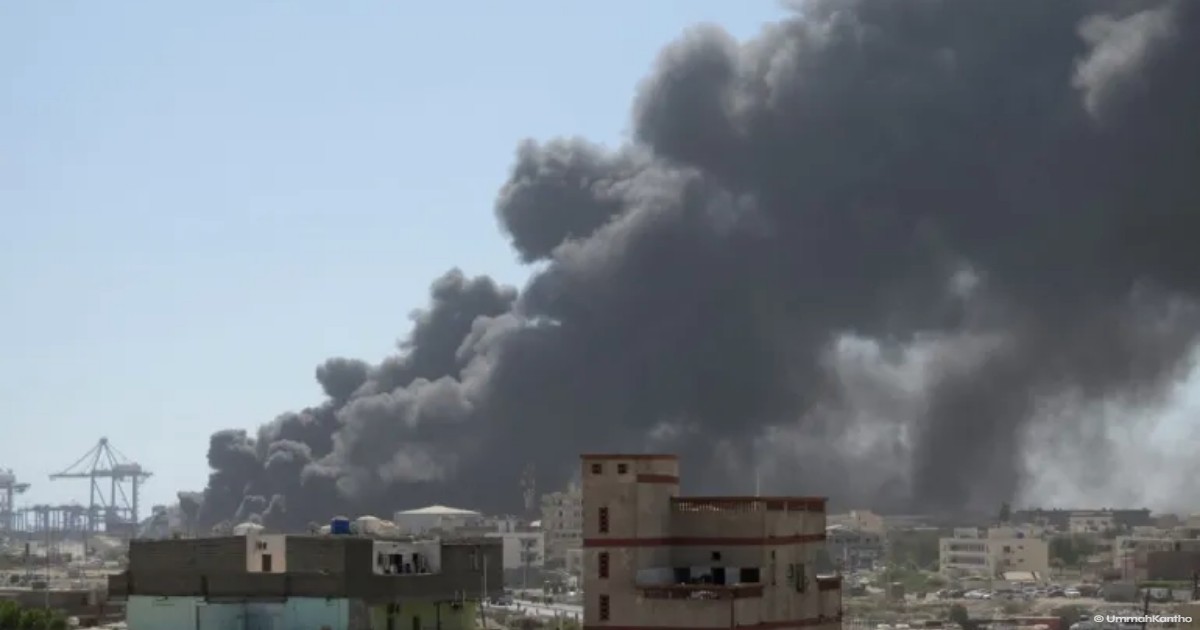
The Sudanese government has leveled serious allegations against neighboring Ethiopia and the United Arab Emirates, accusing both nations of playing a direct role in recent Sudan drone attacks. In a dramatic diplomatic escalation on Tuesday, Khartoum formally recalled its ambassador from Addis Ababa. According to comprehensive reports from Al Jazeera and the French news agency AFP, Sudanese authorities have issued a stern public warning that this perceived foreign aggression will not be met with silence. The diplomatic fallout follows a devastating strike on Khartoum International Airport, a critical infrastructure hub that was forced to completely suspend its operational activities for three days due to the resulting damage.
The Sudanese Armed Forces claim to possess concrete intelligence proving that at least four separate drone strikes have been launched from Ethiopian territory since the beginning of March. Military officials in Khartoum allege that the unmanned aerial vehicles utilized in these cross-border operations were directly supplied by the United Arab Emirates. The strikes on the capital’s international airport represent a crushing blow to recent stabilization efforts. Just last week, the facility welcomed its first commercial flight since the broader conflict began over three years ago. That milestone had briefly signaled a period of relative calm for the war-torn city before being shattered by the renewed aerial bombardments.
In Addis Ababa, the Ethiopian Foreign Ministry swiftly and categorically dismissed the accusations as completely baseless. Rather than accepting blame, Ethiopian officials leveled their own counter-accusations, claiming that Sudan is actively fomenting domestic unrest by providing financial backing to the Tigray People’s Liberation Front (TPLF). The ministry noted that it had previously refrained from publicizing Sudan`s alleged violations of Ethiopian territorial integrity solely because of the "historic and enduring bond of friendship" shared between the two African nations. Meanwhile, Amanuel Assefa, a senior official within the TPLF, told AFP that his organization maintains no connections with Sudanese authorities, suggesting that the Ethiopian federal government is merely looking for scapegoats to cover its own internal failures.
While the United Arab Emirates has not yet issued a specific response regarding the Khartoum airport incident, Abu Dhabi has consistently denied long-standing allegations that it provides financial and military support to the Rapid Support Forces (RSF). The RSF, a powerful paramilitary syndicate, has been locked in a brutal war of attrition with the regular Sudanese Armed Forces since a violent power struggle erupted in April 2023. The human toll of this conflict has been catastrophic. The United Nations currently designates the situation in Sudan as the world’s worst humanitarian crisis, estimating that more than 150,000 people have been killed. In addition, approximately 14 million citizens have been forcibly displaced from their homes. Although the regular army successfully retook Khartoum from the RSF in March 2025, allowing roughly 1.8 million residents to return, much of the sprawling capital remains destitute, lacking electricity and other basic municipal services.
Security analysts warn that this latest diplomatic rupture threatens to ignite a wider regional conflagration. Alan Boswell, the Horn of Africa director at the International Crisis Group, told Al Jazeera that the formal accusations against Ethiopia mark a highly dangerous new dynamic in a war that is already destabilizing neighboring countries. Boswell observed that both Sudan and Ethiopia are grappling with massive internal challenges and are now increasingly viewing each other as state sponsors of their respective armed opponents. He emphasized that the ongoing civil war in Sudan continues to escalate with no clear diplomatic off-ramp, threatening to literally tear the Horn of Africa region apart. Boswell also pointed out the unprecedented level of foreign interference, noting that without external backers supplying advanced munitions like drones, both warring parties in Sudan would have exhausted their military capabilities during the early stages of the conflict