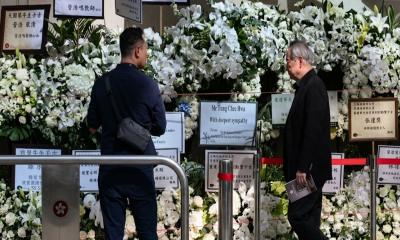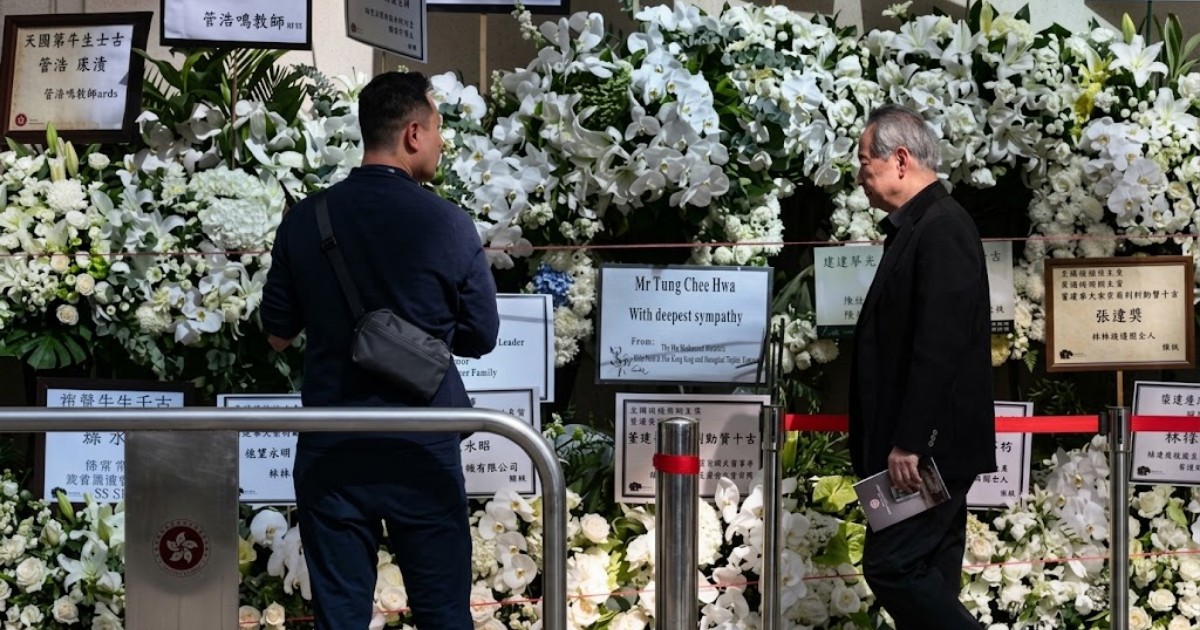
Hong Kong conducted a state funeral on Sunday for Tung Chee-hwa, the territory`s first chief executive following the handover from British governance. Senior Chinese state representatives and regional political figures gathered at the Hong Kong Funeral Home in North Point to pay tribute. The event represents only the third state funeral authorized in the city since its 1997 return to Chinese administration.
Tung passed away on September 8 at the age of 89.
The ceremony was coordinated by an 87-member funeral committee headed by Shi Taifeng, a Chinese Communist Party Politburo member and vice chairman of the Chinese People`s Political Consultative Conference. Beijing`s top representative for Hong Kong affairs, Xia Baolong, attended alongside incumbent Chief Executive John Lee and former regional leaders Leung Chun-ying, Carrie Lam, and Donald Tsang. Tung`s casket, draped in China`s national flag, was borne by pallbearers including Lee and Leung before transport to the Cape Collinson Crematorium.
Civic centers hosted condolence registries for public signatures through midday Sunday.
A commercial shipping magnate with negligible prior bureaucratic experience, Tung was picked in 1996 by a Beijing-convened selection panel to guide the territory through its historic post-colonial transition. His tenure faced immediate instability during the 1997 Asian financial crisis and the 2003 SARS epidemic. Mass demonstrations in 2003 compelled his administration to withdraw contentious national security bills, prompting governance difficulties that persisted until his mid-term resignation in 2005 on medical grounds.
Following his departure from executive office, Tung served as a vice chairman of Beijing`s top political advisory council until 2023. Similar state funeral protocols were historically granted to prominent commercial figures Ann Tse-kai in 2000 and Henry Fok in 2006.
State publications in mainland China characterized Tung as a dedicated patriot throughout his public life. While administrative successor Donald Tsang highlighted his composure and forward-looking outlook, contemporary critics maintained that his administration remained burdened by unresolved socioeconomic friction.