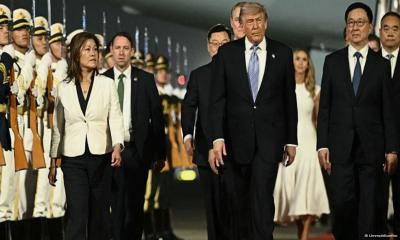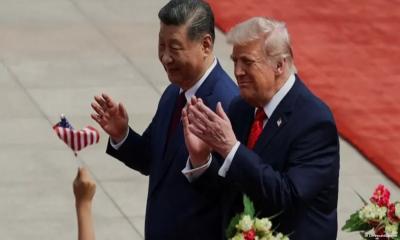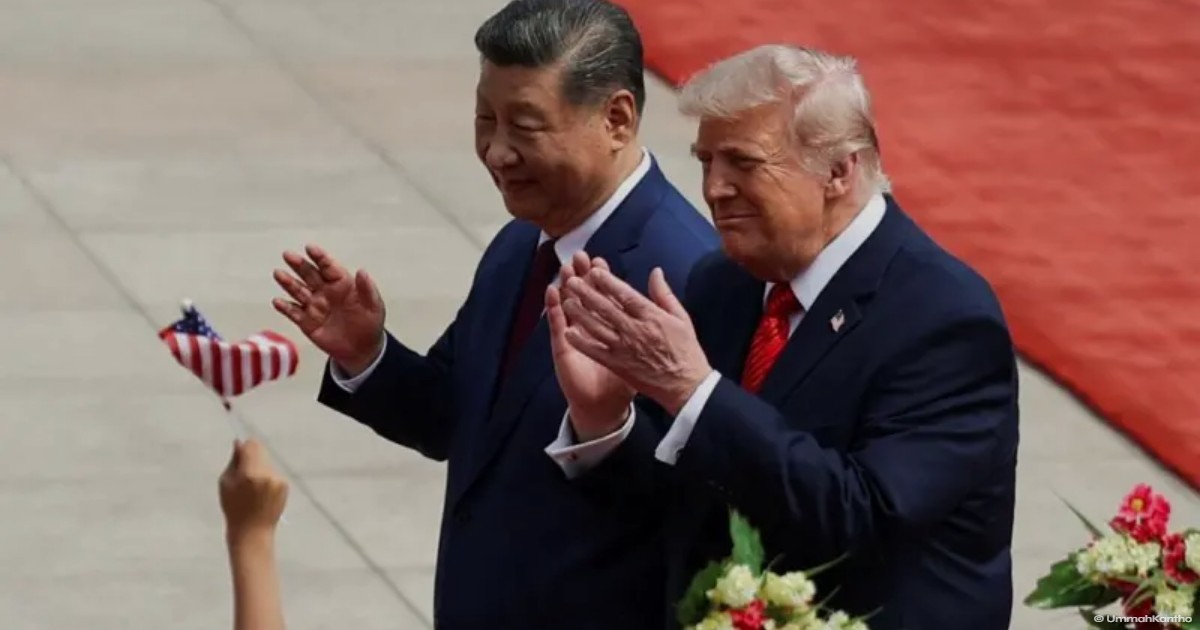
President Donald Trump and Chinese President Xi Jinping concluded a high-stakes bilateral summit in Beijing on Thursday, lasting significantly longer than the scheduled timeframe. During the two-hour discussion at the Great Hall of the People, Xi issued a stern warning regarding Taiwan, describing the island’s status as a potential flashpoint that could drive the two superpowers into direct conflict. Despite the blunt rhetoric on territorial integrity, the Chinese leader opened the meeting by calling for a shift in relations, suggesting that the United States and China should act as partners rather than rivals.
The atmosphere shifted from formal diplomacy to cultural symbolism as the two leaders toured the Temple of Heaven, a 15th-century imperial complex where emperors once prayed for a successful harvest. Walking alongside his host, President Trump lavished praise on Xi, describing him as a great leader and characterizing the talks as incredible. When questioned by reporters about whether the specific issue of Taiwan was resolved, Trump chose to focus on the aesthetics of the host nation, remarking that China is a beautiful place while maintaining a friendly rapport with Xi.
Here is the thing that makes this summit unique: Trump is not traveling alone. He is accompanied by a heavy-hitting delegation of American tech executives, including Tesla’s Elon Musk and Nvidia’s Jensen Huang. The presence of these CEOs underscores the administration`s intent to push Beijing into opening its markets further to US industry. Trump has signaled that he wants China to allow American firms to work their magic within the People’s Republic, particularly as competition over artificial intelligence and semiconductor technology reaches a fever pitch.
Beyond trade and technology, the agenda was dominated by the ongoing war in Iran. Washington is reportedly leaning on Beijing to leverage its significant economic influence over Tehran to help bring an end to the hostilities. Secretary of State Marco Rubio, who is also part of the delegation, noted that China`s heavy dependence on Middle Eastern energy should serve as a primary motivator for them to play a more active role in stabilizing the Persian Gulf. What this really means is that the US sees China not just as a competitor, but as a necessary stakeholder in global security.
The Taiwan question remains the most delicate red line. Xi’s remarks to state media were pointed, suggesting that Taiwan’s independence and regional peace are as irreconcilable as fire and water. This warning comes in the wake of an $11 billion US weapons package for Taipei authorized late last year. While Trump has shown a personal connection with Xi that he believes can prevent a full-scale invasion, the underlying tensions suggest that any misstep in arms sales or diplomatic protocol could derail the fragile stability achieved during this visit.
Returning to Beijing for the first time since 2017, Trump faces a China that is far more assertive and keen to portray itself as a stable global alternative to Western leadership. The world was indeed watching as these two men stood before the cameras. While the initial rhetoric focused on partnership and mutual respect, the unresolved issues of tariffs, chip manufacturing, and regional wars indicate that the road ahead for US-China relations remains fraught with complexity. For now, the image of the two leaders walking through the Temple of Heaven serves as a brief moment of calm in a deeply competitive era.