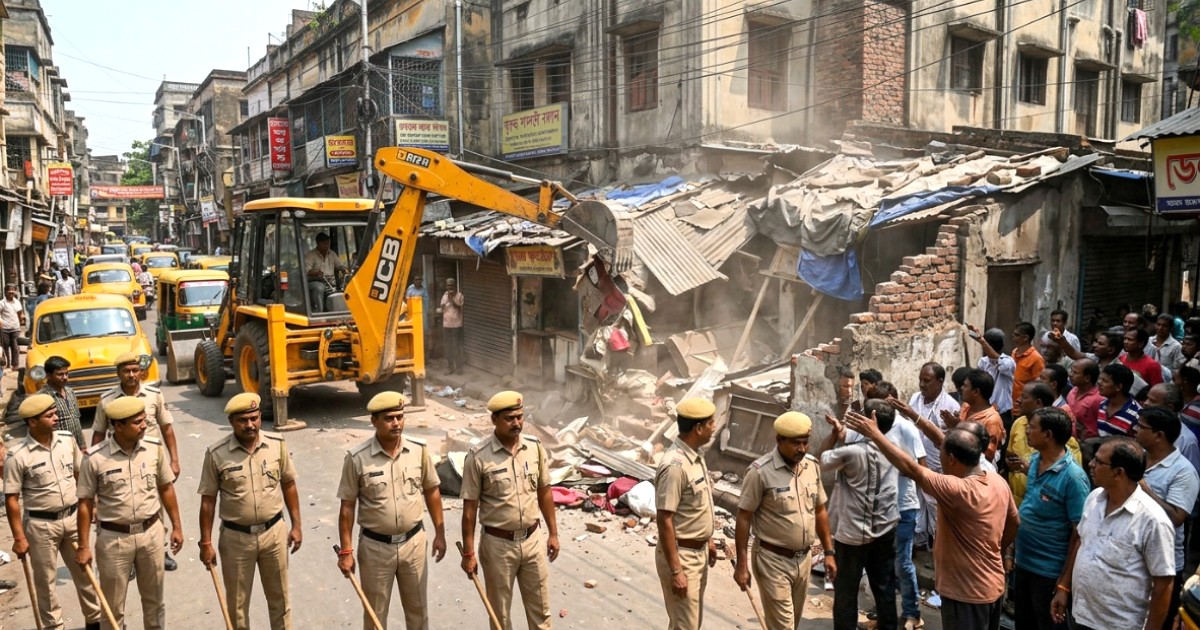
The newly established state administration in West Bengal, directed by Chief Minister Suvendu Adhikari, has initiated a massive, coordinated anti-encroachment campaign targeting unapproved structural extensions and unauthorized commercial settlements. Within days of securing legislative authority, regional municipal directorates deployed heavy industrial earthmovers to clear high-density sectors across Kolkata and adjacent municipal boundaries. The regulatory implementation accelerated significantly on Monday in Howrah’s forty-fourth ward, where administrative teams dismantled the upper structural storeys of a five-story residential complex erected entirely without legal building permissions.
The unprecedented clearing operations have sparked severe civil unrest and widespread panic among tens of thousands of marginalized micro-merchants.
According to verified field logs, a high-intensity clearing action executed between Saturday midnight and Sunday dawn completely purged long-standing roadside setups flanking the vital Howrah and Sealdah railway terminals. Security forces forcefully dismantled hundreds of unauthorized temporal booths to restore unrestricted public transit corridors. State Minister Dilip Ghosh issued an uncompromising warning to media circles, declaring the initial clearance a minor precursor to a comprehensive, statewide structural normalization framework. Ghosh emphasized that the administrative core will enforce absolute state land protection mandates, processing immediate legal liabilities against code violators without political concession.
For generations, primary transit footpaths and historic terminal entries across major sectors including Park Circus, Gariahat, Esplanade, Burrabazar, and Topsia remained severely bottlenecked by commercial encroachments. Municipal engineers noted that the dense clusters of unlicensed food, beverage, and apparel stalls around primary commuter hubs compromised regional emergency access frameworks while severely worsening regional traffic congestion. The current zero-tolerance posturing follows a severe industrial fire incident on May twelve inside an unapproved leather manufacturing unit in the Topsia-Tiljala zone, which resulted in two civilian fatalities and prompted direct executive codes from Adhikari to immediately level the entire complex.
Kolkata Municipal Corporation diagnostics assert that over one thousand unapproved structural properties have been officially registered within the Topsia perimeter alone, indicating that nearly seventy percent of multi-tier structures built over the past decade violate baseline civil engineering codes. However, following immediate petitions by local legal syndicates, the Calcutta High Court intervened late Monday to issue an absolute interim stay order on specific clearing operations tracking through June twenty-two. Displaced traders expressed severe anger outside judicial centers, claiming that administrative teams crushed their fifteen-year-old business infrastructure without issuing prerequisite statutory warnings.
The primary opposition platform, the Trinamool Congress, severely condemned the executive enforcement, designating the sudden deployment of bulldozers as a brutal act of systematic political retribution. Desperate roadside vendors communicated that the destruction of their singular source of family revenue, absent structural resettlement provisions, leaves them facing complete starvation. Conversely, the ruling state hierarchy clarified that the structural clearing campaigns remain fully non-negotiable to transition the metropolitan capital into a safe, code-compliant international urban hub.