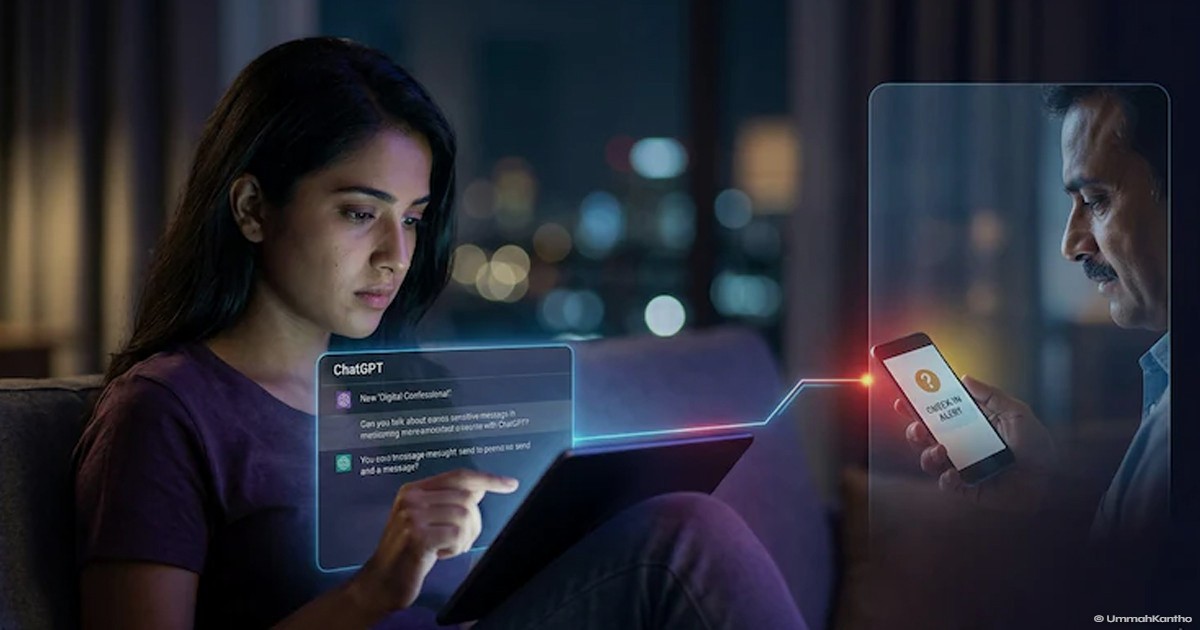
The digital sanctuary where millions of users share their deepest thoughts and emotional struggles with artificial intelligence may no longer be entirely private. OpenAI has recently introduced a new feature called ‘Trusted Contact’ for its ChatGPT platform, aimed at intervening during mental health crises. While the initiative is designed to save lives, it has sparked a global debate over the boundary between safety and the right to digital privacy. As AI moves from being a simple productivity tool to a companion for emotional expression, the implications of this monitoring are profound.
According to OpenAI officials, the ‘Trusted Contact’ system operates on a dual-layered mechanism known as ‘Detect and Verify.’ The internal algorithms of ChatGPT are programmed to scan conversations for specific triggers related to self-harm, suicidal ideation, or extreme psychological distress. Once the system identifies a potential risk, the case is escalated to a human moderation team for further review. If the threat is deemed credible, a notification is sent to a pre-designated emergency contact provided by the user, urging them to check on the individual.
OpenAI has emphasized that the full transcripts or specific private messages are not shared with the trusted contact. The intent is merely to alert someone in the user’s real-world support system that help might be needed. Despite these assurances, privacy advocates and mental health professionals are raising critical questions. The core of the controversy lies in whether an algorithm can truly grasp the nuance of human emotion or if it will lead to frequent false alarms that disrupt personal relationships.
Clinical experts have also voiced significant skepticism regarding AI’s role in crisis intervention. Dr. Samir Parikh, a prominent mental health director, pointed out that a professional therapist considers a wide range of contextual factors before involving a third party, often prioritizing the patient’s consent. The automated nature of AI lacks this human discretion and might fail to distinguish between a temporary emotional venting and a genuine life-threatening crisis. Other specialists, including Dr. Nimesh Desai, argue that the subtle shifts in human thought are far too complex for current algorithms to process without error.
The most immediate impact of this feature could be the emergence of self-censorship among users. If individuals feel that their private conversations are being monitored or could lead to unwanted family interventions, they may stop being honest with the AI. This creates a paradox where a tool designed to provide a safe space for expression actually forces users to hide their feelings. As technology continues to evolve, the challenge for companies like OpenAI will be to find a balance where safety measures do not come at the cost of the fundamental trust between the user and the digital platform. Ultimately, while AI can send an alert, it cannot replace the essential human connection required to navigate a mental health crisis.