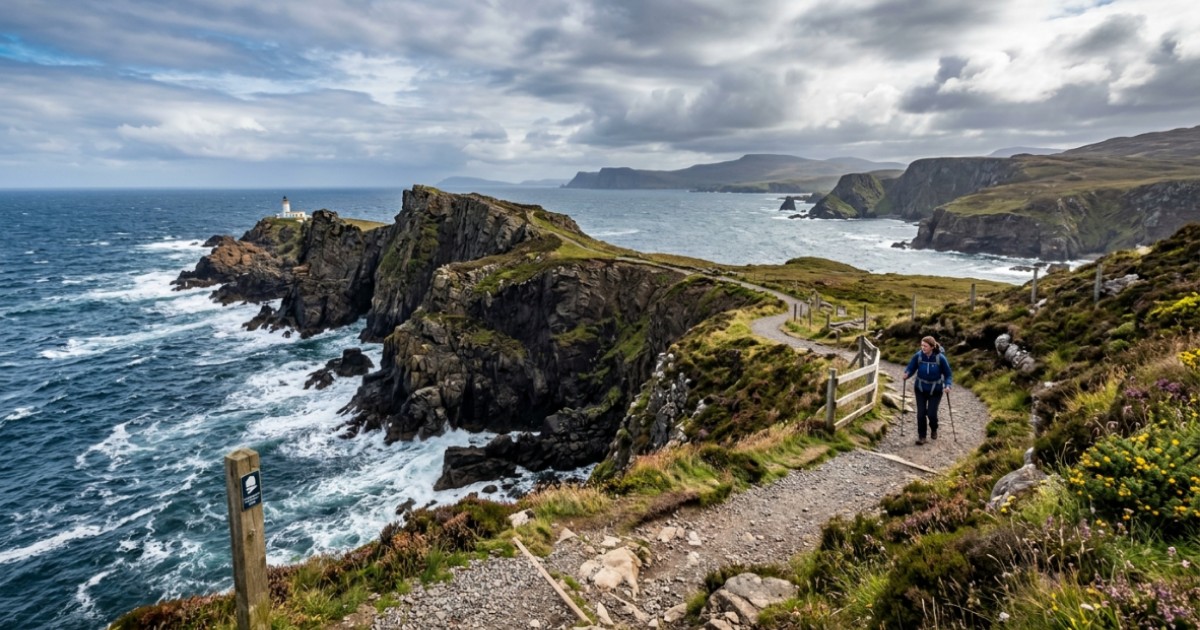
Standing on the grassy cliffs overlooking Siccar Point on Scotland`s east coast, one cannot help but feel the weight of geological history. This rocky outcrop, now the final viewpoint of the newly inaugurated Deep Time Trail, is not merely a scenic coastal spot; it is the site where the very understanding of our planet`s age was transformed. The trail commemorates the 300th anniversary of the birth of James Hutton, the founding father of geology, born in Edinburgh in 1726.
Long before Hutton set eyes on Siccar Point in 1788, he had developed radical theories regarding the formation of the Earth’s surface through cyclical erosion and renewal. However, it was the specific rock formation at this site—now famously known as Hutton’s Unconformity—that provided the empirical evidence needed to convince the 18th-century scientific community. Here, ancient vertical rock strata are capped by younger, horizontal layers of sandstone, revealing a massive gap in Earth’s history that defied the prevailing ideas of the time.
Professor Mark Wilkinson, president of the Edinburgh Geological Society, notes that Hutton essentially discovered geological time. By doing so, he provided the canvas upon which future scientific revelations, including evolution, could be painted. Without the vast, incomprehensible scales of time that Hutton identified, the progression of life as understood by modern science would remain impossible.
The Deep Time Trail begins near Pease Bay and meanders along the cliffs, passing stones engraved with Hutton`s observations and interpretive panels that link to expert audio commentary. As visitors traverse the path, the story of the Scottish polymath unfolds through the narration provided by experts like Dr. Elsa Panciroli, a scientist and author. She emphasizes that while geology can be a daunting subject due to its underground nature and immense scales, connecting the science to a historical figure like Hutton makes the subject far more accessible to the public.
Along the route, hikers pass the ruins of St Helen’s Kirk, a red sandstone church that was already dilapidated when Hutton visited over 230 years ago. The area is surrounded by impressive stone walls made of greywacke, a hard, dark-colored sandstone that defines the rugged coastline. Scanning QR codes along the trail unlocks an audio companion that delves into Hutton’s life as a farmer, chemist, and naturalist—a quintessential figure of the Scottish Enlightenment. He frequently engaged in intellectual discourse with icons like economist Adam Smith and chemist Joseph Black, fostering an environment where new ideas flourished.
Beyond the scientific significance, the trail offers a tranquil escape. The landscape of Scotland’s east coast is softer and more inviting than the western reaches sculpted by the Atlantic`s full force. Rolling green hills and fertile farmland descend into cliffs that plummet toward golden beaches and secluded coves. Quotes from Hutton, such as "In nature there is wisdom, system and consistency," are embedded into the trail, reminding visitors of the philosophical depth that guided his research.
Hutton’s methodology was rooted in observation, a rarity at the time. He utilized his two nearby farms as working laboratories, meticulously observing how soil was washed away and renewed in gradual cycles. Today, the James Hutton Cycle Trail connects these historical sites, providing a comprehensive experience for those interested in his life and work. As Dr. Katie Strang suggests, this trail serves as a beautiful invitation for people to engage with geology in a way they might not have considered before, merging the beauty of the Scottish coastline with the foundations of modern scientific thought.