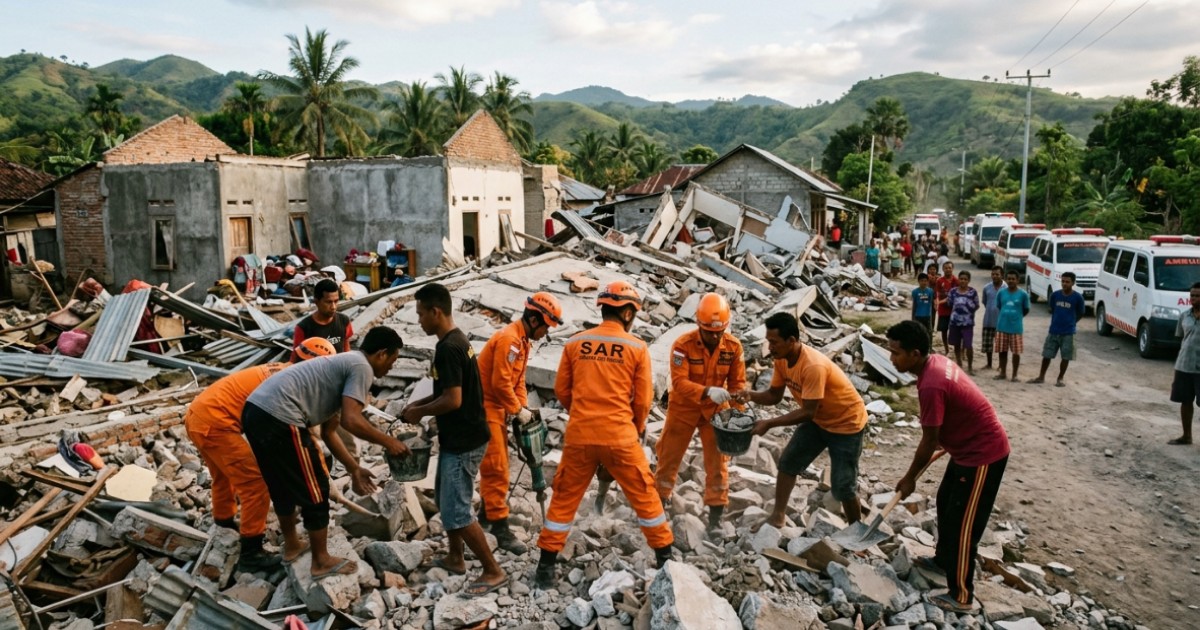
A powerful magnitude 7.7 earthquake struck off the coast of eastern Indonesia early Saturday morning, killing at least 38 people and triggering widespread panic across the region, according to the nation`s disaster mitigation agency. The violent tremor caused buildings to collapse, sparked numerous aftershocks, and prompted a temporary tsunami warning that was later lifted as rescue teams rushed to reach remote and affected communities.
The earthquake occurred shortly before five o`clock local time on Saturday, with its epicentre located off Flores Island at a shallow depth of fifteen kilometres. Seismologists note that shallow earthquakes typically produce more severe surface destruction, and the sheer force of the initial jolt was felt strongly across East Nusa Tenggara, West Nusa Tenggara, and parts of South Sulawesi. Residents were jolted awake by the violent shaking, which many described as lasting for over a minute and feeling like being on a trampoline.
According to Suharyanto, head of Indonesia`s National Disaster Management Agency, known as BNPB, the official death toll rose to thirty-eight as search and rescue operations gained momentum throughout the day. Officials confirmed that several people sustained injuries ranging from minor to severe, while rescue workers continued searching for individuals reported missing or trapped beneath the rubble of collapsed structures. Governor of East Nusa Tenggara Emanuel Melkiades Laka Lena stated that multiple victims tragically lost their lives in their sleep when masonry and structural elements collapsed upon them.
Visuals verified from the port town of Maumere captured dramatic moments as large chunks of concrete broke away from terminal buildings and fell toward passengers waiting to board inter-island ferries. Landslides triggered by the powerful tremor blocked key infrastructure, including sections of the vital Trans-Flores highway, complicating the deployment of emergency equipment and rescue personnel to hard-hit regencies such as Nagekeo. In response to the unfolding emergency, approximately two thousand residents voluntarily evacuated their homes, seeking refuge in higher terrain and temporary shelters.
Authorities initially issued a tsunami warning for coastal zones, urging residents to move away from shores and head towards higher ground. However, monitoring agencies observed no significant sea-level changes or hazardous wave formations, prompting officials to lift the tsunami warning about three hours after the initial jolt. Despite the cancellation, disaster officials emphasized that ongoing monitoring would persist due to the high frequency of aftershocks rattling the region.
Local residents shared harrowing accounts of the disaster. Arnold Welianto, a resident of Talibura village in Sikka regency, recounted waking up to violent shaking and rushing his family outdoors, where neighbors had already gathered near roadsides and hill slopes out of fear. Similarly, university lecturer Yulian Juita Ekalia from Ruteng described the sheer terror of the tremor, noting she had never experienced such a powerful upheaval before.
Preliminary assessments by disaster response teams indicated that dozens of residential homes, healthcare facilities, places of worship, and government warehouses sustained severe structural damage, particularly in Manggarai and surrounding districts. Power outages and communication disruptions across affected islands further complicated initial damage evaluations.
Indonesia remains one of the most seismically active nations in the world, positioned along the volatile Pacific Ring of Fire where major tectonic plates converge. The region`s geological vulnerability was underscored by memories of a devastating historical earthquake that struck Flores Island decades prior. Government authorities continue to urge calm, advising the public to stay away from compromised buildings and coastal zones while recovery efforts proceed.