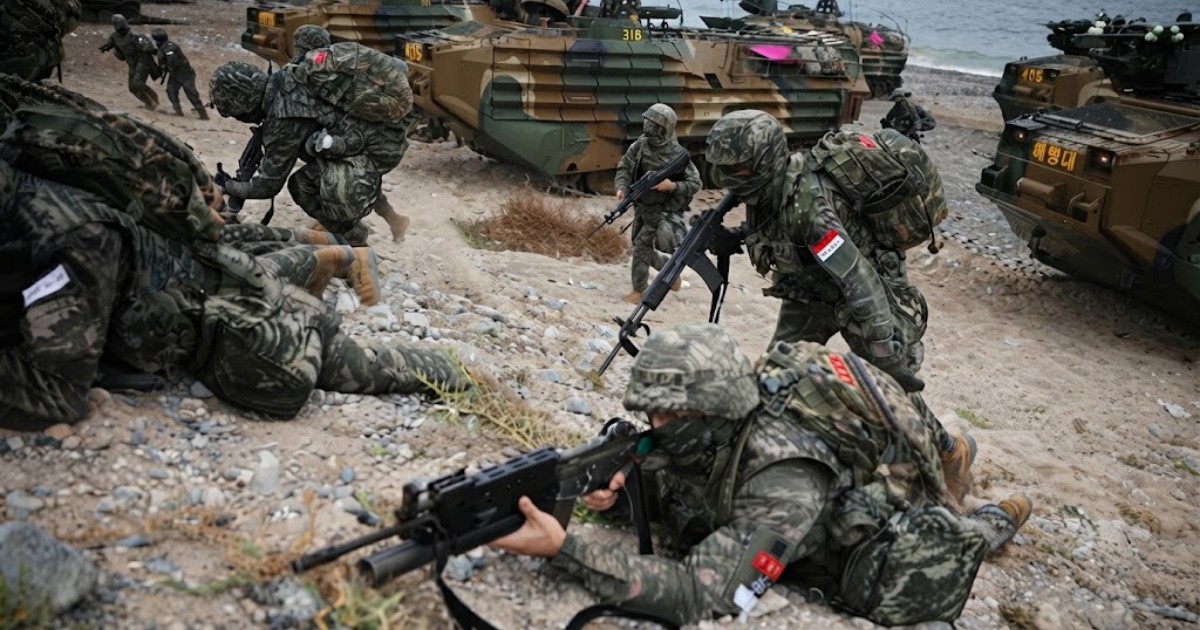
The United States has cancelled a large joint amphibious landing exercise scheduled for next month in South Korea due to force availability constraints stemming from the ongoing US-Israel war on Iran, according to AFP and Reuters. Han Seung-jeon, a spokesman for the South Korean Marine Corps, told reporters at a news briefing on Monday that the US Marine Corps formally notified South Korean forces in June regarding its limited deployment capacity resulting from commitments in the Middle East.
The biennial Ssangyong drills involve marine forces from both South Korea and the United United States, designed specifically to strengthen combined operational readiness through rehearsals involving warships, aircraft, and ground forces executing amphibious landings. Seoul and Washington are continuing high-level consultations regarding the eventual resumption of the suspended exercise, though officials provided no definitive timeline. There was no immediate comment from the Pentagon regarding the formal cancellation notice.
The announcement closely follows US President Donald Trump`s surprise order last week to scale back a separate annual joint military exercise that concluded last Friday. The annual Ulchi Freedom Shield exercises, which traditionally span eleven days, were abruptly shortened to five days. Reports indicate that the decision was driven by financial considerations and Seoul`s refusal to participate directly in the military campaign against Iran, adding strain to bilateral alliance dynamics.
Regional security experts point out that North Korea`s ongoing military posturing makes the maintenance of joint allied readiness particularly critical at this juncture. Any prolonged reduction in large-scale amphibious training exercises could potentially be perceived by rival states as a dip in defensive deterrence. Consequently, defense planners in Seoul are currently evaluating alternative bilateral training formats that require fewer deployed US expeditionary forces while still maintaining core operational competencies.
Geopolitical analysts note that the reallocation of American military assets and operational focus toward the Middle East is creating noticeable ripple effects across allied defense architectures in East Asia. As Washington`s global military commitments stretch thin under the weight of the expanding conflict, regional deterrence drills are increasingly facing postponements or downscaling. This development underscores how escalating Middle Eastern hostilities are directly impacting strategic partnerships and military preparedness thousands of miles away.
The consecutive curtailment of major allied exercises highlights growing friction between Washington and its regional partners over burden-sharing and strategic priorities. While South Korean defense officials maintain that alliance readiness remains robust despite the cancellations, lawmakers and security experts have expressed concern over potential gaps in combined defense capabilities. Further diplomatic talks are anticipated as both nations navigate the complex interplay between Middle Eastern entanglements and Indo-Pacific security commitments.