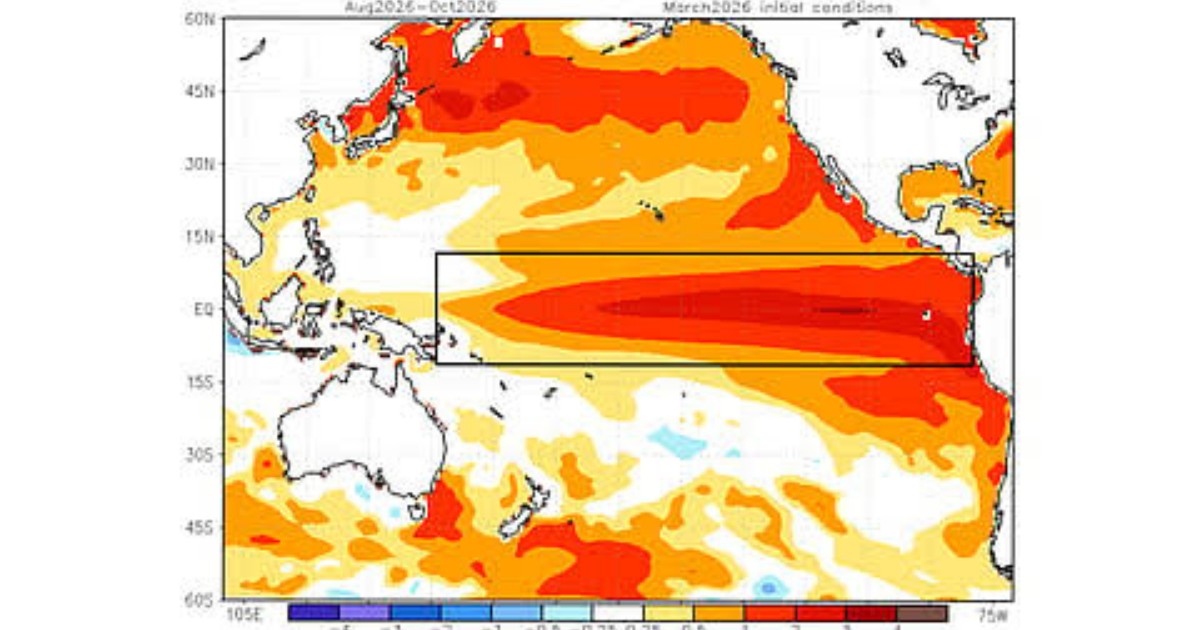
A major climate disturbance has taken hold across the Pacific Ocean, where sea surface temperatures have breached historic thresholds to establish a rare and powerful super El Nino. Data published on September 14 by the United States National Oceanic and Atmospheric Administration confirms that water temperatures in the central and eastern Pacific have surpassed a warming anomaly of 2 degrees Celsius, or 3.6 degrees Fahrenheit. Climate scientists warn that the system, which began forming in June, is poised to peak in early 2027 and maintain severe disruptions to global weather through May.
Global weather systems are entering a period of pronounced instability.
The World Meteorological Organization noted that this natural warming oscillation typically generates stark regional contrasts across continents. Heavy precipitation is projected to batter East Africa, parts of South America, and the southern United States, bringing acute flood risks. The Nairobi-based IGAD Climate Prediction and Applications Centre estimated a 90 percent probability of unusually heavy rainfall between October and December across southern Ethiopia, central and southern Somalia, and northeastern Kenya. Coastal Ecuador, northern Peru, southern Brazil, and northeastern Argentina are similarly bracing for concentrated downpours heading into early next year.
Conversely, vast agricultural regions in the Southern Hemisphere and Asia face prolonged dry spells. Summer monsoon precipitation across India and Pakistan fell well short of expectations, with official records from the India Meteorological Department showing rainfall 15 percent below the seasonal average between June 1 and September 9. In Southeast Asia, Indonesian meteorological agencies registered more than 5,000 wildfire hotspots by late July across Sumatra and Kalimantan. Severe dry conditions and above-normal temperatures are also threatening Australia and Southern Africa, compounding existing environmental pressures.
The uneven climate shocks pose an immediate danger to global food supplies.
Humanitarian agencies warned that agricultural disruptions could trigger severe regional shortages. The United Nations World Food Programme calculated that the current weather oscillation could plunge at least 49 million additional people into acute hunger across 45 vulnerable countries by the end of 2027. Carl Skau, acting executive director of the agency, emphasized that vulnerable populations dependent on rain-fed crops face an existential threat as harvests of staple commodities such as rice and maize collapse across South Asia and Southern Africa.
Beyond agricultural disruption, the phenomenon is expected to accelerate worldwide warming trends. The World Meteorological Organization indicated an 86 percent probability that global temperatures will surpass the historic high set in 2024 before the end of the decade. Alterations to the high-altitude atmospheric jet stream are expected to suppress winter snowfall across the northern United States and Canada, while the atmospheric conditions will likely suppress storm activity across the Atlantic hurricane corridor through the remainder of the season.