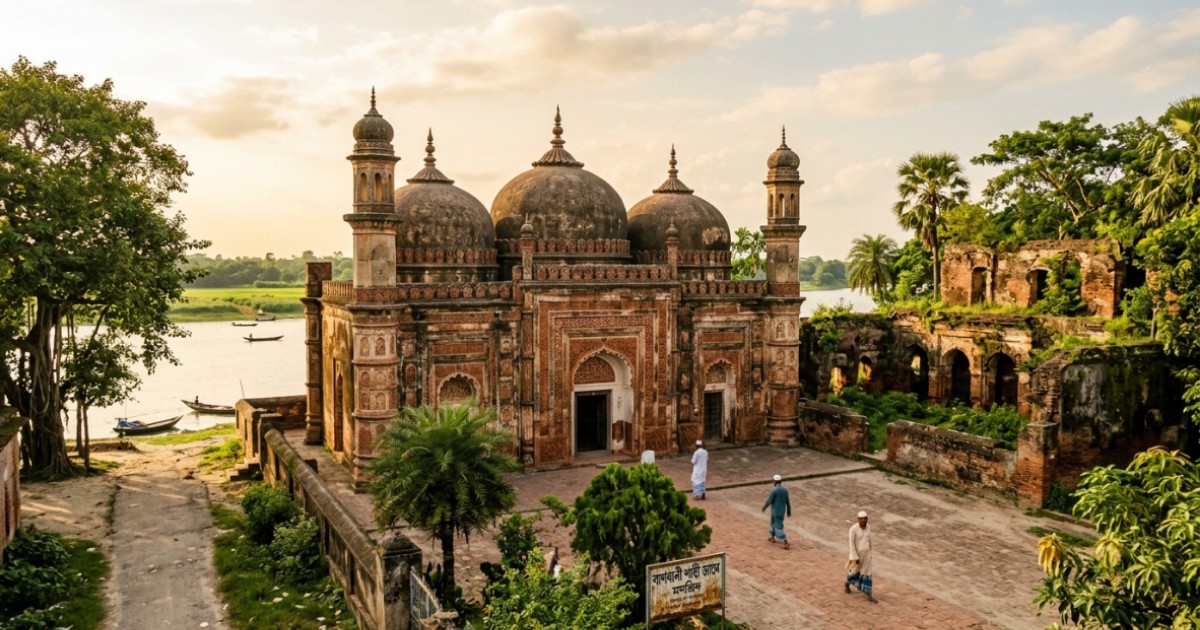
The historic Bagdhani Shahi Jame Mosque in Rajshahi stands as a magnificent and glorious testament to late Mughal architecture and Islamic heritage in Bengal. Remaining resilient across multiple centuries, this ancient religious structure functions not merely as a place of congregational worship, but as a living archive of the social, cultural, and structural evolution of the region. Located in the Bagdhani Kacharipara neighborhood within the Nowhata municipality of Paba Upazila, the site rests approximately 15 kilometers north of Rajshahi city. Once the thriving center of zamindari administration and busy riverine commerce along the Barnai River basin, this historical monument continues to showcase its ancestral grandeur to contemporary visitors.The historic structure was officially constructed in 1701 AD.
Situated a short distance from the Nowhata Degree College intersection, the landmark encapsulates nearly three centuries of regional identity. Definitive historical records managed by the Department of Archaeology, alongside a well-preserved Persian inscription carved over the main entrance, provide authentic validation regarding its lineage. According to the epigraphic data, a wealthy and influential administrator named Munshi Muhammad Inayatullah commissioned the construction of this beautiful three-domed sanctuary. During that historical epoch, the Barnai River served as the primary transportation route and commercial lifeline for the entire district. A bustling boat terminal once occupied the riverbank immediately east of the premises, hosting the largest weekly market in the Paba region where cargo vessels from distant provinces docked every Friday and Tuesday. The nearby ruins of an administrative revenue office, locally known as the kachari ghar, further confirm that the compound operated as the nerve center for regional governance.
The structural footprint of this architectural marvel encompasses approximately 3,200 square feet of land. Measuring roughly 80 feet in length and 40 feet in width, the building features prominent, ornamentally decorated octagonal pillars crowned with miniature domes at its four corners. The roofline is dominated by three large, perfectly proportioned domes that reflect the classic engineering finesse of late Mughal artisans. Both the interior and exterior walls are adorned with intricate porcelain mosaic work and delicate floral patterns, easily captivating contemporary architects and historical researchers alike. The interior layout houses three traditional mihrabs aligned with three main entrance doors, accommodating 87 worshippers within the original main hall, though local communities have recently expanded the eastern facade while maintaining the structural baseline.
However, prolonged structural neglect, environmental exposure, and the absence of institutional preservation have caused several original elements to disintegrate over time. The monument sustained severe structural damage during a catastrophic earthquake in 1990, which permanently destroyed multiple interior frescoes and delicate wall carvings. Although a localized restoration project was initiated in 2016 under the supervision of the local Upazila Nirbahi Officer, the surrounding zamindari ruins and the exposed historical masonry remain highly vulnerable to decay. Securing long-term state intervention and professional archaeological oversight is vital to preserve this invaluable asset, ensuring it transitions into a prominent center for cultural tourism and historical research for future generations.