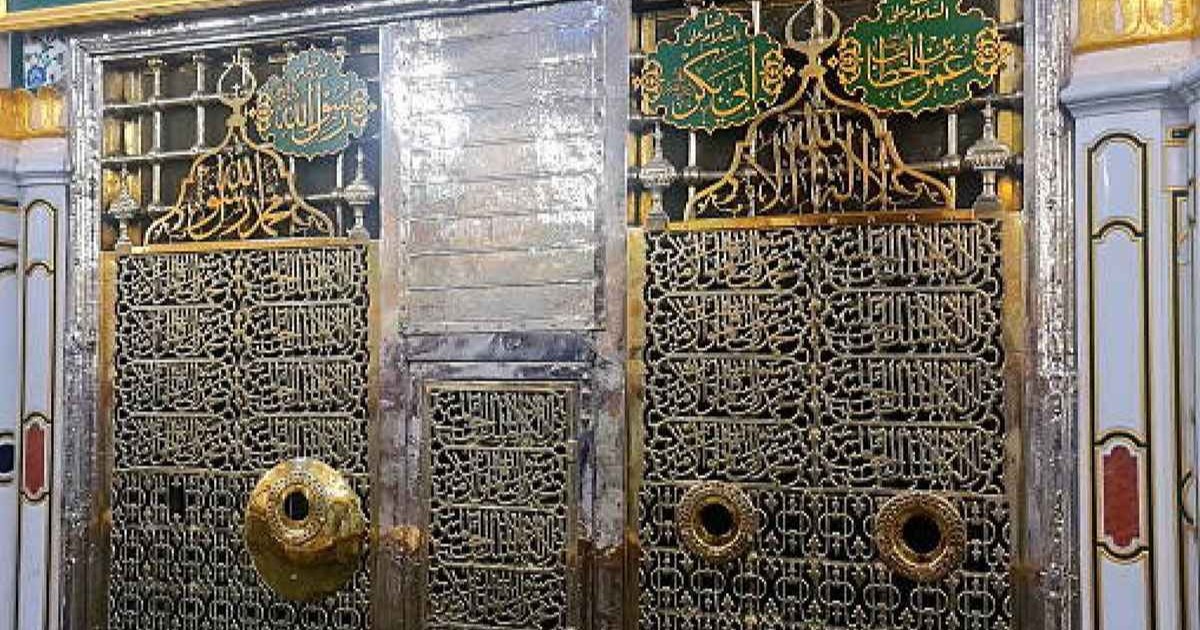
he Rawzah Mubarak, located within the sacred precincts of Al-Masjid an-Nabawi in Madinah, represents one of the most spiritually significant and revered sites in the Islamic world. This hallowed ground serves as the final resting place of the Prophet Muhammad, alongside his two closest companions and the initial caliphs of Islam, Abu Bakr al-Siddiq and Umar ibn al-Khattab. Every year, as millions of pilgrims visit Madinah following their Hajj or Umrah journeys, they are drawn to the intricate brass and copper lattice enclosure surrounding the tombs.
However, observant visitors quickly notice a distinct architectural feature: the inner chamber containing the actual graves possesses no visible doors or windows. This structural design is not accidental but is deeply rooted in early Islamic history, theological safeguarding, and centuries of deliberate architectural fortifications by various Muslim rulers.
To understand the absence of openings in the tomb`s core structure, one must examine its origins as the modest residential chamber, or Hujra, of the Prophet`s wife, Aisha bint Abi Bakr. Following the demise of the Prophet Muhammad, a profound debate arose among his companions regarding the appropriate location for his burial. Some suggested the historic Al-Baqi cemetery, while others proposed alternative sites.
The dilemma was resolved when Abu Bakr recalled a crucial directive from the Prophet himself, stating that every prophet is buried at the exact location where his soul is taken. Consequently, the companion Abu Talha cleared the Prophet`s bedding and excavated a grave directly beneath the spot where he passed away within Aisha`s room.
In subsequent decades, following the passings of Caliph Abu Bakr in 13 AH and Caliph Umar in 24 AH, both were laid to rest adjacent to the Prophet within the same chamber, adhering to strict spatial arrangements. The three graves are aligned closely, with Abu Bakr positioned behind the Prophet, and Umar positioned behind Abu Bakr. Their heads face toward the mosque`s interior, their feet point toward Janat al-Baqi, and their faces are oriented toward the Qibla. Aisha continued to reside in the remaining portion of the chamber until her own passing.
Following Umar`s burial, she erected a permanent partition inside the room out of deep modesty. After her death, the initial entrance to the Hujra was permanently sealed to preserve the absolute sanctity of the resting place.
The Five-Sided Wall and the Elimination of Access
As the Muslim empire expanded and the Prophet`s Mosque underwent successive renovations, the physical infrastructure surrounding the graves was altered to ensure long-term preservation. The first major structural reinforcement occurred during the caliphate of Umar ibn al-Khattab, who replaced the original palm-leaf walls of the Hujra with a durable brick structure.
However, the most definitive and historically significant modification was enacted by the Umayyad Caliph Umar ibn Abdul Aziz during his tenure as the governor of Madinah between 88 and 91 AH. He ordered the construction of a solid, continuous wall utilizing thick black basalt stones to completely envelop the original room.
Umar ibn Abdul Aziz integrated two specific design features into this basalt wall to address both structural security and theological concerns. First, he deliberately designed the wall with a unique five-sided or pentagonal layout rather than a standard square or rectangular shape. This was a critical theological measure intended to distinguish the tomb`s structure from the four-sided Kaaba in Makkah, thereby preventing pilgrims from mistakenly attempting to perform Tawaf around the Prophet`s burial site. Second, he built this stone barrier completely without doors or windows. By eliminating any physical openings, the inner chamber became an entirely solid, inaccessible structure, ensuring that no individual could directly enter the space or view the graves.
The Molten Lead Trench and the Maqsura Enclosure
During the Mamluk and Ottoman eras, further physical interventions were required to counteract external threats and maintain the absolute safety of the site. In 557 AH, Sultan Nuruddin Zengi uncovered a clandestine plot by foreign adversaries attempting to excavate an underground tunnel toward the Prophet`s sacred remains. In immediate response, the Sultan traveled to Madinah and ordered his military engineers to dig a massive, deep trench entirely encompassing the stone burial chamber.
Once the excavation reached bedrock, tons of molten lead were poured into the trench, creating a subterranean metallic wall that remains intact today, protecting the graves from any potential underground intrusion.
Centuries later, in 668 AH, Sultan Ruknuddin Zahir Baibars introduced an exterior protective wooden frame around the stone structure. In 887 AH, Mamluk Sultan Qaitbay replaced the deteriorating wood with a permanent, high-strength iron and brass lattice barrier known structurally as the Maqsura
While this outer decorative mesh features four distinct doors—including Babut Tawba on the south and Babul Fatima on the east—they open only into the outer courtyard area. Unlocking these outer gates reveals only the solid, doorless pentagonal stone wall built by Umar ibn Abdul Aziz, rendering the innermost core completely unreachable.
Similarly, the iconic Green Dome that crowns the structure underwent various evolutions, beginning as a wooden dome constructed under Sultan Muhammad ibn Qalawun in 678 AH. The current stone dome was engineered during the reign of Ottoman Sultan Mahmud II in 1233 AH, and it received its signature dark green paint in 1253 AH under Sultan Abdul Mejid.
Ultimately, the total absence of doors and windows within the inner core of the Rawzah Mubarak stands as a testament to a centuries-old defensive and theological framework. This design ensures that the resting place of the Prophet Muhammad remains structurally sound and entirely protected from unauthorized access or theological deviation across generations.